Thevenin's Theorem Assignment: Solving V1 & V2

Click For Summary
SUMMARY

This discussion focuses on applying Thévenin's Theorem and the Superposition Theorem to solve for the load current in a circuit with two voltage sources, V1 and V2, defined as V1 = Sqr2 × 415cos(100πt) and V2 = Sqr2 × 415sin(100πt). Participants highlight issues with impedance calculations and the current divider rule, emphasizing the importance of using the correct impedance values in calculations. The conversation also references a previous thread for additional context and guidance on similar assignment questions.

PREREQUISITES
  • Understanding of Thévenin's Theorem
  • Familiarity with the Superposition Theorem
  • Knowledge of complex impedance and phasors
  • Proficiency in using current divider rule
NEXT STEPS
  • Study the application of Thévenin's Theorem in AC circuits
  • Learn about the Superposition Theorem for analyzing linear circuits
  • Research complex impedance calculations in electrical engineering
  • Explore the current divider rule and its implications in circuit analysis
USEFUL FOR

Electrical engineering students, circuit analysts, and anyone working on assignments involving circuit theorems and AC analysis.

clembo
Messages
8
Reaction score
0
Hello just wondering if any of you clever people would be able to give me some guidance on an assignment question I have been given. The notes for the course are terrible and they seem to love to through terminologies into the assignments which have not been covered in the course notes.

So does anyone know what is meant by the term : V1 = Sqr2 ×415cos(100πt) V2 = Sqr2 ×415sin(100πt) in relation to the diagram attached. The full question is:

FIGURE 1 shows a 50 Ω load being fed from two voltage sources via
their associated reactances. Determine the current i flowing in the load by:

(a) applying Thévenin’s theorem
(b) applying the superposition theorem

(c) by transforming the two voltage sources and their associated
reactances into current sources (and thus form a pair of Norton
generators.
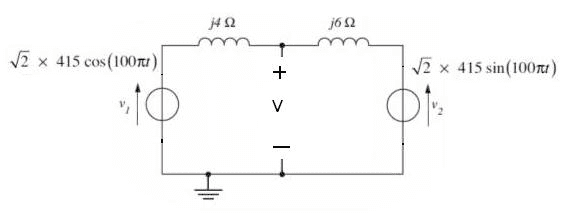

upload_2015-1-31_17-50-43.png
 
Physics news on Phys.org
Hi clembo, Welcome to Physics Forums.

Refer to This Thread.
It seems to be a popular assignment question.

If you have further questions after wading through that, feel free to ask.

In future, please be sure to fill out the formatting template for all questions posted to the homework sections of PF. It's a requirement and in the rules that you accepted when you joined.
 
Hello gneill, thanks for the link to the previous thread about this topic. I have been on this question now for about three weeks... finally I have something like an answer but my Thevenins Current and Superposition Current are not matching up. I have swapped between Polar and Rectangular numbers to make calculation easier. Can this mess the figures up. I have attached a copy of my working out. If you can see anything obviously wrong I would appreciate the advice. Many thanks in advance.
 

Attachments

What I've spotted so far is that in the final line of your first page, when you cross multiplied you swapped the two inductor impedance values.
 
Second observation, when you apply the current divider rule to find the load current due to V1 you've chosen the wrong impedance for the numerator of the ratio. If you already have the total current that is being divided, you no longer care what it flowed through to get where it is "now". Only the two loads that it splits between should be involved.
 
Does this make any difference to the overall equation for Vth as when I follow the equation through I end up with 2490 + J1660 = 166 - J248 or 299.26 /_ -56.31deg
J10
 
clembo said:
Does this make any difference to the overall equation for Vth as when I follow the equation through I end up with 2490 + J1660 = 166 - J248 or 299.26 /_ -56.31deg
J10
It changes the sign of the phase angle.
 
Ahhh I see thank you for your assistance.
 

Similar threads

  • · Replies 28 ·
Replies
28
Views
7K
  • · Replies 2 ·
Replies
2
Views
2K
  • · Replies 11 ·
Replies
11
Views
5K
  • · Replies 10 ·
Replies
10
Views
4K
  • · Replies 183 ·
7
Replies
183
Views
70K
  • · Replies 3 ·
Replies
3
Views
2K
  • · Replies 26 ·
Replies
26
Views
3K
  • · Replies 59 ·
2
Replies
59
Views
22K
  • · Replies 3 ·
Replies
3
Views
2K
  • · Replies 2 ·
Replies
2
Views
1K