Trouble computing the cosine of a complex number

Click For Summary
The discussion centers on computing the cosine of the complex number cos(π/4 + π/4 i). The original poster struggled to match their answer with results from Wolfram Alpha and sought help. A participant identified a sign error in the poster's calculations, specifically in the expression involving parentheses. They also suggested factoring out e^{-\frac{\pi}{4}} and applying the 2cos(θ) identity. The poster expressed relief upon correcting the error and obtaining the correct answer.
gex
Messages
36
Reaction score
2
Mentor note: Thread moved from technical section, so missing the homework template.
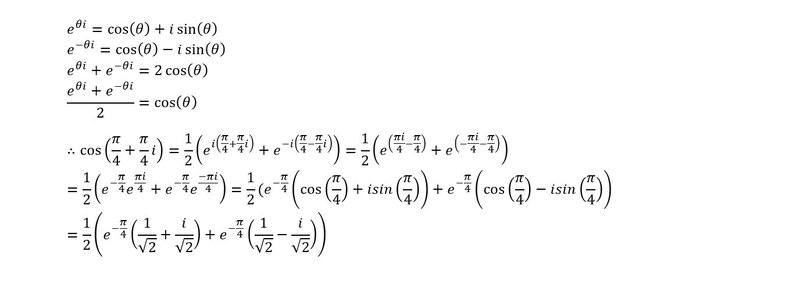
Hi all, I have a homework problem which asks me to compute the complex number cos(π/4 + π/4 i).
I've been playing around with it for a while now and just can't seem to get the answer I get when using Wolfram Alpha to verify. Attached is my most recent attempt at solving the problem, I'd love some input as to where I'm going wrong. Thank you in advance.
Capture.JPG
 

Attachments

  • Capture.JPG
    Capture.JPG
    17.4 KB · Views: 857
Last edited by a moderator:
Physics news on Phys.org
gex said:
Hi all, I have a homework problem which asks me to compute the complex number cos(π/4 + π/4 i).
I've been playing around with it for a while now and just can't seem to get the answer I get when using Wolfram Alpha to verify. Attached is my most recent attempt at solving the problem, I'd love some input as to where I'm going wrong. Thank you in advance.View attachment 224899
You have a sign error. In your "therefore" line (the line with ∴), in the middle expression, the part in parentheses should be ##(\frac \pi 4 + i\frac \pi 4)##. You have a minus where it should be a plus.
 
In the second line, factor out ##e^{-\frac{\pi}{4}}## and apply the ##2cos(\theta)## identity to the other factor.
 
The last expression on the line starting, " ∴ cos( " is wrong -i(n-ni) = -ni +n
 
Thank you so much everyone, I feel foolish for my careless sign error. Most of all I feel relieved that my approach wasn't flawed. I get the correct answer now :)
 
Question: A clock's minute hand has length 4 and its hour hand has length 3. What is the distance between the tips at the moment when it is increasing most rapidly?(Putnam Exam Question) Answer: Making assumption that both the hands moves at constant angular velocities, the answer is ## \sqrt{7} .## But don't you think this assumption is somewhat doubtful and wrong?

Similar threads

  • · Replies 1 ·
Replies
1
Views
1K
  • · Replies 7 ·
Replies
7
Views
5K
  • · Replies 22 ·
Replies
22
Views
909
  • · Replies 5 ·
Replies
5
Views
3K
Replies
3
Views
2K
  • · Replies 2 ·
Replies
2
Views
2K
Replies
2
Views
3K
  • · Replies 1 ·
Replies
1
Views
2K
  • · Replies 7 ·
Replies
7
Views
3K
  • · Replies 4 ·
Replies
4
Views
2K