(Ron)^2=-1
- 16
- 3
Hello guys! I hope you can give me a hand with this one
A satellite consisting of two masses attached by a rigid-massless rod of length L, are orbiting around the Earth at a distance R from the centre of the earth. During the entire movement the rod stays oriented in the radial direction. Consider the Earth to be stationary and the gravitational attraction between the masses to be negligible.
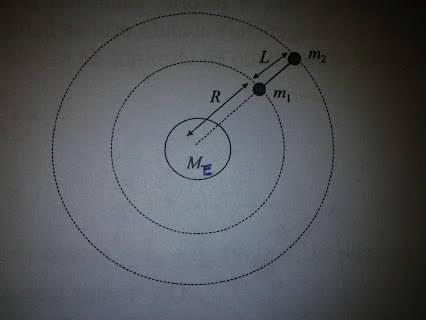 A) Find the angular velocity of the satellite and the force the rod exerts on each mass.
Force of gravity:
First thing I did was to consider the angular frequency of both masses to be the same, so:
Thus angular velocity ω must be the same for both masses, (is this correct?)
From the conservation of angular momentum (as there is no net torque), considering the centre of momentum to be the centre of the earth, I have the following:
Homework Statement
A satellite consisting of two masses attached by a rigid-massless rod of length L, are orbiting around the Earth at a distance R from the centre of the earth. During the entire movement the rod stays oriented in the radial direction. Consider the Earth to be stationary and the gravitational attraction between the masses to be negligible.
Homework Equations
Force of gravity:
For mass 1→ Fg1= -G·Me·m1/R^2
For mass 2 → Fg2= -G·Me·m2/(R+L)^2
For mass 2 → Fg2= -G·Me·m2/(R+L)^2
The Attempt at a Solution
First thing I did was to consider the angular frequency of both masses to be the same, so:
For mass 1 → T1 = 2π/ω1
For mass 2→T2 = 2π/ω2
For mass 2→T2 = 2π/ω2
Thus angular velocity ω must be the same for both masses, (is this correct?)
From the conservation of angular momentum (as there is no net torque), considering the centre of momentum to be the centre of the earth, I have the following:
L=L1+L2 ⇒ L=(m1·R^2 + m2·(R+L)^2)·ω
And as L is constant then:ω=L/(m1·R^2 + m2·(R+L)^2)
Finally from the equations of motion I got:
For mass 1→ ∑F = Fg1 + Tension1 = m1·a=m1·R·ω^2
For mass 2→ ∑F = Fg2 + Tension2= m2·a=m2·(R+L)·ω^2
So, from this two equations I seem to have everything I need, but I think I'm missing something here and I just can't see what it isFor mass 2→ ∑F = Fg2 + Tension2= m2·a=m2·(R+L)·ω^2
Thank you guys for your help!
Last edited: