Two masses, two pulleys and an inclined plane

Join the discussion
Ask a follow-up here, or get your own question answered by working scientists, mathematicians and engineers — people, not an autocomplete.
Real named experts · corrections over time · the nuance an AI answer skips
68 replies · 15K views
erobz said:
I don't know If there is a clear conceptualization to be had without some mathematical funny business. The idea is that you have to fix a coordinate system, and lengths are measured relative to it in the typical fashion ( i.e. positions on one side of it are positive and positions on the other side negative).

Not to pull you back into the weeds, but there is a question that I have. While what I did gets the proper result (and I know it to be commonly used to solve these inextensible rope pulley system problems), what is the idea that lets us say the constraint ##L## the length of the rope - something which is always positive as far as I can tell can be added in this way. I mean, if we added up the RHS we really aren't going to get ##L##. So, I feel like it is still a bit hand wavy?

I feel like it should be:

$$ L = |-y_1| + 2|y_2| + \sum \rm{const}$$
I'm not sure if I fully understand your question... was the question rhetorical lol
 
on Phys.org
AzimD said:
I'm not sure if I fully understand your question... was the question rhetorical lol
I have some "doubts" whether what I told you is mathematically consistent! I'm asking the pro's around here to clarify.
 
Reply
  • Like
Likes   Reactions: AzimD
kuruman said:
I'm glad you sorted that out. If you post your solution with your answer, I will post mine that shows how you can do this using the work-energy theorem as an alternate method.
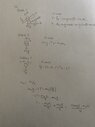
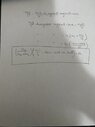
I believe I've gotten it right this time.
 

Attachments

  • IMG_9351.jpg
    IMG_9351.jpg
    22.3 KB · Views: 143
  • IMG_9352.jpg
    IMG_9352.jpg
    21.5 KB · Views: 153
I think I worked out my issue. The inextensible rope constraint is actually this:
erobz said:
$$ L = |-y_1| + 2|y_2| + \sum \rm{const}$$
Then we can say that the following expression is equivalent:

$$ L = \sqrt{( -y_1)^2} + 2\sqrt{( y_2)^2}+ \sum \rm{const} $$

Which taking the derivative of both sides:

$$ 0 = \frac{1}{2}\frac{1}{\sqrt{(-y_1)^2}}( -2 y_1) \dot y_1 + \frac{1}{\sqrt{(y_2)^2}}( 2 y_2) \dot y_2 = - \dot y_1 + 2 \dot y_2 $$

and again taking the time derivative:

$$ 0 = -\ddot y_1 + 2\ddot y_2$$

And all seems to be right with the world again.
 
erobz said:
I have some "doubts" whether what I told you is mathematically consistent! I'm asking the pro's around here to clarify.
If the lengths of the straight sections are initially ##l_1, l_2=l_3## then the total length is ##L=l_1+2 l_2+c##.
If block 1 is displaced ##y_1## up the slope when block 2 descends ##y_2## then ##L=l_1-y_1+2 l_2+2y_2+c##. Differentiate.
Is that you were looking for?
 
haruspex said:
If the lengths of the straight sections are initially ##l_1, l_2=l_3## then the total length is ##L=l_1+2 l_2+c##.
If block 1 is displaced ##y_1## up the slope when block 2 descends ##y_2## then ##L=l_1-y_1+2 l_2+2y_2+c##. Differentiate.
Is that you were looking for?
I was thinking of coordinates. In #57 I suggested to apply the coordinates to the constraint, but that doesn't seem to be copasetic. Adding "lengths" and "coordinates" like that is crap that just happens to work because of what I found in post #66.

But yes, what you are suggesting appears to skirt that issue.
 
Last edited:
AzimD said:
I believe I've gotten it right this time.
Yes, you got it right. Here is a complete solution using the work-energy theorem.

Suppose mass ##m_1## slides up the incline a distance ##s##. If the axle of pulley 2 were attached to the rope, mass ##m_2## would descend distance ##s##. But that is not the case. The rope goes around pulley 2 in which case mass ##m_2## descends distance ##s/2##. So in the same time that ##m_1## moves by some amount, mass ##m_2## moves by half that amount. This means that ##v_2=\frac{1}{2}v_1## and ##a_2=\frac{1}{2}a_1.##

Now let's say that ##m_1## moves distance ##s## up the incline with initial speed ##v_0## and final speed ##v##. The change in kinetic energy of the two-mass system is $$\Delta K=\frac{1}{2}m_1\left(v^2-v_0^2\right)+\frac{1}{2}m_2\left[\left(\frac{v}{2}\right)^2-\left(\frac{v_0}{2}\right)^2\right]=\frac{1}{2}\left(v^2-v_0^2\right)\left(m_1+\frac{m_2}{4}\right).$$The change in potential energy is $$\Delta U=m_1~g~s~\sin\!\theta-m_2~g~\frac{s}{2}.$$ The work done by friction is $$W_{\!f} = -\mu_k~N~s=-\mu_k ~m_1~g~s~\cos\!\theta.$$We apply the work-energy theorem to the two-mass system, $$\begin{align}
& \Delta K+\Delta U=W_{\!f} \nonumber \\
& \frac{1}{2}\left(v^2-v_0^2\right)\left(m_1+\frac{m_2}{4}\right)+m_1~g~s~\sin\!\theta-m_2~g~\frac{s}{2}=-\mu_k~m_1~g~\cos\!\theta \nonumber \\ & \frac{\left(v^2-v_0^2\right)}{2}=
\frac{m_2~g~s/2- m_1~g~s(\sin\!\theta+\mu_k~\cos\!\theta) }{\left(m_1+m_2/4\right)}.\nonumber \\ \end{align}$$ Since all forces are constant, all accelerations are constant. We can use the kinematic equation relating acceleration, displacement and speed squared to find ##a_1.## $$2a_1s=v^2-v_0^2\implies a_1=\frac{\left(v^2-v_0^2\right)}{2s}=\frac{m_2/2- m_1~(\sin\!\theta+\mu_k~\cos\!\theta) }{\left(m_1+m_2/4\right)}g.$$
 
Reply
  • Like
Likes   Reactions: AzimD and erobz