Math Amateur
Gold Member
MHB
- 3,920
- 48
I am reading Karl R. Stromberg's book: "An Introduction to Classical Real Analysis". ... ...
I am focused on Chapter 3: Limits and Continuity ... ...
I need help in order to fully understand Example 3.10 (b) on page 95 ... ... Example 3.10 (b) reads as follows:
View attachment 9208
My question is as follows:Stromberg says that if $$X$$ is any set and $$\mathscr{T}$$ is the family of all subsets of $$X$$ ...
... then $$\mathscr{T}$$ is nothing but the metric topology obtained from the discrete metric ...Can someone demonstrate/explain exactly how/why this is true ...?
Help will be much appreciated ...
Peter
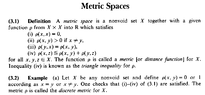
===================================================================================Example 3.10 (b) above refers to Example 3.2 (a) ... ... so I am providing access to the same ... as follows:
View attachment 9212
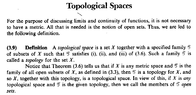
It may help readers of the above post to have access to Stromberg's definition of a topological space ... so I am providing access to the same ... as follows:
View attachment 9209
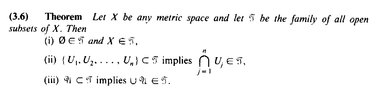
Stromberg's definition of a topological space refers to Theorem 3.6 ... ... so I am providing access to the statement of the same ... as follows:
View attachment 9210
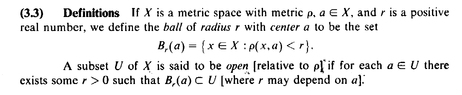
Stromberg's definition of a topological space also refers to Definition 3.3 ... ... so I am providing access to the same ... as follows:
View attachment 9211
Hope that helps ...
Peter
I am focused on Chapter 3: Limits and Continuity ... ...
I need help in order to fully understand Example 3.10 (b) on page 95 ... ... Example 3.10 (b) reads as follows:
View attachment 9208
My question is as follows:Stromberg says that if $$X$$ is any set and $$\mathscr{T}$$ is the family of all subsets of $$X$$ ...
... then $$\mathscr{T}$$ is nothing but the metric topology obtained from the discrete metric ...Can someone demonstrate/explain exactly how/why this is true ...?
Help will be much appreciated ...
Peter
===================================================================================Example 3.10 (b) above refers to Example 3.2 (a) ... ... so I am providing access to the same ... as follows:
View attachment 9212
It may help readers of the above post to have access to Stromberg's definition of a topological space ... so I am providing access to the same ... as follows:
View attachment 9209
Stromberg's definition of a topological space refers to Theorem 3.6 ... ... so I am providing access to the statement of the same ... as follows:
View attachment 9210
Stromberg's definition of a topological space also refers to Definition 3.3 ... ... so I am providing access to the same ... as follows:
View attachment 9211
Hope that helps ...
Peter
Attachments
-
 Stromberg - Example 3.10 (b) ... .png8 KB · Views: 153
 -
 Stromberg - Defn 3.9 ... Defn of a Topological Space ... .png19.3 KB · Views: 180
 -
 Stromberg - Statement of Theorem 3.6 ... .png5.2 KB · Views: 158
 -
 Stromberg - Defn 3.3 ... Defn of a Ball of Radius r with Center a ... .png7.9 KB · Views: 154
 -
 Stromberg - Example 3.2 (a) ... Discrete Metric Space .png14.6 KB · Views: 176