Discussion Overview
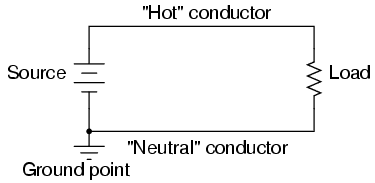
The discussion revolves around the behavior of fuses in AC circuits, particularly regarding the implications of AC polarity and the grounding of the neutral conductor. Participants explore the reasons why fuses do not blow when AC polarity reverses and the role of grounding in electrical safety.
Discussion Character
- Debate/contested
- Technical explanation
- Conceptual clarification
Main Points Raised
- Some participants question why a fuse in the Hot conductor does not blow when AC polarity reverses, suggesting that current flows in both directions and could create a hazardous situation.
- Others explain that the fuse is placed in the Hot lead to ensure that a short to Earth Ground will blow the fuse, as the Neutral is bonded to Earth ground in typical configurations.
- It is noted that current does not flow into the ground under normal circumstances, and the ground serves as a safety measure rather than a current-carrying conductor.
- Some participants clarify that the term "neutral" refers to its connection to transformers, not its bonding to ground, and discuss the implications of different grounding practices in three-phase systems.
- There is a mention of misconceptions regarding the flow of current and the role of the fuse, with some participants emphasizing that the fuse does not differentiate between current directions in AC systems.
- One participant expresses confusion about the relationship between voltage levels in the Neutral and Hot wires and their impact on fuse operation.
Areas of Agreement / Disagreement
Participants express differing views on the operation of fuses in AC circuits and the implications of grounding. There is no consensus on the initial question regarding why fuses do not blow when AC polarity reverses, and the discussion remains unresolved with multiple competing perspectives.
Contextual Notes
Participants highlight various assumptions about AC circuit behavior, grounding practices, and the definitions of terms like "neutral" and "bonding." Some points raised indicate a lack of clarity regarding the electrical principles involved, but these remain unresolved within the discussion.