JD_PM
- 1,125
- 156
- Homework Statement
- Find the general solution for the wave equation ##f_{tt} = v^2 f_{zz}## in the straight open magnetic field tube. Assume that the bottom boundary condition is fixed: there is no perturbation of the magnetic field at or below the photosphere. Solve means deriving the d’Alembert solution for this case (semi-infinite).
- Relevant Equations
- ##f_{tt} = v^2 f_{zz}##
$$f(0, t) = 0 \ \ \ \ \ x=0$$
$$f(x, 0) = \phi(x)$$
$$f_t(x, 0) = \psi(x)$$
Exercise statement
Find the general solution for the wave equation ftt=v2fzzftt=v2fzz in the straight open magnetic field tube. Assume that the bottom boundary condition is fixed: there is no perturbation of the magnetic field at or below the photosphere. Solve means deriving the d’Alembert solution for this case
(semi-infinite).
Some context on the problem:
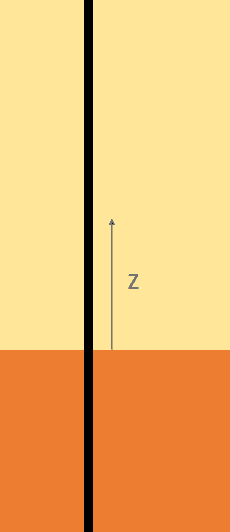
We have an open magnetic flux tube that originates in the solar interior and continues on towards the outer solar system (to be precise at some point it will have to return because there is no net loss of magnetic field lines from the Sun, all lines have to come back, but for our purposes we can assume it goes off to infinity).
What I have done:
I have pictured in my mind the magnetic field line (when observed over time) like an elastic band that can carry waves.
We know that the domain is (0,+∞)(0,+∞).
Thus I have set up the problem as follows:
ftt=v2fzz 0<x<∞ftt=v2fzz 0<x<∞The (Dirichlet) boundary condition (just one because just one end is fixed):
f(0,t)=0 x=0f(0,t)=0 x=0Let's also state two initial conditions:
f(x,0)=ϕ(x)f(x,0)=ϕ(x)
ft(x,0)=ψ(x)ft(x,0)=ψ(x)OK so I am studying the solution method (method of images) given by the nice book Introduction to Partial Differential Equations by Strauss. I will post it and then ask questions.
Let's go step by step:
1) Let's get D'Alembert's solution for the wave equation on the whole line:
Let me skip the derivation of the general solution. It's in many books, such as the one I am reading and also online; for instance, check out:
The solution is:
u(x,t)=12[ϕ(x+ct)+ϕ(x−ct)]+12c∫x+ctx−ctψ(y)dyu(x,t)=12[ϕ(x+ct)+ϕ(x−ct)]+12c∫x−ctx+ctψ(y)dy2) Odd extension (I won't explain why odd and not even; I'll just state that when you're dealing with Dirichlet BCs you have to use odd extensions, and when you're dealing with Neumann BCs you have to use even ones; more details see section 5.2 of PDE book by Strauss) and final solution
The odd extensions are defined as follows:
ϕodd(x)=
f(x,t)=12[ϕodd(x+ct)+ϕodd(x−ct)]+12c∫x+ctx−ctψodd(y)dyf(x,t)=12[ϕodd(x+ct)+ϕodd(x−ct)]+12c∫x−ctx+ctψodd(y)dy
f(x,t)=12[ϕodd(ct+x)−ϕodd(ct−x)]+12c∫ct−xct+xψodd(y)dyf(x,t)=12[ϕodd(ct+x)−ϕodd(ct−x)]+12c∫ct+xct−xψodd(y)dyFor x>v|t|x>v|t| and for 0<x<vt0<x<vt respectively.
My issue is that I do not understand why. I get lost in what Strauss calls the 'unwinding of D'Alembert solution' (pages 59, 60 of the book).
Please let me know if you need me to include more details.
EDIT: Suddenly some equations got messy (also the code). Let me know if I can do something about it.
Find the general solution for the wave equation ftt=v2fzzftt=v2fzz in the straight open magnetic field tube. Assume that the bottom boundary condition is fixed: there is no perturbation of the magnetic field at or below the photosphere. Solve means deriving the d’Alembert solution for this case
(semi-infinite).
Some context on the problem:
We have an open magnetic flux tube that originates in the solar interior and continues on towards the outer solar system (to be precise at some point it will have to return because there is no net loss of magnetic field lines from the Sun, all lines have to come back, but for our purposes we can assume it goes off to infinity).
What I have done:
I have pictured in my mind the magnetic field line (when observed over time) like an elastic band that can carry waves.
We know that the domain is (0,+∞)(0,+∞).
Thus I have set up the problem as follows:
ftt=v2fzz 0<x<∞ftt=v2fzz 0<x<∞
f(0,t)=0 x=0f(0,t)=0 x=0
f(x,0)=ϕ(x)f(x,0)=ϕ(x)
ft(x,0)=ψ(x)ft(x,0)=ψ(x)
Let's go step by step:
1) Let's get D'Alembert's solution for the wave equation on the whole line:
Let me skip the derivation of the general solution. It's in many books, such as the one I am reading and also online; for instance, check out:
The solution is:
u(x,t)=12[ϕ(x+ct)+ϕ(x−ct)]+12c∫x+ctx−ctψ(y)dyu(x,t)=12[ϕ(x+ct)+ϕ(x−ct)]+12c∫x−ctx+ctψ(y)dy
The odd extensions are defined as follows:
ϕodd(x)=
⎧⎪⎨⎪⎩ϕ(x), for x>0−ϕ(−x), for x<00, for x=0
ϕodd(x)={ϕ(x), for x>0−ϕ(−x), for x<00, for x=0
ψodd(x)=
ψodd(x)=
⎧⎪⎨⎪⎩ψ(x), for x>0−ψ(−x), for x<00, for x=0
ψodd(x)={ψ(x), for x>0−ψ(−x), for x<00, for x=0
The book says that the final solution is given by the following pair:f(x,t)=12[ϕodd(x+ct)+ϕodd(x−ct)]+12c∫x+ctx−ctψodd(y)dyf(x,t)=12[ϕodd(x+ct)+ϕodd(x−ct)]+12c∫x−ctx+ctψodd(y)dy
f(x,t)=12[ϕodd(ct+x)−ϕodd(ct−x)]+12c∫ct−xct+xψodd(y)dyf(x,t)=12[ϕodd(ct+x)−ϕodd(ct−x)]+12c∫ct+xct−xψodd(y)dy
My issue is that I do not understand why. I get lost in what Strauss calls the 'unwinding of D'Alembert solution' (pages 59, 60 of the book).
Please let me know if you need me to include more details.
EDIT: Suddenly some equations got messy (also the code). Let me know if I can do something about it.
Last edited:
