Understanding N1 and N2 in DC Network: A Comprehensive Guide

  • Thread starter Thread starter himanshushanka
  • Start date Start date
  • Tags Tags
    Dc Network
Click For Summary

Discussion Overview

The discussion revolves around the interpretation of N1 and N2 in a DC network circuit diagram. Participants explore their meanings and implications within the context of applying Kirchhoff's Current Law (KCL) and the behavior of currents in the network.

Discussion Character

  • Debate/contested
  • Technical explanation

Main Points Raised

  • Some participants suggest that N1 and N2 denote nodes in the circuit and propose applying KCL to analyze them.
  • Others argue that without additional information, the designations of N1 and N2 are meaningless.
  • One participant points out that if the upper and lower corners of the bridge are shorted, it implies a current flow of 1A, but questions how this affects the rest of the circuit.
  • Another participant expresses confusion regarding the assumption of a short circuit, noting that if the voltage is non-zero, the bridge must be resistively loaded, yet no external resistors are shown.
  • A different perspective suggests that N1 and N2 could represent supernodes, indicating that they are independent networks with connections that require further deduction of currents.

Areas of Agreement / Disagreement

Participants express differing views on the meanings and implications of N1 and N2, with no consensus reached on their significance or the correct approach to analyze the circuit.

Contextual Notes

There are unresolved assumptions regarding the circuit configuration, particularly concerning the presence of external resistors and the implications of shorting nodes.

himanshushanka
Messages
5
Reaction score
0
Please suggest what does N1 and N2 mean in the attached dc network.
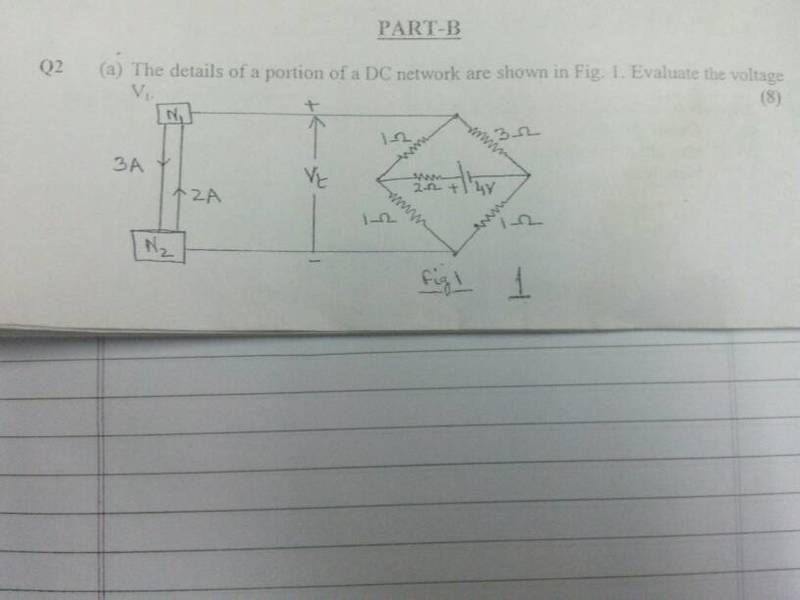
1384711002918.jpg
 
Physics news on Phys.org
As far as I can tell, it is utterly meaningless without further information.
 
I believe they simply denote nodes. Apply KCL to them.
 
the_emi_guy said:
I believe they simply denote nodes. Apply KCL to them.

That makes no sense. They have different currents going in/out but nothing to show how that affects the rest of the circuit.
 
phinds said:
That makes no sense. They have different currents going in/out but nothing to show how that affects the rest of the circuit.

The problem is essentially indicating that if the upper and lower corners of the bridge are shorted, we will get 1A flowing from the upper to the lower corner. This is possible since the bridge includes a power source. Just apply KCL to each of the nodes, N1 must have 1A arriving from bridge, N2 must have 1A returning to bridge.
 
@phinds
You know what, this does make no sense. If it is assuming a short between upper and lower corners, then the voltage in question would be zero.

If we assume that the voltage is non-zero, and we can see that there is 1A of external current associated with it, this means that the bridge is resistively loaded. But there is no resistor external to the bridge shown, only node numbers.

Stupid problem.
 
himanshushanka said:
Please suggest what does N1 and N2 mean in the attached dc network.
I'm flummoxed, too. :frown:
 
How about: N1 and N2 represent supernodes; we don't know what's inside each, but they are independent networks with three outside connections each. The currents between the two are shown, leaving us to deduce the remaining currents...
 
Seems reasonable.
 

Similar threads

  • · Replies 6 ·
Replies
6
Views
3K
Replies
10
Views
5K
Replies
1
Views
2K
  • · Replies 12 ·
Replies
12
Views
2K
Replies
3
Views
2K
  • · Replies 3 ·
Replies
3
Views
4K
  • · Replies 10 ·
Replies
10
Views
5K
  • · Replies 1 ·
Replies
1
Views
3K
  • · Replies 2 ·
Replies
2
Views
4K
  • · Replies 1 ·
Replies
1
Views
2K