What Are Principal Stress Planes and Their Relation to Shear Forces?

Click For Summary
SUMMARY

The discussion clarifies the concept of principal stress planes and their relationship to shear forces. When an element is rotated to a specific angle θ, it is indeed the principal stress plane where no shear force acts. The participants emphasize the importance of understanding transformations, particularly at 45-degree rotations, to transition between pure normal and pure shear stresses. The discussion highlights that complex stress cases can be understood through the superposition of simpler cases, reinforcing the foundational nature of these concepts in material mechanics.

PREREQUISITES
  • Understanding of stress transformation in materials
  • Familiarity with shear and normal stress concepts
  • Knowledge of basic mechanics of materials
  • Ability to interpret stress-strain relationships
NEXT STEPS
  • Study the transformation of stress at 45-degree rotations
  • Learn to derive the angle for pure shear from stress equations
  • Explore the superposition principle in stress analysis
  • Investigate differential surfaces and traction vectors in material mechanics
USEFUL FOR

Students and professionals in engineering, particularly those focused on material mechanics, structural analysis, and anyone seeking to deepen their understanding of stress transformations and shear forces.
Kajan thana
Messages
149
Reaction score
18
TL;DR
I am struggling to understand the concept of Principle Stress plane.
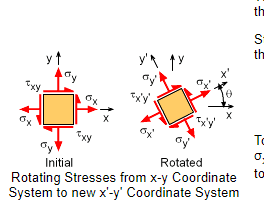
All the materials that I have been reading, it says that when the element is rotated to a θ, this will be called the principle stress plane with no shear force acting on it. but visually when you rotate the element, there will be a shear force acting parallel to the plane. I am very confused, can someone help me, please? Do we have to assume that at some θ, there will be no shear force acting?
1612975852122.png
 

Attachments

  • 1612975810174.png
    1612975810174.png
    2.2 KB · Views: 187
Engineering news on Phys.org
No assumption needed, but start by going back to the simplest cases. Start with the case below, and assume that all normal forces are equal. Study the transformation to the 45 degree rotated case, where the normal forces are zero, and there are four equal shear stresses. Then start with the case of four equal shear stresses without normal stresses, and rotate another 45 degrees. Repeat until it all makes sense.

Then study the equations until you figure out from the equations how far to rotate to get from pure normal to pure shear stress, and vice versa. You know from inspection that the rotation will be 45 degrees, but you need to understand how to find that angle from the equations.
Stress Elements.jpg

The second simplest case is a normal stress in one direction, and zero stress in the perpendicular direction. Study rotations of that case until it all makes sense. Hint: The angle for pure shear will not be 45 degrees. After all of that is clear in your mind, the more complex cases should make sense because the most complex cases are the superposition of the simple cases.

This is a fundamental concept, and it is well worth the time it takes to fully understand it.
 
  • Informative
Likes   Reactions: Kajan thana
There are three orientations of differential surfaces at each location within the material for which the stress vector on the surface (aka traction vector) acts purely normal to the surface.
 
  • Informative
Likes   Reactions: Kajan thana
Thank you so much, It makes much more sense. Appreciate your help.
 
  • Like
Likes   Reactions: jrmichler

Similar threads

  • · Replies 8 ·
Replies
8
Views
6K
  • · Replies 1 ·
Replies
1
Views
2K
  • · Replies 1 ·
Replies
1
Views
2K
  • · Replies 2 ·
Replies
2
Views
2K
  • · Replies 3 ·
Replies
3
Views
6K
  • · Replies 9 ·
Replies
9
Views
18K
  • · Replies 4 ·
Replies
4
Views
3K
  • · Replies 1 ·
Replies
1
Views
2K
Replies
5
Views
4K
  • · Replies 4 ·
Replies
4
Views
2K