Undergrad Understanding the Definition of Cp and its Relationship to Cv: Explained

Click For Summary
The discussion centers on the relationship between the heat capacities Cp and Cv, exploring their definitions and derivations. It begins with the confusion regarding the implications of partial derivatives and the cyclic rule in thermodynamics. The conversation progresses through the derivation of Cv and Cp using the first and second laws of thermodynamics, emphasizing the role of enthalpy and the Legendre transform. Key equations are presented, illustrating how the heat capacities relate to changes in entropy and pressure. Ultimately, the relationship is clarified with the final equation showing how Cp and Cv differ based on temperature and volume conditions.
11thHeaven
Messages
48
Reaction score
0
Hi all, I'm working through a derivation of the general relationship between Cp and Cv and there's one point which is confusing me.

I understand that
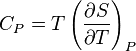
3c0a0cc895e45267dbaa601d4c29318d.png


and

ea5771ed8bd497e2dd089cfcf3e502bf.png


and that this implies the following:

32b7fb39a707cb5f2360d5c6d8b3d76e.png


but isn't this equal to 0? Shouldn't the two partial derivatives on the right hand side, by the cyclic rule, multiply to -(∂S/∂T)V?

I know that I'm missing something here but I can't work out what it is.

Help appreciated!
 
Physics news on Phys.org
What you hold constant makes a difference.
 
Hm, I'm not sure what you want to derive, but let's start defining the heat capacities and see, where this leads to.

Start from energy conservation employing the 1st and 2nd fundamental laws
$$\mathrm{d} U=\mathrm{d} Q-p \mathrm{d} V=T \mathrm{d} S-p \mathrm{d} V.$$
This implies
$$C_V:=\left (\frac{\partial Q}{\partial T} \right)_{V}=\left (\frac{\partial U}{\partial T} \right)_V=T \left (\frac{\partial S}{\partial T} \right)_V.$$
For ##C_p## we need the enthalpy, given by the Legendre transform
$$H=U+p V ; \Rightarrow \; \mathrm{d} H=T \mathrm{d} S+V \mathrm{d} p,$$
and thus
$$C_p=\left (\frac{\partial H}{\partial T} \right )_p=T \left (\frac{\partial S}{\partial T} \right)_p.$$
Now we can use
$$\frac{C_p}{T}=\left (\frac{\partial S}{\partial T} \right)_p = \det \left (\frac{\partial(S,p)}{\partial(T,p)} \right) = \det \left (\frac{\partial(S,V)}{\partial(T,V)} \right) \det \left (\frac{\partial(T,V)}{\partial(T,p)} \right) = \left [ (\partial_T S)_V (\partial_V p)_T-(\partial_V S)_T (\partial_T p)_V \right ] (\partial_p V)_T = \frac{C_V}{T} - (\partial_p S)_T (\partial_T p)_V.$$
Now we can use the Gibb's free energy
$$G=U-TS+pV \; \Rightarrow \; \mathrm{d} G=-S \mathrm{d} T+V \mathrm{d} p,$$
to derive
$$\partial_p \partial_T G=-(\partial_p S)_T=\partial_T \partial_p G=(\partial_T V)_p$$
to get
$$C_p-C_v=T (\partial_T p)_V (\partial_T V)_p.$$
 
Thread 'What is the pressure of trapped air inside this tube?'
As you can see from the picture, i have an uneven U-shaped tube, sealed at the short end. I fill the tube with water and i seal it. So the short side is filled with water and the long side ends up containg water and trapped air. Now the tube is sealed on both sides and i turn it in such a way that the traped air moves at the short side. Are my claims about pressure in senarios A & B correct? What is the pressure for all points in senario C? (My question is basically coming from watching...

Similar threads

  • · Replies 6 ·
Replies
6
Views
2K
  • · Replies 1 ·
Replies
1
Views
2K
Replies
2
Views
3K
Replies
5
Views
9K
Replies
12
Views
2K
  • · Replies 22 ·
Replies
22
Views
3K
  • · Replies 3 ·
Replies
3
Views
2K
  • · Replies 1 ·
Replies
1
Views
2K
  • · Replies 1 ·
Replies
1
Views
2K
  • · Replies 12 ·
Replies
12
Views
3K

