Understanding the S Parameter Matrix for Lossless Transmission Lines"

  • Context: Engineering 
  • Thread starter Thread starter EEuser
  • Start date Start date
  • Tags Tags
    Parameters Scattering
Click For Summary
SUMMARY

The discussion centers on the S parameter matrix for perfect lossless transmission lines, specifically focusing on the S(21) parameter. It is established that S(21) = b2/a1, provided that a2 = 0, which holds true even in complex networks. The conversation emphasizes the importance of understanding the relationship between a1 and b2, particularly in terms of magnitude and potential phase differences in AC networks. The conclusion is that while S(21) can be complex, its magnitude is a critical aspect to consider in both DC and AC scenarios.

PREREQUISITES
  • Understanding of S parameters in two-port networks
  • Knowledge of transmission line theory
  • Familiarity with AC and DC circuit analysis
  • Basic concepts of voltage and current relationships in electrical circuits
NEXT STEPS
  • Study the derivation and implications of S parameters in two-port networks
  • Explore the characteristics of lossless transmission lines in detail
  • Learn about phase differences in AC transmission lines
  • Investigate the impact of network complexity on S parameter measurements
USEFUL FOR

Electrical engineers, students studying transmission line theory, and professionals involved in RF circuit design will benefit from this discussion.
EEuser
Messages
4
Reaction score
0
Homework Statement
What is S(21) for a perfect Transmission Line?
Relevant Equations
See images below
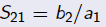
If a perfect transmission line is lossless, then would the S parameter for a perfect transmission line be
Screen Shot 2020-01-05 at 5.45.45 PM.png
?

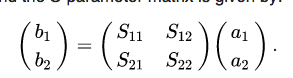
Homework Equation: S parameter matrix
Screen Shot 2020-01-05 at 5.46.25 PM.png
 
Physics news on Phys.org
Disclaimer: It's been awhile since I've worked with two-port networks, so I might be a little rusty.

EEuser said:
Homework Statement:: What is S(21) for a perfect Transmission Line?
Homework Equations:: See images below

If a perfect transmission line is lossless, then would the S parameter for a perfect transmission line be View attachment 255194?

Homework Equation: S parameter matrixView attachment 255195

Yes, you can say that S_{21} = b_2/a_1, but I suspect that's not the whole answer for what is being asked (I think).

You see, S_{21} = b_2/a_1 is always the case, so long as a_2 = 0, because that's how the parameters were measured. Even if the network involves some sort of lossy, complicated transformers and whatnot, that relationship still holds.

But I think you can get more specific. Knowing that the network is supposed to represent a perfect, lossless transmission line (without anything fancy), what is the relationship between a_1 and b_2?

That said, I don't know whether the intended answer is willing to accommodate a phase difference. Even a perfect, lossless transmission line might incur a phase difference if the transmission line is long. But in any case, you should be able to at least say something about the magnitude, | S_{21} |. If you're working with a DC network, ignore this paragraph and give the answer for S_{21} directly. If you're working with AC networks, then the answer might not be so simple since the parameter can be a complex number, but you should at least be able to say something about the parameter's magnitude.
 
  • Like
Likes   Reactions: Jody
My personal answer would just worry about the magnitude.

If I had a voltage source connected to a wire... let's call it a1 and it's equal to 1V... then what voltage (b1) would I expect to see other end of a perfect wire before connecting it to a chip that requires 1V?

If the above is confusing or doesn't work, then maybe thinking about this another way might work. If the wire is lossy and imperfect, then what would you not see on the other end?
 

Similar threads

  • · Replies 3 ·
Replies
3
Views
3K
  • · Replies 18 ·
Replies
18
Views
3K
  • · Replies 1 ·
Replies
1
Views
1K
  • · Replies 2 ·
Replies
2
Views
2K
  • · Replies 2 ·
Replies
2
Views
2K
  • · Replies 4 ·
Replies
4
Views
3K
  • · Replies 4 ·
Replies
4
Views
3K
  • · Replies 11 ·
Replies
11
Views
8K
  • · Replies 1 ·
Replies
1
Views
2K
  • · Replies 4 ·
Replies
4
Views
3K