Understanding Thevenin Equivalent: Why Zeq = 0

Click For Summary
SUMMARY

The discussion focuses on understanding why the equivalent impedance (Zeq) in a Thevenin equivalent circuit is zero when a voltage source is shorted. The Thevenin voltage (Vth) is established at 50<0°, and the process involves calculating the output voltage (VAB) and output current (IAB) under specific conditions. When the voltage source is shorted, all parallel elements are effectively bypassed, leading to a total resistance (R(t)) of zero, as demonstrated through the calculations provided.

PREREQUISITES
  • Understanding of Thevenin's Theorem
  • Familiarity with circuit analysis techniques
  • Knowledge of impedance and resistance calculations
  • Ability to interpret circuit diagrams and symbols
NEXT STEPS
  • Study Thevenin's Theorem in detail, including practical applications
  • Learn about circuit simplification techniques, including source transformations
  • Explore the concept of equivalent circuits in AC analysis
  • Investigate the role of ideal voltage and current sources in circuit design
USEFUL FOR

Electrical engineering students, circuit designers, and professionals involved in circuit analysis and design will benefit from this discussion.

magnifik
Messages
350
Reaction score
0
For the circuit below, can someone please help me understand why Zeq = 0 (in words...not by solving):
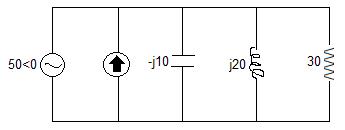
jt6jw4.png


I know Vth = 50<0° since this is the voltage drop across the parallel elements. I don't understand why the equivalent impedance would be 0. I know when you shut off a voltage source, elements in parallel with it also go away. does this have anything to do with it?
 
Physics news on Phys.org
http://en.wikipedia.org/wiki/Th%C3%A9venin%27s_theorem"

To calculate the equivalent circuit, the resistance and voltage are needed, so two equations are required. These two equations are usually obtained by using the following steps, but any conditions placed on the terminals of the circuit should also work:

1. Calculate the output voltage, VAB, when in open circuit condition (no load resistor—meaning infinite resistance). This is VTh.
2. Calculate the output current, IAB, when the output terminals are short circuited (load resistance is 0). RTh equals VTh divided by this IAB.

The equivalent circuit is a voltage source with voltage VTh in series with a resistance RTh.

Step 2 could also be thought of as:

2a. Replace voltage sources with short circuits, and current sources with open circuits.
2b. Calculate the resistance between terminals A and B. This is RTh.

So you know the Thevenin Voltage already. In step two you can short all voltage sources, open all current sources (as per step 2a.) and then comment on the resistance of the remaining circuit.
 
Last edited by a moderator:
What is the element represented by a circle with an arrow in it?
 
What is the element represented by a circle with an arrow in it?
 
NascentOxygen said:
What is the element represented by a circle with an arrow in it?

it's a current source
 
Zryn said:
http://en.wikipedia.org/wiki/Th%C3%A9venin%27s_theorem"


So you know the Thevenin Voltage already. In step two you can short all voltage sources, open all current sources (as per step 2a.) and then comment on the resistance of the remaining circuit.

so is it because when you short the voltage source the elements in parallel are shut off, too?
 
Last edited by a moderator:
It's only a matter of calculating the parallel resistance as per normal:

1/R(t) = 1 / R(short) + 1 / R(open) + 1 / R(C) + 1 / R(L) + 1 / R(R)

R(t) = 1 / [1 / 0 + 1 / inf + 1 / -j10 + 1 / j20 + 1 / 30]

R(t) = 1 / [(1 + 0 + 0 + 0 + 0)/0] (put all 5 fractions over a common denominator)

R(t) = 1 / [1 / 0]

R(t) = 1 * [0 / 1]

R(t) = 0

You could have just 'seen' that by knowing that the short circuit from the voltage source will bypass all the other elements in the circuit, since current will follow the path of least resistance and split down parallel paths in inverse proportionality to the magnitude of the resistance of each path. I guess 'shut off' is correct, but you could word it better :smile:.
 
Are we treating this whole 5 element thing as a voltage source? So we seek the equivalent impedance as seen between the top rail and the bottom rail?

Or are we determining the thevenin impedance of a voltage source comprising an ideal voltage source in parallel with a current source?

(Please don't say it doesn't matter. I can see that! I'd still like to know the question before I state the answer. :smile: )
 

Similar threads

  • · Replies 10 ·
Replies
10
Views
4K
  • · Replies 42 ·
2
Replies
42
Views
6K
  • · Replies 5 ·
Replies
5
Views
3K
  • · Replies 1 ·
Replies
1
Views
2K
  • · Replies 10 ·
Replies
10
Views
3K
  • · Replies 7 ·
Replies
7
Views
3K
  • · Replies 6 ·
Replies
6
Views
2K
  • · Replies 17 ·
Replies
17
Views
3K
  • · Replies 8 ·
Replies
8
Views
3K
  • · Replies 9 ·
Replies
9
Views
6K