Visible light Absorption Spectra vs Color of mineral

Click For Summary
SUMMARY

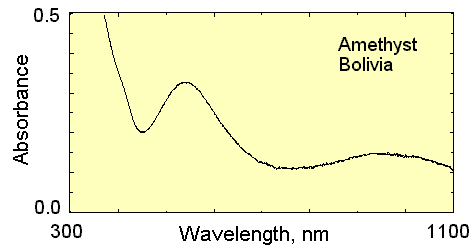
The discussion focuses on understanding the relationship between the absorption spectra of minerals, specifically Bolivian Amethyst, and their perceived color. The absorption peak for the Amethyst occurs around 500-600 nm, indicating a green-yellow absorption, with the complementary color being purple. The reflection peak at approximately 450 nm suggests that this wavelength contributes to the visible color. To accurately quantify the perceived color, one must consider the entire 450-700 nm spectrum and integrate it with the light source's spectrum using tristimulus values for human vision.

PREREQUISITES
  • Understanding of absorption spectra and their interpretation
  • Familiarity with the concept of complementary colors
  • Knowledge of the visible light spectrum (450-700 nm)
  • Basic principles of human color perception and tristimulus values
NEXT STEPS
  • Research the integration of light source spectra with mineral absorption spectra
  • Study the application of tristimulus values in color science
  • Explore advanced techniques for measuring mineral color quantitatively
  • Investigate the effects of thickness on light absorption and reflection in gemstones
USEFUL FOR

Geologists, mineralogists, gemologists, and anyone interested in the optical properties of minerals and their color perception.

mubashirmansoor
Messages
258
Reaction score
0
I have been wondering how to realize the color of a mineral by having the absorption Spectra...

The following case is an example;
amethyst.gif


The image is the absorption spectra of a Bolivian Amethyst which looks like this;

[PLAIN]http://www.tequilabay.com/amethyst300lbbolivian.jpg
I have tried interpreting the purplish color just by reading the spectra, but I wasn't successful... So I will be very thankful for your guidance.
 
Last edited by a moderator:
Science news on Phys.org
Well all the absorption below 400 nm is UV and so you can ignore that part. You have an absorption peak around 500-600 nm, which is in the green-yellow region.
The complementary color to green-yellow is purple.
 
When light fall on an object, it does 3 things : it gets absorbed, transmitted and reflected.

Assuming the gems are sufficiently thick, we can assume there is no transmission. That leaves absorption and reflection.

As you see in your graph, the absorption is minimal around 450 nm, which means there is a reflection peak at around 450 nm. Remember the reflection is what we see.

Then you use this chart :
http://en.wikipedia.org/wiki/File:Rendered_Spectrum.png
 
alxm said:
Well all the absorption below 400 nm is UV and so you can ignore that part. You have an absorption peak around 500-600 nm, which is in the green-yellow region.
The complementary color to green-yellow is purple.

This is sure helpful but what about the rest of the absorptions throughout the 450 - 700 nm spectrum?

How to get the exact tone or wavelength of the color in a quantitative way?

Thanks in advance :)
 
I don't see what you want more. The graph describes the "tone" the only quantitative way it can be described. You can't restrict to a single wavelength. The eye absorbs everything within 450 - 700 nm. The "color" that is perceived includes all the absorbed wavelengths of the graph.
 
Basically, the perceived color of a surface includes many wavelengths at varying intensities, just like the perceived taste of a pizza includes flavors of many ingredients in varying intensities.
 
You combine this graph with one for the light source. Then integrate the result with "tristimulus values" for human vision.
 

Similar threads

  • · Replies 207 ·
7
Replies
207
Views
13K
  • · Replies 13 ·
Replies
13
Views
3K
  • · Replies 5 ·
Replies
5
Views
2K
Replies
8
Views
5K
  • · Replies 2 ·
Replies
2
Views
2K
  • · Replies 66 ·
3
Replies
66
Views
7K
  • · Replies 20 ·
Replies
20
Views
4K
  • · Replies 5 ·
Replies
5
Views
3K
  • · Replies 1 ·
Replies
1
Views
1K
  • · Replies 3 ·
Replies
3
Views
3K