OsHEe
- 1
- 0
Hey guys,
I am studying in heriot watt university Dubai. I would like to be a Fluids expert. I have been doing well in my course-works and my professor usually helps me around to get a few extra info.
However recently due to a tight schedule he is unable to help me out. I have managed to get this real life fluids problem But am unable to solve it can you help me...
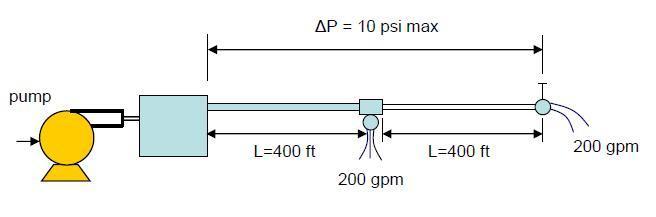
Water must be pumped through 400 ft of one diameter pipe to a point where 200 gpm exits through a valve. The pipeline, now constructed of a different diameter, extends from that point another 400 ft to a second valve where a second 200 gpm is to exit at the end of the line. See figure below. If a total maximum pressure drop of 10 psi from the pump to the second valve can be tolerated, specify some possible diameters for:
a) The functional design(s); and
b) The satisfactory design(s).
c) Assuming that the cost of the pipeline is directly proportional to the diameter of the pipe used, specify an optimal solution.
d) Specify an appropriate type of pump driven by an electric motor, and calculate the power required. Choose a lower cost option if more than one type is available. Assume that the electric drive and associated hardware have an overall power conversion efficiency of 89%.
I am studying in heriot watt university Dubai. I would like to be a Fluids expert. I have been doing well in my course-works and my professor usually helps me around to get a few extra info.
However recently due to a tight schedule he is unable to help me out. I have managed to get this real life fluids problem But am unable to solve it can you help me...
Homework Statement
Water must be pumped through 400 ft of one diameter pipe to a point where 200 gpm exits through a valve. The pipeline, now constructed of a different diameter, extends from that point another 400 ft to a second valve where a second 200 gpm is to exit at the end of the line. See figure below. If a total maximum pressure drop of 10 psi from the pump to the second valve can be tolerated, specify some possible diameters for:
a) The functional design(s); and
b) The satisfactory design(s).
c) Assuming that the cost of the pipeline is directly proportional to the diameter of the pipe used, specify an optimal solution.
d) Specify an appropriate type of pump driven by an electric motor, and calculate the power required. Choose a lower cost option if more than one type is available. Assume that the electric drive and associated hardware have an overall power conversion efficiency of 89%.