What are the electrons doing in this example?

  • Context: Undergrad 
  • Thread starter Thread starter beg
  • Start date Start date
  • Tags Tags
    Electrons Example
Join the discussion
Registration is free. Ask a follow-up in this thread, or start your own.
5 replies · 2K views
beg
Messages
5
Reaction score
0
Given the following image of 2 conductors, a negatively charged inner ring and positively charged outer ring, taken from http://www.physicsclassroom.com/class/estatics/u8l4d.cfm"
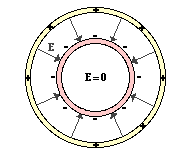
u8l4d2.gif


Where are the electrons located in the outer ring?

If there was no inner ring, and as the outer is positively charged, the electrons would position themselves equally over the volume of the ring.

But because there is an inner ring that is negatively charged, wouldn't they now repel that inner ring and position themselves on the surface of the outer ring?

The tutorial seems to imply they won't do this, but why?
 
Last edited by a moderator:
Physics news on Phys.org
My guess: If all electrons were on the outer rim, their mutual repulsion would push some back inwards.
 
The lines of force point from positive to negative and since there would be no lines of force inside the conductor itself the electrons would experience no force away from the negative ring.
 
Consider the nature of the "charge" on the outside conductor---
DC
 
Dr_Morbius said:
The lines of force point from positive to negative and since there would be no lines of force inside the conductor itself the electrons would experience no force away from the negative ring.

What do you mean? Electrons follow the opposite direction of the field lines, so why wouldn't the electrons in the outer ring feel some repulsion from the inner ring?
 
Electrons inside a conductor are normally distributed evenly throughout and and will always try to return to that even distribution. An external electric field will not cause an imbalance of distribution. An external electric field does not propagate through a conductor. Please note the words inside and conductor. This is not true of an insulator or a semiconductor.

You might want to avoid online rehash articles and get a good physics book that covers electric theory.

DC
 
Last edited: