mcastillo356
Gold Member
- 660
- 365
Hi PF
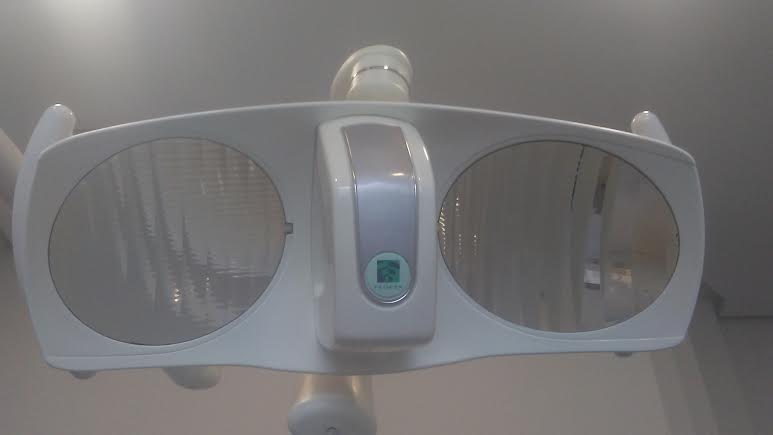
I've been twice to the dentist recently, and I've taken this picture. I don't find it in Google, and I know nothing about optics, but some words that appear at the textbook I'm now studying seem to be related: concavity, reflection, parabole...In few words, I'm more concerned about this device than about my teeth's health. What does suggest this image to you?.
I will describe it: at the center there are two lights, on both sides, hidden at the picture, that head to a concave surface; this concave surface is provided with rectangular mirrors. I've asked the dentist: does it concentrate the light at a certain point? She's kept doing her work (clean them) and told, "it helps". But let me take the picture.
What should I know? I am studying the textbook "Calculus", by Robert A. Adams. I've posted at the Lounge, because I just want to relate it with the book I´m reading, and my book is not about optics.
Regards
I've been twice to the dentist recently, and I've taken this picture. I don't find it in Google, and I know nothing about optics, but some words that appear at the textbook I'm now studying seem to be related: concavity, reflection, parabole...In few words, I'm more concerned about this device than about my teeth's health. What does suggest this image to you?.
I will describe it: at the center there are two lights, on both sides, hidden at the picture, that head to a concave surface; this concave surface is provided with rectangular mirrors. I've asked the dentist: does it concentrate the light at a certain point? She's kept doing her work (clean them) and told, "it helps". But let me take the picture.
What should I know? I am studying the textbook "Calculus", by Robert A. Adams. I've posted at the Lounge, because I just want to relate it with the book I´m reading, and my book is not about optics.
Regards