What happens when capacitors are reconnected?

  • Context: Undergrad 
  • Thread starter Thread starter Calpalned
  • Start date Start date
  • Tags Tags
    Capacitors
Click For Summary

Discussion Overview

The discussion revolves around the behavior of capacitors when they are reconnected after being charged and disconnected from a battery. Participants explore the charge distribution and the implications of reconnection, focusing on the sequence of states represented in diagrams and the underlying principles of charge movement.

Discussion Character

  • Exploratory
  • Debate/contested
  • Technical explanation

Main Points Raised

  • One participant questions how the charge distribution changes when capacitors are reconnected, noting an initial state with two positive charges and a subsequent state with both positive and negative charges.
  • Another participant suggests that the second diagram simply shows one capacitor turned around, indicating a swap in connections between the two capacitors.
  • A different viewpoint asserts that even without reconnection, the charge distribution must satisfy Kirchhoff's loop rule, implying that charge would flow automatically.
  • In response, a participant challenges this claim, stating that the removal of the battery leaves the system in equilibrium, meaning no charge will flow.
  • A later reply acknowledges the misunderstanding and agrees with the assertion that the system is already in equilibrium.

Areas of Agreement / Disagreement

Participants express differing views on whether charge will flow automatically upon reconnection or if the system remains in equilibrium after the battery is removed. The discussion reflects multiple competing perspectives without a clear consensus.

Contextual Notes

There are unresolved assumptions regarding the initial charge states and the implications of reconnection. The discussion also highlights potential misunderstandings about equilibrium and charge flow in capacitor systems.

Calpalned
Messages
297
Reaction score
6
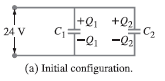
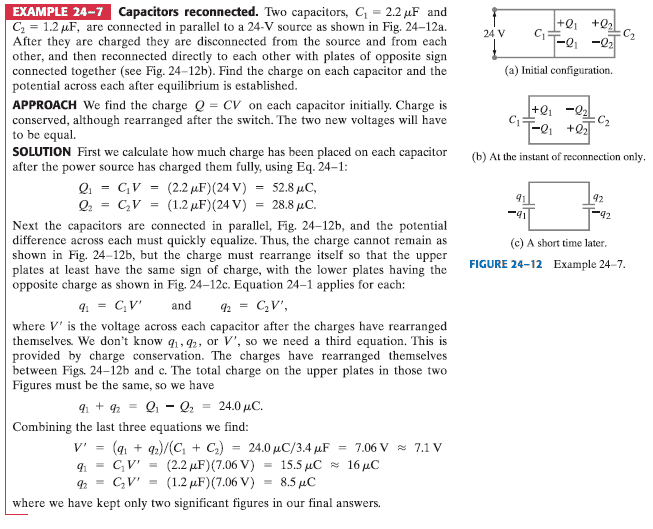
In an example from my textbook, two capacitors are fully charged and then disconnected from the battery. (The full text is on the bottom of the thread).
Screenshot (71).png

Initially, the positive charge is on top, negative on the bottom.
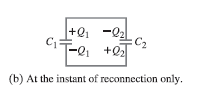
Screenshot (72).png

How did this occur? This is the part that I don't understand. Originally the top had two positive charges and now it has both positive and negative. Is this natural, or was something done during the re-connection?
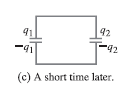
Screenshot (70).png

So the charges move back to the same configuration as in (A) - positive on top, negative on the bottom. This makes sense. Once again, I don't understand part B, because part B doesn't seem to fit the sequence. A can go to C, but B doesn't fit.

Below is the full example, if it helps
Screenshot (73).png

Thank you.
 
  • Like
Likes   Reactions: kbr2020
Physics news on Phys.org
Looks like C2 is simply "turned around" between the two first diagrams, i.e. the connectors between C1 and C2 are swapped in the second diagram compared to the first.
 
  • Like
Likes   Reactions: davenn
Calpalned said:
How did this occur? This is the part that I don't understand. Originally the top had two positive charges and now it has both positive and negative. Is this natural, or was something done during the re-connection?
Read the second sentence of the first paragraph of the question. Carefully.
 
  • Like
Likes   Reactions: davenn
Filip Larsen said:
Looks like C2 is simply "turned around" between the two first diagrams, i.e. the connectors between C1 and C2 are swapped in the second diagram compared to the first.

Yes

DaleSpam said:
Read the second sentence of the first paragraph of the question. Carefully.

and yes :smile:
 
CrazyNinja said:
But even otherwise, if the battery was disconnected and the capacitors weren't the charge distribution would still be as shown in (b). It has to be to satisfy kirchhoffs loop rule. No reconnection is required, charge will flow automatically.

You may want to re-think that. The removal of the battery leaves the system in the state shown at (a). It is already in equilibrium and no charge will flow.
 
jbriggs444 said:
You may want to re-think that. The removal of the battery leaves the system in the state shown at (a). It is already in equilibrium and no charge will flow.

Yeah it is. Sorry for that. I'll jus delete the previous post. Thanks!
 

Similar threads

  • · Replies 16 ·
Replies
16
Views
3K
  • · Replies 7 ·
Replies
7
Views
2K
  • · Replies 19 ·
Replies
19
Views
6K
  • · Replies 7 ·
Replies
7
Views
2K
  • · Replies 7 ·
Replies
7
Views
3K
  • · Replies 3 ·
Replies
3
Views
6K
  • · Replies 10 ·
Replies
10
Views
3K
  • · Replies 2 ·
Replies
2
Views
2K
  • · Replies 7 ·
Replies
7
Views
20K
  • · Replies 4 ·
Replies
4
Views
3K