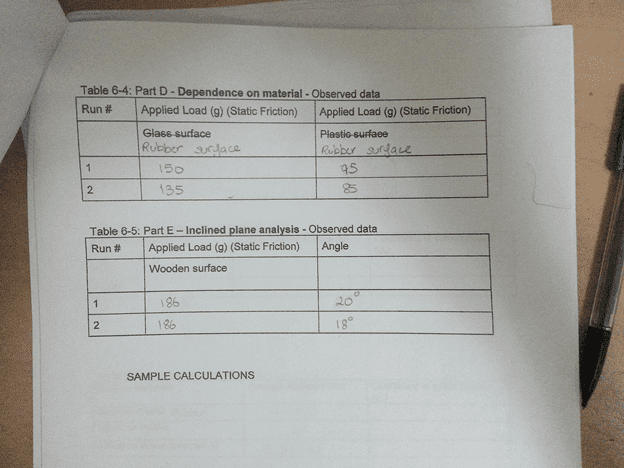
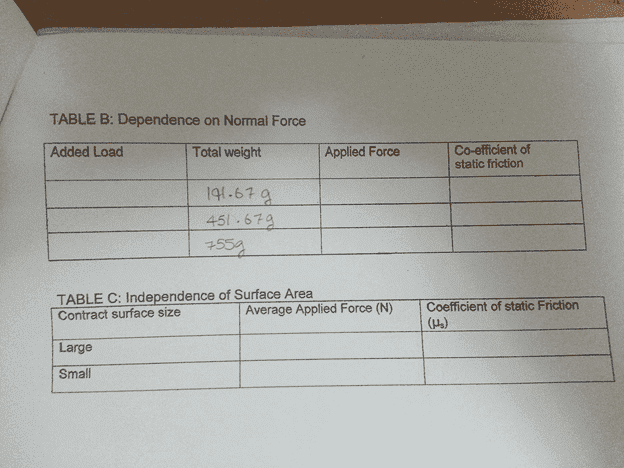
What is applied load, applied force, and added load? friction

Click For Summary
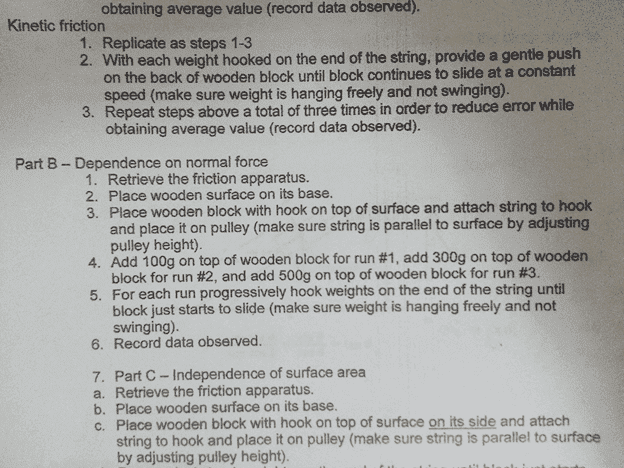
Applied load refers to the total weight acting on the system, typically measured in grams, which influences the frictional force. Applied force, measured in Newtons, is the force exerted to move the object, overcoming static friction. The experiment aims to calculate the coefficient of friction by analyzing how these forces interact. Understanding the relationship between added load and applied force is crucial for accurately determining friction. This knowledge enhances comprehension of the experimental method and its objectives.
SagarPatil
Messages
34
Reaction score
2
So we are doing a lab in class where you have to calculate coefficient of friction.

This picture shows exactly what we are doing except the wooden block is flat

There weight on the string.

http://facstaff.gpc.edu/~apepper/website pics/friction2.jpg

So

what does added load (there is no units beside it)
What does applied force (assuming in Newtons, they are static friction)
What does applied load mean? (The units are in grams)

Here is some other info

Weight of wooden block is 186 G
upload_2015-3-18_22-1-35.png


upload_2015-3-18_22-1-44.png


upload_2015-3-18_22-1-54.png
 
  • Like
Likes PhanthomJay
Physics news on Phys.org
Use the context of the instructions and your past experience of doing these labs to figure it out.
What would be best described as the load" on the cart? Do you ever add to it?
Do you apply a force to the cart at some stage?

Do you understand what the experiment is supposed to find and how the method let's you find it?
i.e. don't just follow instructions - understand them.
 
My friend explained it. Thanks for helping.
 
Great... what was the explanation?
This is so other people may be helped by this thread.
 
The book claims the answer is that all the magnitudes are the same because "the gravitational force on the penguin is the same". I'm having trouble understanding this. I thought the buoyant force was equal to the weight of the fluid displaced. Weight depends on mass which depends on density. Therefore, due to the differing densities the buoyant force will be different in each case? Is this incorrect?

Similar threads

Replies
7
Views
1K
  • · Replies 20 ·
Replies
20
Views
2K
  • · Replies 11 ·
Replies
11
Views
2K
  • · Replies 9 ·
Replies
9
Views
4K
  • · Replies 5 ·
Replies
5
Views
2K
  • · Replies 5 ·
Replies
5
Views
2K
  • · Replies 8 ·
Replies
8
Views
2K
  • · Replies 16 ·
Replies
16
Views
5K
  • · Replies 1 ·
Replies
1
Views
2K
  • · Replies 4 ·
Replies
4
Views
3K