What is phase velocity and how does it relate to group velocity?

Click For Summary
SUMMARY

The discussion clarifies the concepts of phase velocity and group velocity in wave mechanics. Group velocity is defined as the velocity of the overall wave packet, exemplified by a Gaussian wave packet moving to the right. Phase velocity, on the other hand, refers to the velocity of individual waves within the wave packet, which can be observed as moving to the left. The conversation emphasizes that phase velocity is determined by tracking an individual peak of the wave, while group velocity relates to the energy propagation of the wave packet.

PREREQUISITES
  • Understanding of wave mechanics and wave packets
  • Familiarity with Fourier transforms and sine waves
  • Knowledge of constructive and destructive interference
  • Basic grasp of phasors and their representation
NEXT STEPS
  • Study the relationship between phase velocity and group velocity in wave theory
  • Explore Fourier transforms and their application in wave analysis
  • Investigate the concept of phasors and their role in wave mechanics
  • Learn about energy propagation in wave packets and its implications
USEFUL FOR

Students and professionals in physics, particularly those studying wave mechanics, signal processing, and related fields, will benefit from this discussion.

mycotheology
Messages
86
Reaction score
0
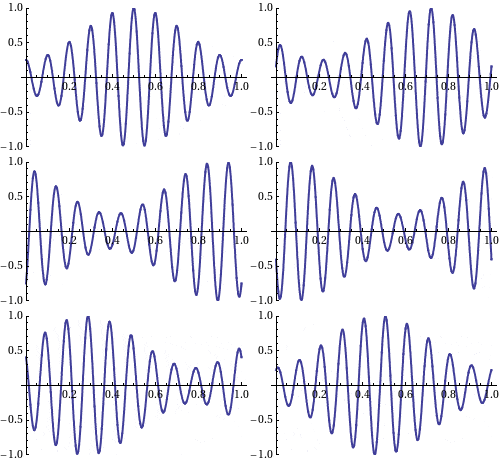
According to the wiki page, this diagram:
Wave_opposite-group-phase-velocity.gif

shows the phase velocity and group velocity moving in opposite directions. I think I understand what group velocity is, its the velocity of the overall wavepacket, in the diagram I can see a Gaussian wavepacket moving to the right so I'm guessing that's the group velocity. I can't see the phase velocity. I don't know what I'm looking for because I don't really know what phase means. I understand the concept of constructive and destructive interference and how 2 waves can be in or out of phase but I don't understand what phase means with respect to an individual wave. Does the word phase mean where the waveform is on the y axis, at a particular point on the x axis? Thats the idea I have of phase and with that in mind, I can't understand how phase can have a velocity.
 
Last edited:
Physics news on Phys.org
mycotheology said:
According to the wiki page, this diagram:

shows the phase velocity and group velocity moving in opposite directions. I think I understand what group velocity is, its the velocity of the overall wavepacket, in the diagram I can see a Gaussian wavepacket moving to the right so I'm guessing that's the group velocity.

Correct!

I can't see the phase velocity.

The phase velocity refers to the individual waves "inside" the wave packet, which are moving to the left in your example. Actually, what you're seeing is the average phase velocity of the individual waves that combine to produce the wave packet.
 
Last edited by a moderator:
I think the way to see the phase motion is to pick an individual peak and keep your finger on it.
 
jtbell said:
The phase velocity refers to the individual waves "inside" the wave packet, which are moving to the left in your example. Actually, what you're seeing is the average phase velocity of the individual waves that combine to produce the wave packet.
So if I did a Fourier transform on the wavepacket and broke it down into its constituent sine waves, they'd be moving to the left. Still can't see it though. Are you able to see the individual waves inside the packet in that diagram?

Simon Bridge said:
I think the way to see the phase motion is to pick an individual peak and keep your finger on it.

Whats confusing me is the way each individual ripple is growing and shrinking as it moves from left to right. In other words, each peak is moving up and down the y-axis as it traverses the x axis. I thought that phase depended on the position on the y axis. If I follow an individual peak, I do see it moving from right to left though, should I just forget about the y axis?
 
Group velocity is, essentially, the velocity by which ENERGY propagates. Energy is what effectively determines the actual AMPLITUDE of a given peak, whereas the peak itself moves with a different velocity. THAT velocity is what we call phase velocity.
 
DocZaius said:
Ignore the up and down motion. Just identify a peak - any peak - and consider its left-right velocity. That is the phase velocity.

Ah right, that clears it up, thanks a lot.
 
That's it :)
The phase is the angle that the phasor makes with the horizontal axis.
If the length of the phasor is constant, then that corresponds to the y-coordinate.
But if the length of the phasor is a function of time, then the same phase points may have different y-positions. All the peaks have the same phase - and they are easy to see - so...

http://en.wikipedia.org/wiki/Phasor (second diagram)
 

Similar threads

  • · Replies 8 ·
Replies
8
Views
2K
  • · Replies 4 ·
Replies
4
Views
2K
  • · Replies 2 ·
Replies
2
Views
2K
  • · Replies 3 ·
Replies
3
Views
1K
  • · Replies 14 ·
Replies
14
Views
4K
  • · Replies 47 ·
2
Replies
47
Views
5K
  • · Replies 1 ·
Replies
1
Views
1K
  • · Replies 3 ·
Replies
3
Views
2K
  • · Replies 1 ·
Replies
1
Views
2K
  • · Replies 3 ·
Replies
3
Views
1K