What is the color code for a zero Ohm resistance?

  • Context: High School 
  • Thread starter Thread starter shahroz
  • Start date Start date
  • Tags Tags
    Code Color Resistance
Click For Summary

Discussion Overview

The discussion revolves around the concept of zero Ohm resistors, specifically focusing on their color coding, existence in practical applications, and their role in circuit design. Participants explore the implications and uses of zero Ohm resistors in electronics.

Discussion Character

  • Exploratory
  • Technical explanation
  • Debate/contested

Main Points Raised

  • Some participants inquire about the color code for zero Ohm resistors, questioning if they exist and how they are represented.
  • Others mention that zero Ohm resistors can be used as jumpers in circuit design, allowing for flexibility in selecting circuit behavior.
  • There are references to the practicality of zero Ohm resistors in industry, with some participants noting their use in modern circuit boards compared to traditional wire jumpers.
  • Some participants express skepticism about the concept of zero Ohm resistors, suggesting that a wire would suffice, while others argue that they serve a specific purpose in design.
  • Questions arise regarding the tolerance of zero Ohm resistors and how it relates to their labeling and functionality.
  • Participants share personal experiences and historical context regarding the use of jumpers and resistors in circuit design.

Areas of Agreement / Disagreement

There is no clear consensus on the necessity or definition of zero Ohm resistors, with multiple competing views on their purpose and application in electronics.

Contextual Notes

Participants discuss the implications of tolerance bands for zero Ohm resistors, but there is uncertainty regarding how these apply in practice. The conversation also touches on historical practices in circuit design, indicating a shift in methods over time.

Who May Find This Useful

Electronics enthusiasts, engineers, and students interested in circuit design and the practical applications of resistors may find this discussion relevant.

shahroz
Messages
1
Reaction score
0
What will be the color code of a zero Ohm resistance?
 
Last edited by a moderator:
Physics news on Phys.org
Color codes are seen on resistor you can buy in a shop. Does anybody sell resistors of zero ohm resistance?
 
It will be silver if it's an aluminum wire or copper-colored if it's a copper wire. :smile:

Actually, I do seem to recall from another thread here that there IS such a thing as a zero-ohm resister but that just seems weird to me since all you need is a wire.
 
If you ask enough silly questions you will just sometimes get a sensible answer :

https://en.wikipedia.org/wiki/Zero-ohm_link
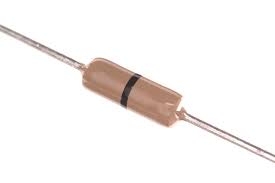
images?q=tbn:ANd9GcREw_D5OgoxKbpajzYuZSCLBXvWGwzumiDuKSFHCJwR7On7cI7kHQ.jpg
 
  • Like
Likes   Reactions: ehild
Nidum said:
If you ask enough silly questions you will just sometimes get a sensible answer :

https://en.wikipedia.org/wiki/Zero-ohm_link
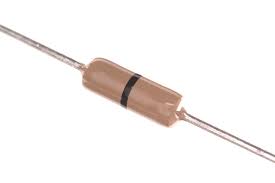
images?q=tbn:ANd9GcREw_D5OgoxKbpajzYuZSCLBXvWGwzumiDuKSFHCJwR7On7cI7kHQ.jpg
Not really such a daft idea, actually. The zero ohm link could be replaced by a link, when required, with finite resistance which would fit straight into position.
 
sophiecentaur said:
Not really such a daft idea, actually. The zero ohm link could be replaced by a link, when required, with finite resistance which would fit straight into position.
Yup, very common in industry practice. One incorporates a number of "jumpers" into the circuit design. Removing or adding zero-ohm resistors at those points selects certain circuit behavior - for instance, choice of 5V or 3.3V power.
 
tfr000 said:
Yup, very common in industry practice. One incorporates a number of "jumpers" into the circuit design. Removing or adding zero-ohm resistors at those points selects certain circuit behavior - for instance, choice of 5V or 3.3V power.
Clever. So this way the PC board doesn't have to be modified, just the component insertion process. When I was an engineer trainee back in the '60s we just used wire jumpers, but then we were doing everything by hand but this is great for automation. I DO recall that the wire jumpers we used (they weren't just wire, they were a plastic form containing pins) were smaller than a resistor form factor and I remember using the same things on PC boards back in the early days of personal computers, but they didn't allow the option of putting an actual component in the same position which, as Sophie points out, these do.
 
Also allows design of one board which can be "programmed" via jumpers to do a number of different things. Often used to disable/enable certain premium features.
 
Nidum said:
If you ask enough silly questions you will just sometimes get a sensible answer :

https://en.wikipedia.org/wiki/Zero-ohm_link

images?q=tbn:ANd9GcREw_D5OgoxKbpajzYuZSCLBXvWGwzumiDuKSFHCJwR7On7cI7kHQ.jpg
I use lots of these in commercial gear I build :smile:

a section of one of my boards, note the zero Ohm links ...
PA200001asm.jpg


Dave
 
  • Like
Likes   Reactions: Nidum
  • #11
I would think that term would only apply to a superconductor jumper; but, I guess the correct tolerance band value deals with that issue.
 
  • #12
JBA said:
I would think that term would only apply to a superconductor jumper; but, I guess the correct tolerance band value deals with that issue.

How much is a relative error of plus or minus ten percent on a zero ohm resistor?
 
  • #13
A good point, I just let my mind slide through the fact that they are in percentages to the fact that the result is always a numerical value range. As a result, there justr seems to be no real excuse for this gross product mislabeling. (Just kidding)
At this point I shall simply make my way back to the ME section where I belong and leave it the EE folks to deal with this dilemma.
 
  • #14
JBA said:
but, I guess the correct tolerance band value deals with that issue.

look at those ones on my circuit board pix ... do you see a tolerance band ? ... noDave
 

Similar threads

  • · Replies 16 ·
Replies
16
Views
2K
  • · Replies 20 ·
Replies
20
Views
3K
  • · Replies 57 ·
2
Replies
57
Views
14K
  • · Replies 8 ·
Replies
8
Views
2K
  • · Replies 105 ·
4
Replies
105
Views
13K
  • · Replies 3 ·
Replies
3
Views
2K
  • · Replies 13 ·
Replies
13
Views
3K
  • · Replies 22 ·
Replies
22
Views
3K
Replies
22
Views
3K
  • · Replies 57 ·
2
Replies
57
Views
6K