What is the effect of efficiency on the cost of electricity?

Click For Summary

Discussion Overview

The discussion revolves around the relationship between efficiency and the cost of electricity in photovoltaic (PV) systems. Participants explore various aspects of this relationship, including assumptions about investment and maintenance costs, the impact of efficiency on cost per kilowatt-hour (kWh), and the practical considerations of upgrading solar panels.

Discussion Character

  • Debate/contested
  • Exploratory
  • Technical explanation

Main Points Raised

  • One participant notes that as the efficiency of a PV system increases, the cost of electricity appears to rise according to a graph they provided, while another argues that higher efficiency generally leads to lower cost per kWh if production costs remain stable.
  • There is a suggestion that more efficient systems may incur higher initial costs due to increased materials and labor, which could affect overall cost calculations.
  • Another participant mentions the rapid improvement in solar panel technology, indicating that the performance-to-price ratio doubles approximately every three years, which complicates decisions about when to upgrade panels.
  • Concerns are raised about the practicality of replacing panels frequently, especially in specific contexts like living on a boat, where size and installation pose additional challenges.
  • One participant expresses skepticism about achieving high efficiency levels in realistic conditions, questioning the feasibility of reaching 240 watts in a specific area with current technology.
  • There is a discussion about the expected improvements in panel efficiency over a short time frame, with some participants doubting significant advancements within three years.

Areas of Agreement / Disagreement

Participants express differing views on the relationship between efficiency and cost, with no consensus reached on whether increased efficiency leads to higher or lower costs. The discussion remains unresolved regarding the practical implications of these factors in real-world applications.

Contextual Notes

Participants' claims depend on various assumptions, including the stability of investment and maintenance costs, the expected lifetime of solar panels, and the specific conditions under which the panels are used. There are also unresolved questions about the realistic efficiency achievable in practical settings.

says
Messages
585
Reaction score
12
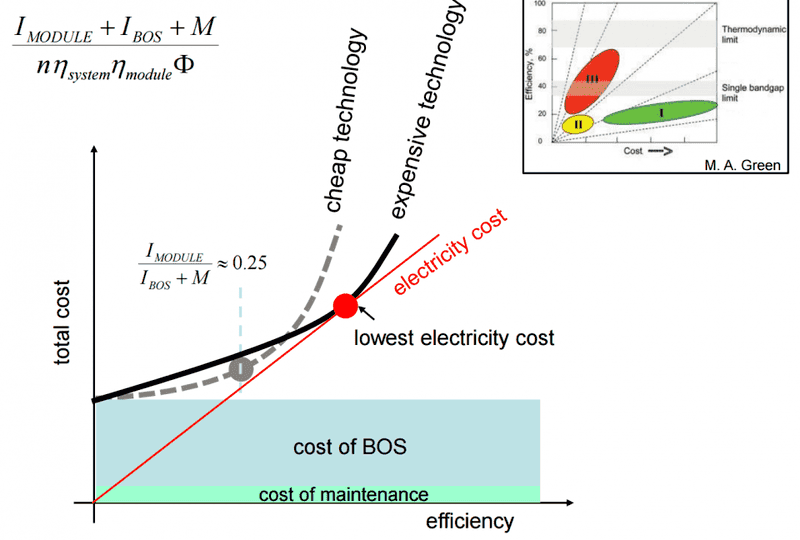
I'm having trouble understanding the effect of efficiency on the cost of electricity for a PV system.

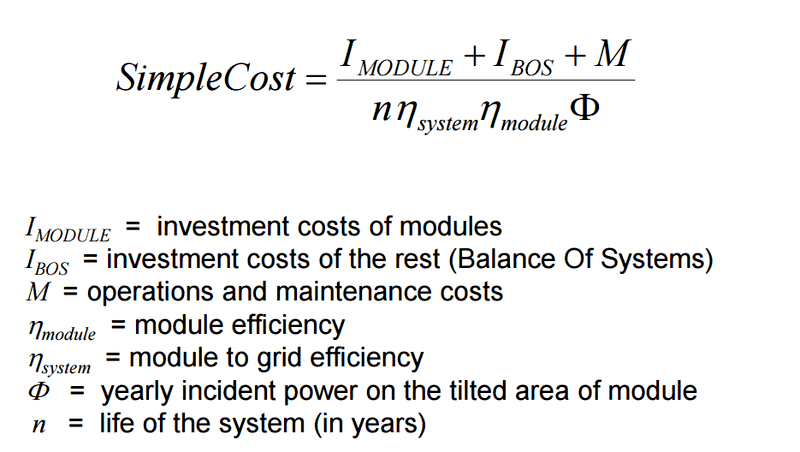
By the graph I've uploaded, as the efficiency of a PV system goes up, the cost of electricity goes up. But the equation in the other photo has efficiency in the denominator of the equation, meaning that when efficiency increases, the cost of electricity decreases, assuming investment and maintenance costs stay the same.

I'm intuitively thinking that as efficiency increases electricity prices also increase. Is my problem that I'm assuming investment and maintenance costs stay the same? I would assume that a more efficient system costs more to make as it uses more materials and more labor.
COE.png
COE2.png
COE.png
COE2.png
 
Engineering news on Phys.org
says said:
By the graph I've uploaded, as the efficiency of a PV system goes up, the cost of electricity goes up.
Which graph? In general that statement is not true.
says said:
I'm intuitively thinking that as efficiency increases electricity prices also increase.
If you can produce more power for (nearly) the same price, cost per kWh goes down. At some point an increase in efficiency gets too expensive, so there is some ideal point, marked with a red dot in the total cost/efficiency plot.
 
They are trying to tell you that high efficiency systems cost more. Usually more money buys more quality, but it has nothing to do with physics.

I try to remember that solar panels are improving rapidly doubling in performance price ratio every three years of so. I plan to buy new panels in 2016 and to discard them as obsolete in 2019. Others may spend more today and plan to keep them for 20 years. Without a perfect crystal ball foreseeing the future, nobody can say with certainty which plan is better.

Your cost per kwh depends on your assumption about the useful lifetime, and on the discount rate on money in your mind.

In the 1970s AT&T was still building phones designed to last for 45 years. At the time, most people thought that was optimum.
 
anorlunda said:
I plan to buy new panels in 2016 and to discard them as obsolete in 2019.
Do you really expect to get the cost of 2016 panels back in 3 years? Otherwise just wait. Installation costs are relevant as well.
 
  • Like
Likes   Reactions: CalcNerd
mfb said:
Do you really expect to get the cost of 2016 panels back in 3 years? Otherwise just wait. Installation costs are relevant as well.

It is not just cost. I am a sailor. I live on a boat. Where to put those darn things is a problem. This year I will replace three panels with one having slightly more watts. In three years, I want to replace that one with a smaller one.

The size of the panels is inconvenient and a hazzard to seaworthines of the vessel. Hurricane force winds or breaking waves can rip it loose and turn it into a projectile.

When I get down to 240 watts in 4 ##ft^2##, I'll stop upgrading.
 
Ah, on a boat replacing them makes more sense.

240 W in 0.37 m2 is ... optimistic. Even if they are exactly aligned with the sun (and I guess they are not) that still needs an efficiency above 50%, something that has been demonstrated in a lab but not in realistic conditions.
 
anorlunda said:
When I get down to 240 watts in 4 ft2 , I'll stop upgrading.
64% efficient ? I'd settle for that !
 
  • Like
Likes   Reactions: dlgoff
I doubt the efficiency of a PV panel will improve much in three years. There is probably a greater difference between types/makes of panel available today.
 

Similar threads

Replies
9
Views
3K
Replies
15
Views
2K
  • · Replies 10 ·
Replies
10
Views
3K
Replies
7
Views
8K
Replies
35
Views
8K
  • · Replies 41 ·
2
Replies
41
Views
8K
  • · Replies 32 ·
2
Replies
32
Views
3K
Replies
3
Views
2K
  • · Replies 6 ·
Replies
6
Views
2K
Replies
12
Views
2K