What is the formula for calculating RPM of a gear with a known force?

  • Context: High School 
  • Thread starter Thread starter Maximusflash
  • Start date Start date
  • Tags Tags
    Force Gear Rpm
Click For Summary

Discussion Overview

The discussion revolves around calculating the RPM of a gear or pulley system when a known force is applied. Participants explore the relationship between force, torque, RPM, and the effects of resistance factors such as friction and power output. The conversation includes theoretical considerations and practical implications related to gears, pulleys, and generators.

Discussion Character

  • Exploratory, Technical explanation, Debate/contested, Mathematical reasoning

Main Points Raised

  • One participant inquires about calculating the RPM of a gear when a constant force is applied, noting the importance of torque and gear radius.
  • Another participant argues that without accounting for friction and resistance, the gear would theoretically spin indefinitely, highlighting the need for additional information to calculate a maximum RPM.
  • Some participants mention that the ability to maintain a constant force is limited by the power available from the engine or source, such as a wind turbine.
  • A participant suggests that the formula for power, expressed as Power = Torque x Angular Velocity, should be considered in the context of this problem.
  • There is discussion about how torque and RPM are interdependent, with one participant proposing that higher torque would lead to lower RPM under certain conditions.
  • Another participant attempts to derive a formula for RPM based on power and torque, expressing confusion about the relationships between these variables.
  • Participants discuss the implications of resistance and how it affects the RPM, with one noting that increasing torque could lead to a decrease in RPM if power output is fixed.

Areas of Agreement / Disagreement

Participants generally agree that additional factors such as friction, resistance, and power output are crucial for accurately calculating RPM. However, there is no consensus on how to approach the problem or the relationships between the variables involved.

Contextual Notes

Limitations include the lack of specific values for friction and resistance, as well as the dependence on the definitions of power and torque in the context of the discussion. The conversation reflects a range of assumptions and conditions that affect the calculations.

Maximusflash
Hey guys

I do apologize in advance for any errors or misunderstandings in my question, been that english is not my native language.

I was wondering how to calculate the RPM of a gear (or a wheel) applied with a known force. I'm guessing I'm not using the correct terminologies using Google, because I seem to not find exactly what I'm looking for.
upload_2017-8-9_14-19-14.png


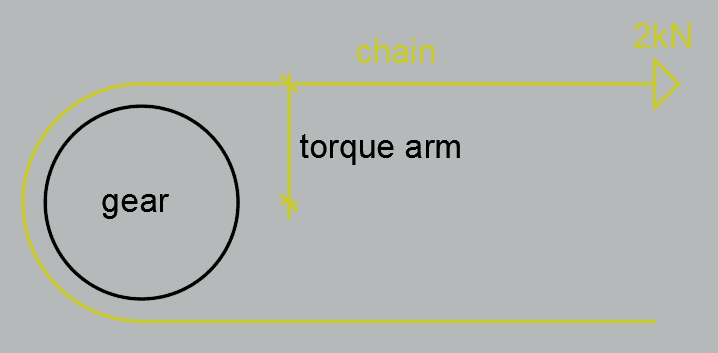
Let's say you have some sort of pulley system or a bike gear for that matter. If one where to apply a constant force of f.ex 2kN to this pulley: what RPM will the gear have? It will of course be relative to the radius of the gear, which again will be important for the torque. So for the sake of calculating with numbers, let's say the gear is 1m across, making the radius 0.5m. So toques is 2kN x 0.5m = 1kNm.
But I can't seem to figure out how to calculate the RPM of the gear.

Anyone who can push me in the right direction?
 
Physics news on Phys.org
You can't find how to calculate the RPM because there is no way to calculate the RPM here.

If the only torque on the gear is from a constant force on the chain, then the gear will keep on spinning faster and faster; the longer you watch it the faster the gear will turn, without limit. This is the situation you've described here.

Of course we never see gears behave this way, so we know we've left something out of the description. What is the friction in the shaft of the gear? That friction is acting to slow the gear down, and there is some RPM at which the torque from the friction will be enough to exactly cancel the torque from the chain; that will be the maximum RPM. But we can't calculate that until we know what the torque from the friction is as a function of the RPM, and you haven't included that in the problem.
 
@Nugatory has mentioned friction. That is the limiting factor in many cases. There is another limiting factor. That is the ability of the engine or bicyclist to supply a constant force when the chain velocity becomes very large.

Unlimited speed with a constant force requires unlimited power.
 
Thanks for the replies!

Of course.. I now understand that my description is lacking some factors. 15 years off the school bench seems to much.

Let us go back and add some information. A pulley would have the weight of an object to hold it back (and friction), and a bicycle the total mass (and drag,friction..)

If we were to add a generator to the equation: Let's say that the permanent force on the chain is generated from a windturbine (knowing that the math to find the force on the blade to make it turn is simplified to a x-kN.) I just googled to find a generator with specs and came across something like: 20kw generator needs 250rpm and 650Nm to provide 26A. This would then be the resistance?
The pulley we played with earlier gave 1kNm with the gear being 1m across. Neglecting a need for a higher spike power to start the rotation; would the gear be able to provide the necessary RPM along with the torque? Now Torque and speed are some what of depended of each other. Higher torque in a bigger gear will give a slower RPM, and vica versa. So the equation I guess would either need more force to be able to meet the criteria or less resistance.
But how would you go along with finding RPM on a gear? Torque being the easier..
Or for the bike: we could have put a dynamo to the wheel, but I couldn't really find the information needed.
 
Maximusflash said:
would the gear be able to provide the necessary RPM along with the torque?

Still not enough information to answer that. You need to know the power output of the wind turbine.

Your diagram shows a force acting on a pulley. A force is not power. A book sitting on a shelf applies a force to the shelf without generating any power.
 
I think the formula
Power = Torque X Angular Velocity should be borne in mind.
It's the rotational equivalent of
Power = Force times Speed (in the direction of the force)
Real motors and engines have limits to their speed range and the optimum power and torque out can be at various different revs, depending on the technology.
 
  • Like
Likes   Reactions: Maximusflash
Seems as it's back to the drawing board to redefine the question/problem. I've been thinking that either my translation is making me use wrong terminology, or as pointed out: something is missing from the "easy" equation.
My original thought was that if a force was applied to a circular gear, one would be able to figure out the rotational time, or RPM. This pans out to be impossible due to the lack of input. The idea that the force would give the gear torque depending on the position and orientation of the force, and that one could calculate the RPM knowing the circumference. From what I have learned here now, that force or torque would give the gear unlimited speed due to the lack of resistance.

Not finding any data on a cycle dynamo, I bumped it up to a generator. It could of course be a giant on a cycle, but let's say it is driven by water/wind/manpower.

upload_2017-8-10_12-29-38.png


Maybe I need to turn things around to be able to calculate what force is necessary to provide a given resistance (generator) with the given specs. My first toughs are that if the generator is supplied with 650Nm at 250rpm, it will generate electricity. Now, 250rpm is pretty fast so this will need to be geared down. But do I need to assume an rpm for the input (top gear) to be able to find the required torque/force? To half the rpm one would need to increse the torque by a factor of 2. A larger wind turbine usually operates at 12-15rpm, but with large torque due to the wings.
So I would think that rotation would indeed depend on resistance, but how would one go about finding the input force to make this configuration work?
If I were to assume rpm: let's say 30rpm, needed torque would be 250/30 = 12.5 reduction factor. 650Nm x 12.5 = 8.125kNm.
(now on thin ice) an applied force of 8.125kN 1.0m from the center of the gear (then being 2.0m across) would give the torque, but would it give 30rpm?

Or would I need to use Power = Torque X Angular Velocity to find the rpm?
Power been Watt
Torque Nm
and Angular Velocity ω (rad/s) converted to π x rpm/30
So for the generator Power (17kw) = 650Nm x π x 250/30 = 17kw, seems fair.
For the gear: 17kw = 8125Nm x π x rpm/30 => 20rpm?

Pretty sure I got something mixed up here...
 
Maximusflash said:
Or would I need to use Power = Torque X Angular Velocity to find the rpm?
Power been Watt
Torque Nm
and Angular Velocity ω (rad/s) converted to π x rpm/30
So for the generator Power (17kw) = 650Nm x π x 250/30 = 17kw, seems fair.
For the gear: 17kw = 8125Nm x π x rpm/30 => 20rpm?
That looks entirely correct.
 
  • Like
Likes   Reactions: Maximusflash
Hmm.. been thinking about this for a couple of days:

If Power = Torque x Angular Velocity is "converted" to find RPM as I did above, that gives:
W = Nm x π x rpm/30

Solve for rpm gives:
rpm = W x 30 / (Nm x π)

In my mind (without overthinking) if one were to apply more torque, you should get more rpm (more force to the system). And reducing resistance should also give more rpm
But by the formula: More W (resistance?) gives more rmp, and more torque gives less rpm.

What I am I missing?
 
  • #10
Maximusflash said:
Hmm.. been thinking about this for a couple of days:
Solve for rpm gives:
rpm = W x 30 / (Nm x π)

In my mind (without overthinking) if one were to apply more torque, you should get more rpm (more force to the system). And reducing resistance should also give more rpm
But by the formula: More W (resistance?) gives more rmp, and more torque gives less rpm.

What I am I missing?
You have chosen to use the symbol "W" to represent power (in Watts). That's the rate of energy production per unit time. It is not "resistance".

Yes, if you apply more torque and, as a result, get more rpm then you will get more power output. But if you assume that the output power is fixed then you must also have changed out the generator design (e.g. used a higher gear ratio) so that the input RPM decreased in proportion to the input torque increase.
 
  • Like
Likes   Reactions: russ_watters, sophiecentaur and Maximusflash
  • #11
Ok, I think I understand. Thank you for the quick followup!
 
  • #12
Maximusflash said:
In my mind (without overthinking) if one were to apply more torque, you should get more rpm (more force to the system). And reducing resistance should also give more rpm
But by the formula: More W (resistance?) gives more rmp, and more torque gives less rpm.

What I am I missing?
The principle (which is based on the conservation of energy) is that whatever power ##P## you produce at the input will be transferred at the output or:
$$P_{in} = P_{out}$$
Or, from the opposite point of view, if you determine that the output power you need is X watts, then you also need to produce X watts of power at the input.

So, if you need an output that produces 500 N.m of torque @ 100 rad/s, you know that this represents 50 kW of power. Therefore, your input source must produce 50 kW of power. But it doesn't have to be 500 N.m @ 100 rad/s, it could be, say, 50 N.m @ 1000 rad/s or 1000 N.m @ 50 rad/s. It doesn't even have to be mechanical, it could be an electrical source that produces 208 A @ 240 V, which is also 50 kW.

So identify clearly the power requirement of your system (more torque = more power; more rpm = more power). Then, you know that whatever power gets out, it must comes in somehow.
 
  • Like
Likes   Reactions: Maximusflash
  • #13
What Jack says is true, assuming 100% conversion efficiency which is itself never true. What he says is a good place to start, but you will have to allow for losses if you want to have realistic results.
 
  • Like
Likes   Reactions: Maximusflash and russ_watters
  • #14
Thank you jack for the clarifying answer. From what I have read this is how windturbines work (in general): large amount of torque, slow rpm => geared down to fast rpm for a smaller generator. And of course Dr.D there are losses in a system, in all connections and gears and drag...
Thank you for all of the answers!
 

Similar threads

  • · Replies 4 ·
Replies
4
Views
4K
  • · Replies 4 ·
Replies
4
Views
2K
  • · Replies 6 ·
Replies
6
Views
8K
  • · Replies 27 ·
Replies
27
Views
22K
  • · Replies 19 ·
Replies
19
Views
10K
  • · Replies 60 ·
3
Replies
60
Views
7K
  • · Replies 2 ·
Replies
2
Views
2K
  • · Replies 6 ·
Replies
6
Views
16K
  • · Replies 3 ·
Replies
3
Views
4K
  • · Replies 66 ·
3
Replies
66
Views
6K