What is the magnetic field off-axis in the y direction?

Click For Summary

Discussion Overview

The discussion revolves around calculating the magnetic field off-axis in the y direction, specifically in relation to a circular current loop. Participants explore various methods and formulas, including elliptic integrals and axial formulas, to determine the magnetic field components.

Discussion Character

  • Exploratory
  • Technical explanation
  • Mathematical reasoning

Main Points Raised

  • One participant reports using C++ software and a calculator for elliptic integrals but finds the calculated Br smaller than Bx, leading to confusion about calculating By.
  • Another participant questions the formula used and suggests verifying the implementation by calculating manually with elliptic integral tables.
  • A participant clarifies that Br is not the diagonal but the vertical axis, indicating a potential misunderstanding in the diagram.
  • One participant mentions testing the axial formula and finding it satisfactory, while also noting an error in the C++ program related to negative radii.
  • A participant shares results from testing a long radii loop, reporting high accuracy in the magnetic field measurement close to the wire.

Areas of Agreement / Disagreement

Participants express differing views on the interpretation of the magnetic field components and the correctness of the calculations. There is no consensus on the best approach or the accuracy of the results.

Contextual Notes

Some assumptions regarding the definitions of the magnetic field components may be missing, and there are unresolved mathematical steps related to the implementation of the C++ program.

Who May Find This Useful

Individuals interested in magnetic field calculations, particularly in the context of circular current loops and the application of elliptic integrals.

Javier Lopez
Messages
74
Reaction score
3
I used the following links:
C++ software using elliptics integral at: https://tiggerntatie.github.io/emagnet/offaxis/elliptic_c.htm
And the calculator here: https://tiggerntatie.github.io/emagnet/offaxis/iloopcalculator.htm
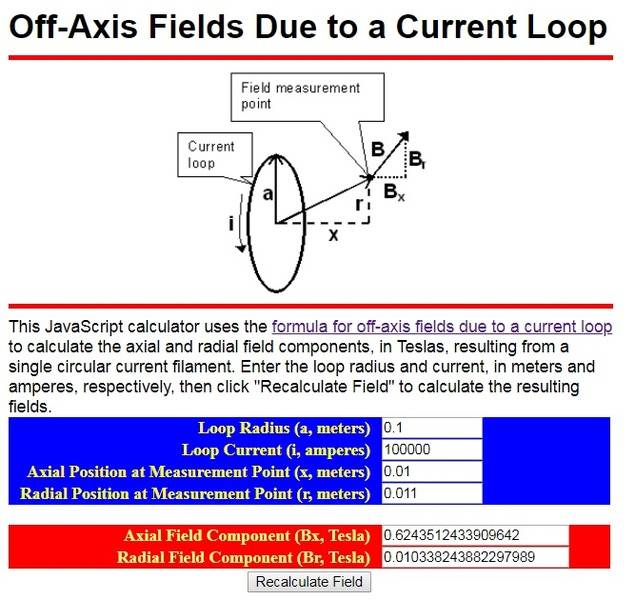
I placed some values and obtained Br smaller than Bx, so I do not know how to calculate By (perpendicular to the axis) unless it is imaginary :) :
qxklsi.jpg
 

Attachments

  • qxklsi.jpg
    qxklsi.jpg
    62.7 KB · Views: 782
Physics news on Phys.org
What formula did you try to implement?

Have you tried calculating manually (elliptic integral tables are available for download) to see if the implementation is correct?

If your diagram is correctly labelled, ##B_r^2=B_y^2+B_z^2##, so I don't understand why you regard ##B_r<B_x## as a problem anyway.
 
  • Like
Likes   Reactions: Javier Lopez
Ok, I understand, you say that Br is not the diagonal but the vertical axel, then I can test using on axis formula, also the elliptics.
 
Last edited:
Javier Lopez said:
Ok, I understand, you say that Br is not the diagonal but the vertical axle, then I can test using on axis formula, also the elliptics.
##B_r## is radial, which happens to be vertical in the diagram, yes.
 
Thank you.
I tested it using axial formula and was OK, but I found an error in the c++ program: if r<0 then the loop not finalizes, so I wote an "if" at the begin that if r<0 r=-r and a flag is activated to make Bz=-Bz at the end
 
I tested also making a long radii loop and measuring close to the wire (that is the worse case) to check again field close to a long wire.
I stated at the result an incredible accuracy:
At 1mm of a long wire it is expected to have 2.2 Teslas
Loop Radii: 5 meters
At x,r= 5.001,0 Bx=-2.19766907587031
At x,r= 5.0, 0.001 gives Br = 2.19999969
 

Similar threads

  • · Replies 1 ·
Replies
1
Views
2K
  • · Replies 15 ·
Replies
15
Views
3K
  • · Replies 1 ·
Replies
1
Views
2K
  • · Replies 19 ·
Replies
19
Views
2K
  • · Replies 2 ·
Replies
2
Views
2K
  • · Replies 3 ·
Replies
3
Views
1K
  • · Replies 3 ·
Replies
3
Views
1K
  • · Replies 1 ·
Replies
1
Views
9K
  • · Replies 2 ·
Replies
2
Views
2K
  • · Replies 2 ·
Replies
2
Views
3K