What is the Maximum Power Transfer Theorem?

Join the discussion
Ask a follow-up here, or get your own question answered by working scientists, mathematicians and engineers — people, not an autocomplete.
Real named experts · corrections over time · the nuance an AI answer skips
5 replies · 2K views
anand raj
Messages
17
Reaction score
0
1. Homework Statement
A voltage source of 240 v having an internal impedance of (3-j4) ohm, is supplying power to a complex load impedance Z1. What will be the maximum power transferred to load?


2. Homework Equations


3. The Attempt at a Solution
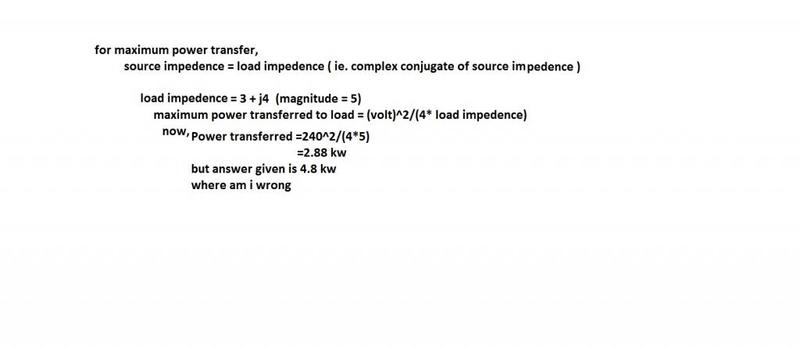
Untitled123_zps7c59c2fa.jpg
 
Physics news on Phys.org
You want to look at the real power delivered to the load. So you don't want to incorporate the imaginary parts of the impedances and use the magnitude.

One quick & dirty shortcut here is that since the two impedances are in series and are complex conjugates, their sum is purely real and comprised of two equal pieces; only the two real components are "seen" by the source since the complex bits cancel. That makes it dead easy to calculate the current and voltage across the load...
 
Since you haven't defined the load impedance numerically, the problem has no solution.

If the load impedance is the complex conjugate of the source impedance then gneill has given you a good hint.
 
anand raj said:
A voltage source of 240 v having an internal impedance of (3-j4) ohm, is supplying power to a complex load impedance Z1. What will be the maximum power transferred to load?
With the load connected, what is the total circuit impedance?

With the load connected, what will be the magnitude of the current?