Discussion Overview
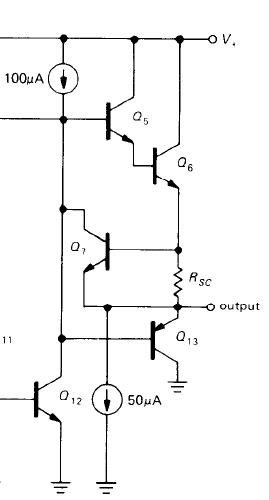
The discussion revolves around the output stage of the 324 operational amplifier, focusing on its design and functionality. Participants explore the specifics of the output stage circuitry, including the role of various transistors and current limiting features.
Discussion Character
- Technical explanation, Conceptual clarification, Debate/contested
Main Points Raised
- One participant expresses confusion regarding the output stage of the 324 op-amp, specifically questioning whether it employs a complementary symmetry Darlington configuration.
- Another participant notes that if the voltage drop across Rsc reaches approximately 0.6 volts, a transistor (Q1) will start limiting the output source current.
- A subsequent reply confirms that the output stage does indeed utilize a complementary symmetry Darlington configuration, stating that Q13 will conduct only if there is a path from its base to ground, which is provided by Q12.
- Further elaboration is provided on the function of Q7, indicating that it acts as a current limiter that activates when the voltage drop across Rsc exceeds 0.6 volts, thereby affecting the current flow through other transistors (Q5 and Q6).
Areas of Agreement / Disagreement
Participants present multiple viewpoints regarding the output stage's design and operation, with some agreeing on the presence of a complementary symmetry Darlington configuration while others focus on the specifics of the current limiting mechanism. The discussion does not reach a consensus on all aspects.
Contextual Notes
Some assumptions regarding the operation of the transistors and the specific voltage thresholds are mentioned but not fully explored, leaving certain details unresolved.