What is the period of a book swinging like a pendulum?

Click For Summary

Homework Help Overview

The discussion revolves around calculating the period of a book swinging like a pendulum, with specific dimensions provided (28 cm and 19 cm). The original poster attempts to apply formulas related to moments of inertia and the period of pendulum motion, but reports multiple incorrect results.

Discussion Character

  • Exploratory, Assumption checking, Mathematical reasoning

Approaches and Questions Raised

  • Participants discuss various formulas for moments of inertia, including those for different axes of rotation. There are attempts to calculate the period using different inertia equations and the parallel axis theorem. Questions arise regarding the appropriateness of the formulas used and the assumptions about the book's rotation.

Discussion Status

Several participants have pointed out potential errors in the original poster's calculations and assumptions regarding the moment of inertia. There is ongoing exploration of the correct approach, with references to the parallel axis theorem and the modeling of the book as a simple pendulum. No consensus has been reached on the correct method or result.

Contextual Notes

Participants are navigating the complexities of applying the parallel axis theorem and the implications of mass distribution on the period of the pendulum. There is mention of differing results from other sources, highlighting the uncertainty in the calculations being discussed.

jellyman
Messages
4
Reaction score
0
1. In the figure below, a book is suspended at one corner so that it can swing like a pendulum parallel to its plane. The edge lengths along the book face are 28 cm and 19 cm. If the angle through which it swings is only a few degrees, what is the period of the motion?
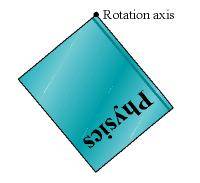
W0358-N.jpg


2. I=(ML^2)/12
I=(ML^2)/3
T=2∏√I/M*G*dcom


3. I got dcom by using the distance formula and it's .1692 m
Then I tried to using both inertia equations and using length, width. Then I plugged in all the numbers. (multiple attempts)

All wrong answers (.788s, .394s, 1.062s)


Appreciate your help! :)

.
 
Physics news on Phys.org
You don't have the right moments of inertia.
 
Oh.

Then that leaves me with I= M(a2 + b2)/12.

That gave me a period of .476 second which has been marked wrong.
 
Yep - that's the wrong moment of inertia as well.
That is for an oblong rotating about it's center.

You book is not rotating about it's center - otherwise it could not act as a pendulum.

Look up: parallel axis theorem.
 
debad27da7daea89152bd3c7b5d34dd7.png


I|| = \frac{1}{12}Mdcom2 + Mdcom2

This doesn't make sense though because it leaves me with an M on the top in the equation for T.EDIT: I asked somewhere else and they used T = 2π√[L/g] and got .83 seconds. This doesn't sound quite right. It's too easy this way!
 
Last edited:
$$I_{CM}=\frac{M}{12}(a^2+b^2)$$
##r## is the distance from the corner to the center of the book; by pythagoras: $$r^2=\frac{a^2}{4}+\frac{b^2}{4}$$... therefore, by the parallel axis theorem: $$I=I_{CM}+Mr^2=\cdots$$... you finish up.
 
EDIT: I asked somewhere else and they used T = 2π√[L/g] and got .83 seconds. This doesn't sound quite right. It's too easy this way!
That would be pretty normal ... he's modeled the book as a simple pendulum.

For a simple pendulum ##I=ML^2## ... completing the calculations above will tell you how taking the mass distribution into account affects the period.
http://en.wikipedia.org/wiki/Pendulum_(mathematics)#Compound_pendulum
 

Similar threads

  • · Replies 7 ·
Replies
7
Views
4K
  • · Replies 9 ·
Replies
9
Views
3K
  • · Replies 20 ·
Replies
20
Views
2K
Replies
17
Views
1K
  • · Replies 8 ·
Replies
8
Views
3K
  • · Replies 7 ·
Replies
7
Views
5K
Replies
3
Views
2K
Replies
73
Views
5K
  • · Replies 1 ·
Replies
1
Views
1K
  • · Replies 15 ·
Replies
15
Views
2K