What is the significance of 'i' in quantum computation notation?

Click For Summary
SUMMARY

The letter 'i' in quantum computation notation represents the imaginary unit, defined as the square root of -1. In the context of quantum states, it appears in column vector notation, specifically in the vector [1, i], where '1' is the coefficient for the basis vector |0⟩ and 'i' is the coefficient for the basis vector |1⟩. Understanding complex numbers is essential for grasping quantum mechanics, as they are foundational to the representation of quantum states.

PREREQUISITES
  • Complex numbers and their properties
  • Quantum state representation in vector spaces
  • Understanding of basis vectors in quantum mechanics
  • Familiarity with column vector notation
NEXT STEPS
  • Study the fundamentals of complex numbers and their applications in quantum mechanics
  • Learn about quantum state representation and the significance of basis vectors |0⟩ and |1⟩
  • Explore column vector notation and its use in quantum computing
  • Investigate the role of normalization factors in quantum state vectors
USEFUL FOR

Beginners in quantum computation, students studying quantum mechanics, and anyone interested in the mathematical foundations of quantum states.

Quark Effect
Messages
9
Reaction score
4
TL;DR
The meaning of notation 'i'?
Hi guys, I am currently having some difficulties with this quantum state. I don't entirely understand what that letter 'i' means, where it comes from and why it appears in brackets [1, i]. Shouldn't there be a '0' instead?
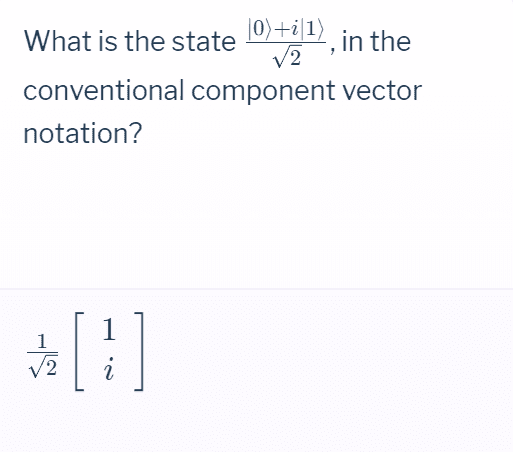
Formula q.png

I am an absolute beginner in quantum computation. I've been following a tutorial for beginners while this quantum state appeared with the letter 'i' and there's no further explanation where it comes from and what it means.
 
Physics news on Phys.org
Quark Effect said:
I don't entirely understand what that letter 'i' means

It's the square root of ##-1##.
 
  • Like
Likes   Reactions: Quark Effect
Quark Effect said:
I am an absolute beginner

Thread level changed to "B" accordingly.
 
You'll need to know complex numbers for everything in quantum mechanics.
 
  • Like
Likes   Reactions: Quark Effect
PeterDonis said:
It's the square root of ##-1##.
mfb said:
You'll need to know complex numbers for everything in quantum mechanics.
Thanks a lot!
 
Quark Effect said:
why it appears in brackets [1, i]. Shouldn't there be a '0' instead?

No. What you have shown is column vector notation. You have a vector space with two basis vectors, ##|0\rangle## and ##|1\rangle##. The upper number in the column vector is the ##|0\rangle## component of the vector and the lower number is the ##|1\rangle## component. The image you showed has factored out the common ##1 / \sqrt{2}## factor, so that leaves ##\begin{bmatrix} 1 \\ i \end{bmatrix}## since the coefficient in front of ##|0\rangle## is ##1## and the coefficient in front of ##|1\rangle## is ##i##.
 
  • Like
Likes   Reactions: Quark Effect
PeterDonis said:
No. What you have shown is column vector notation. You have a vector space with two basis vectors, ##|0\rangle## and ##|1\rangle##. The upper number in the column vector is the ##|0\rangle## component of the vector and the lower number is the ##|1\rangle## component. The image you showed has factored out the common ##1 / \sqrt{2}## factor, so that leaves ##\begin{bmatrix} 1 \\ i \end{bmatrix}## since the coefficient in front of ##|0\rangle## is ##1## and the coefficient in front of ##|1\rangle## is ##i##.
Finally understood it. Thanks a lot man!
 
Quark Effect said:
Thanks a lot man!

You're welcome!
 

Similar threads

  • · Replies 4 ·
Replies
4
Views
1K
  • · Replies 2 ·
Replies
2
Views
2K
  • · Replies 14 ·
Replies
14
Views
3K
  • · Replies 3 ·
Replies
3
Views
2K
  • · Replies 8 ·
Replies
8
Views
3K
  • · Replies 8 ·
Replies
8
Views
2K
  • · Replies 2 ·
Replies
2
Views
2K
  • · Replies 11 ·
Replies
11
Views
3K
  • · Replies 2 ·
Replies
2
Views
1K
  • · Replies 4 ·
Replies
4
Views
7K