What part of momentum moves the boat in the inclined plane paradox experiment?

Click For Summary

Discussion Overview

The discussion revolves around the mechanics of momentum in the context of a cannon firing on a boat positioned on an inclined plane. Participants explore how momentum is distributed between different vectors and its implications for the movement of the boat, considering both ideal and non-ideal scenarios.

Discussion Character

  • Exploratory
  • Technical explanation
  • Debate/contested

Main Points Raised

  • Some participants question how momentum is divided when a cannonball is fired, specifically what part of the momentum affects the boat's movement.
  • There is a suggestion that the force can be distributed in two different vectors, with some arguing that only half of the force acts in the horizontal direction.
  • One participant proposes that firing the cannon results in the boat moving left while the cannonball moves right, indicating a non-ideal scenario where the boat continues to move left due to air resistance.
  • Another participant emphasizes the importance of precision in discussing momentum, noting that momentum is conserved in both horizontal and vertical directions separately.
  • Questions are raised about the effects of replacing a flat plane with an inclined plane and whether this would change the indications on a balance scale used in the experiment.
  • There is a discussion about the distinction between force and impulse, with one participant suggesting that less vertical momentum leads to less impulse and maximum force.
  • Concerns are expressed about the misunderstanding of momentum as a scalar quantity, with a clarification that momentum is a vector and can change direction upon collision with an inclined plane.

Areas of Agreement / Disagreement

Participants express differing views on how momentum is distributed and its effects on the boat's movement. There is no consensus on the implications of the cannon firing or the effects of the inclined plane on momentum transfer.

Contextual Notes

Some participants highlight the need for clarity regarding the definitions of force, impulse, and momentum, as well as the external forces acting on the system, such as gravity and air resistance. The discussion remains unresolved regarding the specific outcomes of the proposed experiments.

migyonne
Messages
8
Reaction score
0
Hello and thank you for welcoming me to your forum!
To get started, I would like to give you a little help:
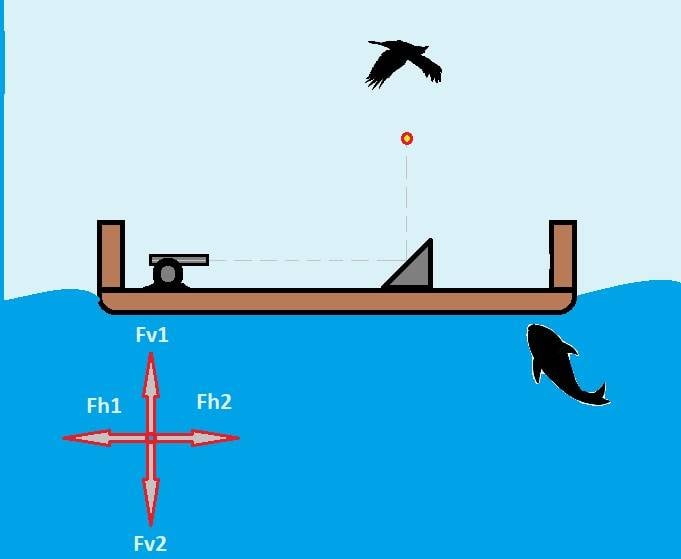
In the pattern experiment, when firing the cannon,
if part of the momentum reaches the bird,
and if another part of the momentum manages to stun the fish,
what part of the momentum would be likely to make the boat move?

It seems that there is no example on the internet... nor in physical science books...
action22.jpg
 
Physics news on Phys.org
:welcome:

Is this problem troubling you?
 
Why does the bird fly upside-down?

The boat moves left when you fire the cannon.
The boat stops when the ball hits the inclined plane.
The momentum is then divided in two, half down among the fishes, half up to the birds.
 
  • Like
  • Haha
Likes   Reactions: Juanda, russ_watters and PeroK
Thank you for your answer. So you deduce that no part of force moves the boat to the right?
 
Let's say that many people do not admit that a force can be distributed in 2 different vectors...
More precisely, there is only half of the force which presses in the horizontal vector. Do you agree with this deduction?
 
migyonne said:
Let's say that many people do not admit that a force can be distributed in 2 different vectors...
More precisely, there is only half of the force which presses in the horizontal vector. Do you agree with this deduction?
Force, impulse and momentum are vectors. Whether everyone accepts this is not a question of physics.

You can use conservation of linear and angular momentum to analyse the above problem. Note, however, that gravity and the water provide external forces to the system of boat + cannonball.
 
migyonne said:
So you deduce that no part of force moves the boat to the right?
Ideally, the force of firing the ball from the cannon will be exactly cancelled by the later deflection of the ball. Each time the cannon is fired, the boat will step to the left a small distance, while the ball is moving horizontally to the right.

Non-ideally, the powder used to fire the cannon will accelerate the boat to the left, but will be absorbed by the air over the boat, not deflected, causing the boat to continue very slowly to the left, while the air moves slowly to the right. If the duck is hit by the cannonball, while it is flying upside down, it will quack up.
 
  • Haha
Likes   Reactions: phinds
In my idea, if the ball hits a straight plane, the boat does not move. here, one half makes it move to the left since the other half goes in a vertical vector (up and down)... the total momentum is however preserved... do you agree with that?
 
migyonne said:
In my idea, if the ball hits a straight plane, the boat does not move. here, one half makes it move to the left since the other half goes in a vertical vector (up and down)... the total momentum is however preserved... do you agree with that?
You need to be more precise. Note that momentum is conserved in each direction separately. In this case, both horizontal and vertical momentum are conserved.

PS it's not some overall magnitude of momentum that is conserved.
 
  • #10
Indeed, I have to be more precise but also very careful.
In this image, do you think:

We replace the flat plane with an inclined plane as shown on BalanceB.

-If we do this experiment, will BalanceB display the same indication?
-If we place a test tube as indicated, will this test tube receive an impulse (red arrow)?
-Is there still part of the vertical momentum in this horizontal vector?
(Question 1 is the most important)
Balances base3.jpg
 
  • #11
migyonne said:
Indeed, I have to be more precise but also very careful.
In this image, do you think:

We replace the flat plane with an inclined plane as shown on BalanceB.

-If we do this experiment, will BalanceB display the same indication?
-If we place a test tube as indicated, will this test tube receive an impulse (red arrow)?
-Is there still part of the vertical momentum in this horizontal vector?
(Question 1 is the most important)View attachment 336126
You are also confusing force with impulse, which is force over time. In the second case, there is less change in momentum in the vertical direction, so less impulse. This may lead to less maximum force.

However, the change in horizontal momentum means that there is a torque on the scales, so you would need to analyse the reaction force for this as well.

In any case, what shows on each scale will be a variable force.
 
  • Like
Likes   Reactions: Ibix
  • #12
PS in either case vertical momentum is transmitted ultimately to the Earth. In the second case, horizontal momentum is also transmitted to the Earth. In both cases, its the Earth that ultimately provides an external force that changes the momentum of the object. Note in particular that a ball bouncing elestically off the ground does not show conservation of momentum. In this scenario (like your diagram on the left), the direction of the vertical momentum is changed and this represents a change in momentum.

I think your mistake is to see momentum as some sort of "scalar" quatity that there is only so much of. It's not like energy. Momentum is a vector. In a collision with an inclined plane there is an external horizontal impulse on the object that results in horizontal momentum. Likewise, there may be a vertical impulse that reduces the vertical momentum to zero.
 
  • #13
@migyonne PF is not for discussion of personal projects.

The OP question has been answered. Thread closed.
 

Similar threads

  • · Replies 1 ·
Replies
1
Views
1K
  • · Replies 2 ·
Replies
2
Views
3K
  • · Replies 26 ·
Replies
26
Views
7K
  • · Replies 24 ·
Replies
24
Views
4K
  • · Replies 8 ·
Replies
8
Views
2K
  • · Replies 21 ·
Replies
21
Views
3K
  • · Replies 4 ·
Replies
4
Views
7K
  • · Replies 69 ·
3
Replies
69
Views
17K
  • · Replies 3 ·
Replies
3
Views
4K
  • · Replies 81 ·
3
Replies
81
Views
7K