What Should I Look at to Find Vce(sat) for PN2222A Transistor?

  • Thread starter Thread starter Genji Shimada
  • Start date Start date
  • Tags Tags
    Transistor
Click For Summary

Discussion Overview

The discussion centers around the expected saturation voltage (Vce(sat)) for the PN2222A bipolar transistor, particularly in relation to different collector currents (Ic) and base currents (Ib). Participants explore how to interpret datasheet values and graphs to estimate Vce(sat) for specific applications, considering both typical and maximum values.

Discussion Character

  • Technical explanation
  • Debate/contested
  • Conceptual clarification

Main Points Raised

  • One participant notes a discrepancy between the datasheet's stated Vce(sat) of about 0.3 volts at Ic/Ib=10 and the graph showing Vce(sat) not exceeding 0.2 volts at 500mA.
  • Another participant references a datasheet figure indicating typical values rather than maximum values for Vce(sat).
  • Some participants suggest that Vce(sat) can vary significantly depending on the application, with one proposing a typical value of around 0.2V for Ic<100mA and Ib=Ic/10.
  • There is mention of using a maximum value for critical applications, such as spacecraft design, where Vce(sat) might be assumed to be 0.3V for Ic<150mA and around 1V for Ic>200mA.
  • A later reply expresses gratitude for the clarification provided, indicating that the discussion was helpful.
  • One participant humorously remarks on the simplicity of the scenario, suggesting that the context is less complex than designing for larger systems.

Areas of Agreement / Disagreement

Participants do not reach a consensus on a single value for Vce(sat), as views vary based on application context and specific conditions. Multiple competing perspectives on how to approach the estimation of Vce(sat) remain present.

Contextual Notes

Limitations include the dependence on specific application requirements and the variability of Vce(sat) based on different operating conditions. The discussion highlights the need for careful consideration of datasheet values and application scenarios.

Genji Shimada
Messages
46
Reaction score
4
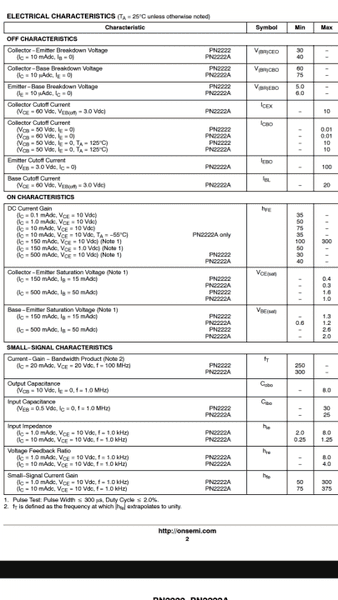
On this datasheet of PN2222A bipolar transistor
Screenshot_2016-08-14-21-06-06.png


it is said that Vcesat at Ic/Ib=10 is about 0,3volts. However in the Icollector vs Vcesat graph for the same transistor that I will be posting immediately after I post this thread cause I can't add one more image here, it is shown that Vce hardly even exceeds 0,2 volts at 500mAmps. And I am confused, what should I look at to find what value of Vcesat to expect at given collector current?
 

Attachments

  • Screenshot_2016-08-14-21-06-21.png
    Screenshot_2016-08-14-21-06-21.png
    24.8 KB · Views: 481
Engineering news on Phys.org
And here's the graph
Screenshot_2016-08-14-21-06-21.png
 
Jony130 said:
figure 11 show a typical values not the maximum one.
http://www.aoc.nrao.edu/~pharden/hobby/HG_DS1.pdf
https://www.physicsforums.com/threa...-gain-in-saturation-mode.865392/#post-5432159
Hmm, so if we look at this datasheet, the developers have tested the transistor under 150mA Ic and under 500mA Ic and have gotten 0,3volts Vcesat for 150mA and 1volt for 500mA. And how do you engineers do in such a case? Do you choose a value let's say close to Ic= 150mA and Ib=15mA and expect a Vcesat of about 0,3volts? I want to learn what to do in such cases, how to know roughly what Vcesat I will get at a given current.
Screenshot_2016-08-14-22-04-02.png
 
No single answer exist, It depends on an given application. Normally I assume that the Vce(sat) is around 0.2V for Ic<100mA and Ib = Ic/10 without even looking into data sheet. But for example if you build a single circuit just for hobby peruse you can use a typical value from figure 11. But if you want to design a circuit for a " spacecraft " then you must use a maximum value in your capitulations. For exampel you can assume Vce(sat) = 0.3V for Ic<150mA and Vce(sat) around 1V for Ic > 200mA.
 
  • Like
Likes   Reactions: Genji Shimada
Jony130 said:
No single answer exist, It depends on an given application. Normally I assume that the Vce(sat) is around 0.2V for Ic<100mA and Ib = Ic/10 without even looking into data sheet. But for example if you build a single circuit just for hobby peruse you can use a typical value from figure 11. But if you want to design a circuit for a " spacecraft " then you must use a maximum value in your capitulations. For exampel you can assume Vce(sat) = 0.3V for Ic<150mA and Vce(sat) around 1V for Ic > 200mA.
:D thanks, that helped a lot!
 
Jony130 said:
your capitulations

It's just one transistor. Not a whole robot army! :eek:?

BoB
 
  • Like
Likes   Reactions: Jony130 and Genji Shimada

Similar threads

Replies
2
Views
2K
Replies
68
Views
7K
  • · Replies 4 ·
Replies
4
Views
9K
  • · Replies 13 ·
Replies
13
Views
2K
  • · Replies 5 ·
Replies
5
Views
27K
Replies
3
Views
6K
  • · Replies 2 ·
Replies
2
Views
4K
  • · Replies 13 ·
Replies
13
Views
6K
Replies
3
Views
2K
  • · Replies 3 ·
Replies
3
Views
3K