Where did I go wrong in finding the length x using the grabber-statics example?

3 replies · 2K views · last reply
mrshlnnxfa
Messages
2
Reaction score
0
Hello,

We should get the length x , when the grabber can just hold the box.
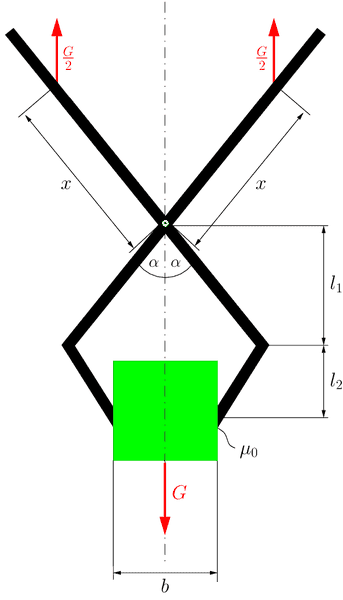
Diagram of a gripper with two crossed arms pivoting at a central joint, each arm carrying force G/2 upward, gripping a green box of weight G with friction coefficient mu0; lengths x, l1, l2, angle alpha and width b labelled.


I made two moment equations:

Equation M1 = G/(2μ) * sqrt((l1 + l2)^2 + (b/2)^2), with G over 2μ multiplying a square root of (l1 + l2) squared plus (b over 2) squared.


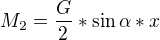
Handwritten equation: M2 = (G/2) * sin α * x, where G/2 is multiplied by sin α times x.


Then I put them together into one equation:
Equation M1 = M2 written as plain mathematics, showing two moment terms set equal to each other.


And from that equation I found out x:
Formula: x = csc α * sqrt(b^2 + 4(l1 + l2)^2) / (2μ)
Unfortunately the result seems to be wrong. Can you please help me? Where I made the mistake?
 
i think the frictional force balance the wight of the box.we have to give the normal force on the box that give rise to the friction by giving a torque to the grabber