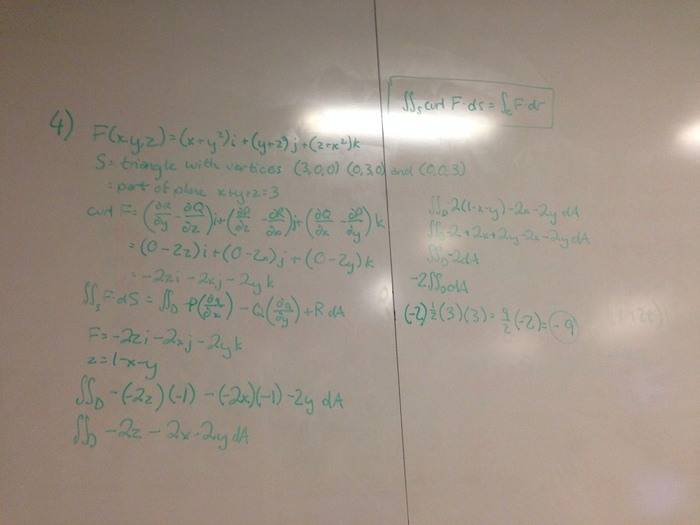
Where did I go wrong with my application of Stoke's Theorem?

Click For Summary

Homework Help Overview

The discussion revolves around the application of Stokes' Theorem in a multivariate calculus context. The original poster seeks assistance in identifying errors in their calculations related to a surface integral and a line integral involving a triangle defined by three points in space.

Discussion Character

  • Exploratory, Assumption checking, Problem interpretation

Approaches and Questions Raised

  • Participants discuss the geometry of the triangle, including the lengths of its sides and the normal vector to the plane. There are suggestions to verify calculations and to consider alternative methods of applying Stokes' Theorem, such as using surface integrals over different planes.

Discussion Status

Some participants have provided guidance on the geometric aspects of the problem and suggested alternative approaches. The original poster acknowledges a mistake in their calculations but does not detail the nature of the error, leaving the discussion open-ended.

Contextual Notes

The original poster's homework involves applying Stokes' Theorem, and there is an emphasis on ensuring the correctness of calculations and understanding the geometric setup of the problem.

Joosh
Messages
7
Reaction score
4
Hello again, everyone. Have a multivariate calculus question this time around. If anyone can point me in the right direction and help me see where WebAssign finds me wrong, it would be greatly appreciated.

1. Homework Statement

uENviZ0.png


Homework Equations


∫∫ScurlF ⋅ dS = ∫CF ⋅ dr

The Attempt at a Solution


h04n0dd.jpg
 
Physics news on Phys.org
Your picture is very difficult to read, but I solved it, and I think I can get you to the correct answer. This triangle has vertices at the 3 points, but what is the length of each side? (Hint: Each side does not have length 3). Also, this triangle lies in a plane. What is the unit vector ## \hat{n} ## normal to that plane? Be sure and properly normalize it. Now ## \nabla \times F \cdot \hat{n} ## is constant in the plane of the triangle, because the plane of the triangle has a simple equation (which you should be able to write out very quickly) and shows up in this ## \nabla \times F \cdot \hat{n} ## expression . (Please write out this equation for the plane of the triangle, so that it can be verified that you got it correct. It helps to see the calculations, and your picture is hard to read.) Finally, what is the height (altitude) of the equilateral triangle?, which you need to compute the area of the triangle, etc. Try again; I think you will be able to correct a mistake or two that you made.

 
Last edited:
Alternatively, this problem can be worked by performing the surface integral over the 3 perpendicular faces (in the xy plane, the xz plane, and yz plane) instead of integrating over the single plane of the triangle (containing the 3 points). I computed the calculation this way as well and got the same answer. (For this case, the three surface integrals are essentially equivalent, and it just takes a little effort to set up the limits on a single relatively simple 2-D integral.) For the surface integral side of Stokes theorem, so long as F(x,y,z) is a well-behaved function, I believe the surface used in the surface integral can be any well-defined surface whose perimeter involves the line integral. Perhaps one of the other readers can add to this, but I believe I have this concept correct.
 
I appreciate the pointers, Charles! However, I eventually figured what I did wrong. I simply made a mistake while plugging in my numbers.
 
  • Like
Likes   Reactions: Charles Link

Similar threads

  • · Replies 2 ·
Replies
2
Views
2K
  • · Replies 5 ·
Replies
5
Views
2K
  • · Replies 1 ·
Replies
1
Views
3K
  • · Replies 6 ·
Replies
6
Views
3K
Replies
6
Views
2K
  • · Replies 6 ·
Replies
6
Views
3K
  • · Replies 5 ·
Replies
5
Views
2K
Replies
1
Views
2K
  • · Replies 6 ·
Replies
6
Views
2K
  • · Replies 21 ·
Replies
21
Views
4K