Where do the initial neutrons come from?

  • Context: Undergrad 
  • Thread starter Thread starter Eagle9
  • Start date Start date
  • Tags Tags
    Initial Neutrons
Click For Summary

Discussion Overview

The discussion revolves around the source of initial neutrons necessary to trigger fission reactions in atomic bombs, focusing on the roles of Uranium, Plutonium, and alternative neutron sources such as Polonium-Beryllium alloys. The scope includes theoretical and practical aspects of nuclear fission and the mechanisms involved in neutron generation.

Discussion Character

  • Technical explanation
  • Debate/contested

Main Points Raised

  • One participant notes that while Uranium and Plutonium undergo spontaneous fission, it may not be sufficient for initiating the chain reaction, raising the question of neutron sources.
  • Another participant suggests that Uranium or Plutonium can provide some neutrons through spontaneous fission, but emphasizes the practicality of using a Polonium-Beryllium alloy as a more reliable neutron source.
  • A different viewpoint argues that Plutonium generates too many neutrons from spontaneous fission, which could lead to premature reactions, thus necessitating a separate neutron source for bomb designs.
  • One participant requests clarification on how Beryllium converts alpha particles into neutrons, indicating a desire for deeper understanding of the nuclear processes involved.
  • A later post elaborates on the mechanism by which Beryllium interacts with alpha particles to produce neutrons, describing the fusion process that occurs during the initiation of the fission reaction.

Areas of Agreement / Disagreement

Participants express differing views on the adequacy of spontaneous fission in Uranium and Plutonium for neutron generation, with some advocating for the use of a separate neutron source. The discussion remains unresolved regarding the optimal approach to initiating fission reactions.

Contextual Notes

Some claims about spontaneous fission rates and the effectiveness of neutron sources depend on specific conditions and definitions that are not fully explored in the discussion.

Eagle9
Messages
238
Reaction score
10
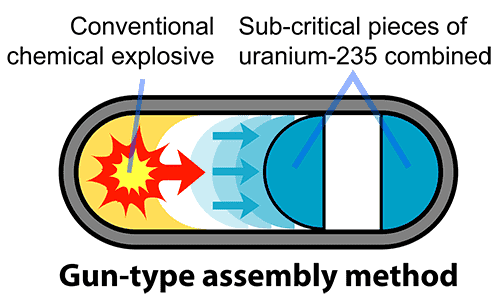
In atomic bomb there are two hemispheres of fission material (Uranium or Plutonium), they are joined by means of conventional chemical explosives, the necessary critical mass is reached and the atomic bomb explodes, everybody knows this:
eeYE18y.png

But is this condition enough? Indeed, the initial neutrons are needed to trigger the fission reaction, where do these neutrons come from? Definitely not from the Uranium or Plutonium………….:rolleyes:
 
Physics news on Phys.org
Yes, the Uranium or Plutonium have a low level of spontaneous fission happening all the time that may provide the neutrons needed to initiate the chain reaction. It is possible in theory, but in practice it works better to have a separate more reliable neutron source such as a Polonium-Beryllium alloy. The Polonium provides alpha particles and the Beryllium converts them into neutron radiation.
 
Last edited:
Actually, Plutonium produces too many neutrons from spontaneous fission for this design. The reaction would start too early and the pieces would repel each other before most of the material was used.

Therefore, all Plutonium bombs (and all current bombs in general) implode a hollow ball and have a separate neutron source - that is faster and more reliable.
 
dauto said:
Yes, the Uranium or Plutonium have a low level of spontaneous fission happening all the time that may provide the neutrons needed to initiate the chain reaction. It is possible in theory, but in practice it works better to have a separate more reliable neutron source such as a Polonium-Beryllium alloy. The Polonium provides alpha particles and the Beryllium converts them into neutron radiation.

I hate to intrude on someone else's topic and ask questions but would you mind explaining how Beryllium converts Alpha particles into Neutrons, does it somehow capture the protons?
 
delsaber8 said:
I hate to intrude on someone else's topic and ask questions but would you mind explaining how Beryllium converts Alpha particles into Neutrons, does it somehow capture the protons?

See this article on Beryllium: 'Nuclear Properties'

http://en.wikipedia.org/wiki/Beryllium

The part of a nuclear device which furnishes the initial neutrons to start the fission reaction is called an 'initiator'. The initiator for the first atomic bombs was made by smashing Polonium and Beryllium together when the bomb was detonated. The neutrons produced by the initiator then stuck the fissile uranium or plutonium fuel and started the chain reaction.

When a Be-9 nucleus is struck by an energetic alpha particle produced by the decay of Polonium, the alpha particle fuses with the beryllium nucleus to produce a carbon-12 nucleus plus a neutron.

Later designs of initiators cause a few atoms of deuterium and tritium to fuse by use of high-voltage electrical current to generate neutrons.

http://en.wikipedia.org/wiki/Neutron_generator
 
  • Like
Likes   Reactions: 1 person
dauto
mfb
SteamKing
Thanks guys :smile:
 

Similar threads

  • · Replies 4 ·
Replies
4
Views
3K
  • · Replies 6 ·
Replies
6
Views
3K
  • · Replies 20 ·
Replies
20
Views
3K
  • · Replies 7 ·
Replies
7
Views
4K
  • · Replies 12 ·
Replies
12
Views
5K
  • · Replies 11 ·
Replies
11
Views
3K
  • · Replies 3 ·
Replies
3
Views
3K
  • · Replies 9 ·
Replies
9
Views
8K
  • · Replies 15 ·
Replies
15
Views
3K
  • · Replies 2 ·
Replies
2
Views
4K