Where would this transistor fail?

  • Thread starter Thread starter tamtam402
  • Start date Start date
  • Tags Tags
    Transistor
Click For Summary

Discussion Overview

The discussion revolves around the implications of changing the emitter resistor (Re) value in a transistor circuit, particularly in relation to the emitter current (Ie) and the overall operation of the transistor. Participants explore theoretical and practical aspects of transistor behavior, including biasing, current flow, and potential failure modes.

Discussion Character

  • Exploratory
  • Technical explanation
  • Debate/contested

Main Points Raised

  • One participant questions the effects of lowering Re, suggesting that it could lead to a situation where the equation Ie = Ib + Ic does not hold, indicating a potential failure in the circuit's operation.
  • Another participant provides calculations for Re values corresponding to different emitter currents, emphasizing the need for a complete circuit redesign if Re is altered.
  • A participant reflects on their earlier misunderstanding regarding the relationship between base voltage (Vb) and emitter current (Ie), noting that lowering Re would increase Ie and consequently affect Vb, potentially leading to the transistor entering cut-off mode.
  • In contrast, another participant argues that lowering Re would actually push the transistor into saturation rather than cut-off, providing a calculation for maximum collector current (Ic_max) based on the circuit parameters.
  • One participant elaborates on the complexity of transistors, stating that a lower Re could lead to overheating, altered biasing, and distorted output signals, all of which could contribute to transistor failure.

Areas of Agreement / Disagreement

Participants express differing views on the consequences of lowering Re, with some suggesting it leads to cut-off and others asserting it results in saturation. There is no consensus on the specific outcomes or failure modes associated with changing Re.

Contextual Notes

Participants acknowledge that the behavior of the transistor is influenced by multiple factors, and the discussion highlights the need for careful circuit design to avoid potential failures. There are unresolved assumptions regarding the circuit's overall configuration and the specific conditions under which the transistor operates.

tamtam402
Messages
199
Reaction score
0
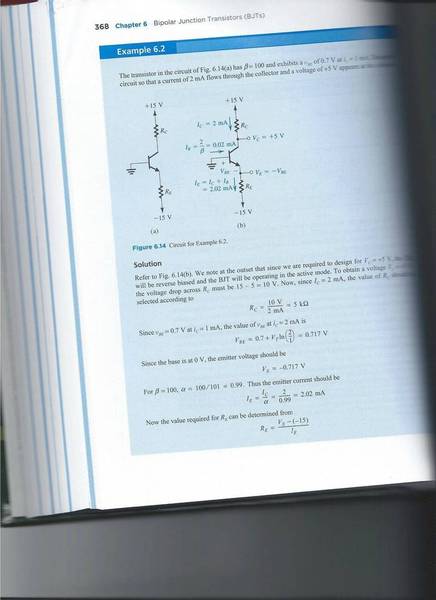
I succesfully did this example from my book without checking the solution, but I came up with a question that I cannot answer on my own. What would happen if Re was set lower?

The base is grounded and Vbe is independent of the current Ie, so by choosing a resistance smaller than 7070ohm for Re, it seems like the equation Ie = Ib + Ic wouldn't hold anymore, which is impossible. So, what would happen if I were to set a Re too small?

Basically, I have a problem where the book says the emitter current should be 2.02mA. Yes, that's what I calculated, but what would happen if I were to set a value for Re that makes would give a 3mA current, for example?Since the scan didn't work properly (the book is huge and I couldn't make the whole page fit flat), here's the first paragraph:

The transistor in the circuit of Fig. 6.14(a) has B=100 and exhibits a Vbe of 0.7V at Ic=1mA. Design the circuit so that a current of 2Ma flows through the collector and a voltage of +5V appears at the collector.Edit: I didn't scan the second page. It's simply the last equation of the first page with the values replaced for Ve (-0.717V) and Ie (2.02mA).
wsH6z.jpg
 
Engineering news on Phys.org
These formulas only apply as long as the transistor is adequately biased and operating linearly.

The emitter resistor in this case would be about 7.15 K. (15 V- 0.7V) /0.002 A = 14.3 V / 0.002 A or about 7.15 K.

If you wanted 3 mA then the emitter resistor would be (15 V- 0.7V) /0.003 A or 4.77 K.

This depends on there being sufficient current available from the collector circuit, so you need to make this a part of a complete design. Changing the emitter resistor must be accompanied by a redesign of the collector circuit if the output voltage of 5 volts is to be retained.

In this case if the emitter current was to be 3 mA then the collector resistor would have to be about 10 V / 0.003 A or 3.33 K.
Notice that the actual collector current would be 3 mA - 0.01 * 3 mA or 2.97 mA, but this makes little difference to the final calculation and you would still use a 3.3 K resistor.
 
Yes I understand that the resistance must be about 7k, I used the same formula you used. I was simply wondering what would happen if the resistance was set lower, thus forcing a Ie to be bigger than excepted. I just answered my own question though, and I'll explain it just in case anyone else was wondering.

In my first post I stated that Vb would be unaffected by a change in the current Ie. That's simply not true, because we know Vb = Ve + 0.7V. By changing the resistor to a lower value, the current Ie increases and the voltage Ve will also be higher. The voltage Vbe wouldn't be 0.7V anymore, and the transitor wouldn't be in active (or saturation) mode. No current would flow since it would have to be in cut-off.
 
tamtam402 said:
In my first post I stated that Vb would be unaffected by a change in the current Ie. That's simply not true, because we know Vb = Ve + 0.7V. By changing the resistor to a lower value, the current Ie increases and the voltage Ve will also be higher. The voltage Vbe wouldn't be 0.7V anymore, and the transitor wouldn't be in active (or saturation) mode. No current would flow since it would have to be in cut-off.
No, by changing the Re resistor to a lower value BJT will enter saturation region not cut-off.
Ic_max = Vcc/Rc = 15V/5K = 3mA
So If Ie > 3mA the BJT will enter saturation region.


I would first like to clarify that transistors are complex electronic devices with multiple factors that can contribute to their failure. It is not possible to pinpoint a specific location where a transistor would fail without a thorough analysis of the circuit and its components.

That being said, setting a lower value for Re can have several consequences. One possibility is that it may result in a higher current flowing through the transistor, which could lead to overheating and damage to the device. This is because Re is responsible for limiting the amount of current flowing through the transistor.

Additionally, a lower value of Re may also affect the biasing of the transistor, which can alter its operating characteristics and potentially cause it to fail. This is because Re is part of the biasing network that sets the base voltage and controls the amount of current flowing through the transistor.

Furthermore, a lower value of Re may also affect the gain of the transistor, which is the ratio of the output current to the input current. This can result in a distorted output signal and potential failure of the transistor.

In summary, setting a lower value for Re can have multiple consequences and may lead to failure of the transistor. It is important to carefully design and select components in a circuit to ensure proper functioning and avoid failure.
 

Similar threads

Replies
68
Views
7K
Replies
10
Views
2K
Replies
12
Views
3K
  • · Replies 5 ·
Replies
5
Views
4K
  • · Replies 13 ·
Replies
13
Views
2K
  • · Replies 5 ·
Replies
5
Views
4K
  • · Replies 5 ·
Replies
5
Views
4K
Replies
6
Views
2K
Replies
19
Views
7K
  • · Replies 13 ·
Replies
13
Views
4K