Why Do We Need an External Voltage in Photodiode Circuits?

Click For Summary

Discussion Overview

The discussion revolves around the functioning of photodiodes in circuits, specifically addressing the necessity of external voltage, the role of resistors, and the behavior of the circuit when light interacts with the photodiode. Participants explore various aspects of circuit design, including the implications of biasing, resistance, and signal measurement.

Discussion Character

  • Exploratory
  • Technical explanation
  • Debate/contested
  • Mathematical reasoning

Main Points Raised

  • Some participants assert that an external voltage is necessary for current to flow through the photodiode circuit.
  • Others propose that the resistor is essential for converting the current generated by the photodiode into a measurable voltage.
  • There is a discussion about the behavior of the resistor when light hits the photodiode, with some stating that the voltage across the resistor increases with light intensity.
  • One participant questions why the voltage is measured between the photodiode and the resistor, suggesting that this is due to the circuit configuration.
  • Some participants express uncertainty about the influence of external voltage on the photodiode's output voltage, with conflicting views on whether the external voltage affects the photodiode's behavior.
  • There is a query regarding the purpose of a capacitor in the circuit, with one participant suggesting it is used for noise filtering.
  • Some participants clarify that a photodiode does not generate voltage like a solar panel but instead changes its resistance when exposed to light.
  • There is a correction regarding the nature of current flow in the circuit, with discussions on whether it refers to electron flow or conventional current.

Areas of Agreement / Disagreement

Participants express multiple competing views on the necessity of external voltage and the role of resistors in photodiode circuits. The discussion remains unresolved regarding the influence of external voltage on the photodiode's output and the specific functions of components in the circuit.

Contextual Notes

Some participants note that the questions posed could apply to various simple circuits, indicating a broader context for understanding circuit design principles. There are also mentions of the non-linear response of the circuit without a resistor, highlighting the complexity of the interactions within the circuit.

mk9898
Messages
109
Reaction score
9
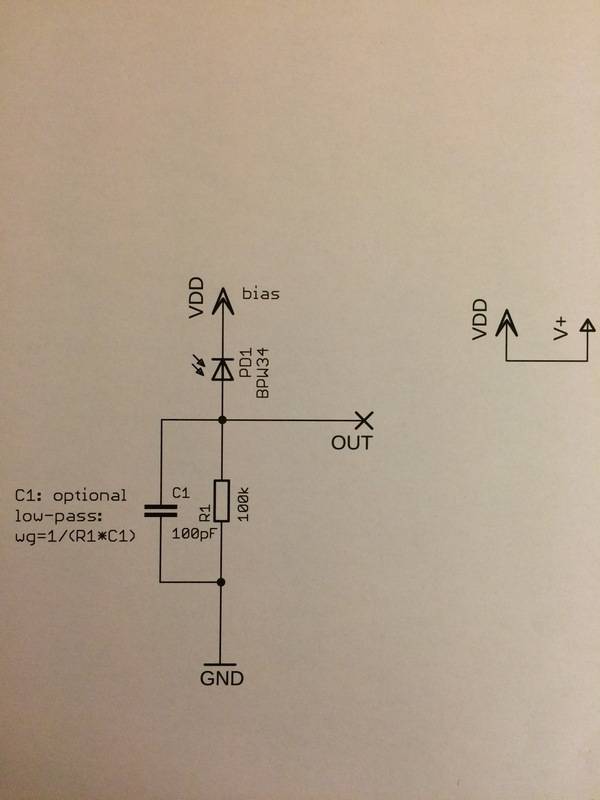
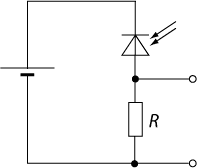
I am a bit confused on a few things regarding photodiodes. Here is are two circuits that I am referring to:
dE4D4.png


or

5DCY7.jpg
For the second circuit the capacitor is not of importance.

Here are my fundamental questions:

1. Why do we need an external voltage?
2. Why do we need a resistor?
3. What is exactly happening to the resistor when light hits the photodiode?
4. Why is the voltage measured between the photodiode and the resistor?
5. Why doesn't the external voltage influence the voltage from the photodiode (assuming the voltage from the photodiode is relatively low compared to the external voltage)?
6. For the second photo: what would be the need for a capacitor here? What would it change?

I don't expect all the questions from one user to be answered but I would definitely appreciate some insight or perhaps some recommendations what I should read to fill in some of the gaps. I know the questions seem rudimentary but I need those "Aha!" moments right about now.
 

Attachments

  • dE4D4.png
    dE4D4.png
    852 bytes · Views: 1,839
  • 5DCY7.jpg
    5DCY7.jpg
    22.9 KB · Views: 1,733
Engineering news on Phys.org
The way the circuit works is as follows. The diode is reverse biased, so if no light is falling on it, the current is basically zero. So the current through the resistor is zero, so the voltage across the resistor (V=IR) is zero. So all of the applied voltage is dropped across the diode. When you shine light on the diode, it causes a small current to flow which is proportional to the light intensity. So the voltage across the resistor (V=IR again) increases, and this voltage is proportional to the light intensity.

mk9898 said:
Here are my fundamental questions:

1. Why do we need an external voltage?
Without an external voltage, no current will flow.

2. Why do we need a resistor?
See above. The resistor is basically used to convert the current into a voltage for you to measure.
3. What is exactly happening to the resistor when light hits the photodiode?
See above.
4. Why is the voltage measured between the photodiode and the resistor?
See above.
5. Why doesn't the external voltage influence the voltage from the photodiode (assuming the voltage from the photodiode is relatively low compared to the external voltage)?
Your assumption is wrong,. Typically almost all of the external voltage is dropped across the diode, and the voltage across the resistor is small.
6. For the second photo: what would be the need for a capacitor here? What would it change?
The capacitor is used to filter out noise so you get a smoother signal (I think).
 
phyzguy said:
The way the circuit works is as follows. The diode is reverse biased, so if no light is falling on it, the current is basically zero. So the current through the resistor is zero, so the voltage across the resistor (V=IR) is zero. So all of the applied voltage is dropped across the diode. When you shine light on the diode, it causes a small current to flow which is proportional to the light intensity. So the voltage across the resistor (V=IR again) increases, and this voltage is proportional to the light intensity.

Is this because we place the photodiode so that the passage direction is blocked? I.e. no current will flow based on the nature of diodes? Just to be clear: are we talking about technical direction or electrons? From the first photo I would assume technical current flow since the diode is placed so that no + would go to - but just want to make sure. Also, we place the photodiode so, since we know that the current flows in the blocking direction, right? When we say current in this direction flows, do we then mean the electrons or again the technical current i.e. the holes?

Without an external voltage, no current will flow.

Why not?
See above. The resistor is basically used to convert the current into a voltage for you to measure.

So that means if we didn't have a resistor there we would have V/R = I and it would go to infinity, right? I.e. the wire would melt.
 
phyzguy said:
Without an external voltage, no current will flow.
Not true. Hook an LED to a DVM and shine some light on the LED -- you get a voltage from the photocurrent flowing through the DVM's measurement resistance. :smile:
mk9898 said:
1. Why do we need an external voltage?
There's an important reason to use at least a few volts of reverse bias across the photodiode -- it has to do with bandwidth. Do a little Google searching to see if you can find a good explanation of that, and post it here. :smile:

LED under a lamp with DVM measuring the voltage (Red positive lead on the LED anode):

upload_2019-3-22_14-3-43.png
 

Attachments

  • upload_2019-3-22_14-3-43.png
    upload_2019-3-22_14-3-43.png
    79.7 KB · Views: 1,364
mk9898 said:
Is this because we place the photodiode so that the passage direction is blocked? I.e. no current will flow based on the nature of diodes? Just to be clear: are we talking about technical direction or electrons? From the first photo I would assume technical current flow since the diode is placed so that no + would go to - but just want to make sure. Also, we place the photodiode so, since we know that the current flows in the blocking direction, right? When we say current in this direction flows, do we then mean the electrons or again the technical current i.e. the holes?

I don't think I understand your question. In your diagram, the current flow through the photodiode is downwards. In the wires, this means electrons are flowing upward. In the diode, whether the current flow is holes flowing downward or electrons flowing upward depends on where in the diode you are talking about and how the diode is constructed.

Why not?

berkeman is right that current will flow whether there is an applied voltage or not. I was wrong on this point. A better answer is that we want a large applied voltage across the diode so there is a large depletion region, because this increases the sensitivity of the diode.

So that means if we didn't have a resistor there we would have V/R = I and it would go to infinity, right? I.e. the wire would melt.
No of course not. If there is no resistor, the current is limited by the diode. It won't be infinite. But if you eliminate the resistor and measure the voltage across the diode, you will get a very non-linear response.
 
  • Like
Likes   Reactions: berkeman
In case its not obvious a photodiode does not work like a solar panel. It doesn't "create" a voltage like a solar panel. Instead, when you shine light on it it effectively changes its resistance.
 
CWatters said:
In case its not obvious a photodiode does not work like a solar panel. It doesn't "create" a voltage like a solar panel. Instead, when you shine light on it it effectively changes its resistance.
Is that true? Both create a photocurrent from the light...

EDIT -- I think you may be thinking of the light-dependent resistor (LDR), instead of photodiodes:

https://en.wikipedia.org/wiki/Photoresistor
 
Last edited:
  • Like
Likes   Reactions: Tom.G and davenn
berkeman said:
Both create a photocurrent from the light...
Yep. Here's an image from a page from this excellent web book on http://ecee.colorado.edu/~bart/book/book/contents.htm.

photodiodes.jpg
 

Attachments

  • photodiodes.jpg
    photodiodes.jpg
    83 KB · Views: 1,078
  • Like
Likes   Reactions: berkeman
  • #10
Yes you are right, I was thinking of an LDR.
 
  • #11
mk9898 said:
1. Why do we need an external voltage?
2. Why do we need a resistor?
3. What is exactly happening to the resistor when light hits the photodiode?
4. Why is the voltage measured between the photodiode and the resistor?
5. Why doesn't the external voltage influence the voltage from the photodiode (assuming the voltage from the photodiode is relatively low compared to the external voltage)?
6. For the second photo: what would be the need for a capacitor here? What would it change?
To sum up:
These questions could nearly all apply to virtually any simple circuit. To 'use' the signal from any transducer, you need to present the following circuit with a suitable bias (volts or current, depending) and 'source resistance'. That design assumes that the circuit is connected to a 'voltage amplifier', which will have a high but unspecific input resistance. The 100kR resistor defines the load on the diode. With no light, there is no photo current from the diode so the output volts will go to Zero. Increasing current will bring the output volts positive (1V per 10μA of photocurrent), reference to 0V, which will suit most amplifier designs.
The purpose of the C, as in many circuits, will Low Pass filter the signal volts to eliminate high frequency noise. The photo current could be very small so the front end circuit could be susceptible to RFI (sparks etc.), without the Capacitor.
 

Similar threads

Replies
3
Views
3K
Replies
7
Views
3K
  • · Replies 1 ·
Replies
1
Views
2K
  • · Replies 3 ·
Replies
3
Views
2K
  • · Replies 24 ·
Replies
24
Views
4K
  • · Replies 1 ·
Replies
1
Views
2K
  • · Replies 18 ·
Replies
18
Views
5K
  • · Replies 32 ·
2
Replies
32
Views
4K
  • · Replies 12 ·
Replies
12
Views
3K
  • · Replies 78 ·
3
Replies
78
Views
6K