Discussion Overview
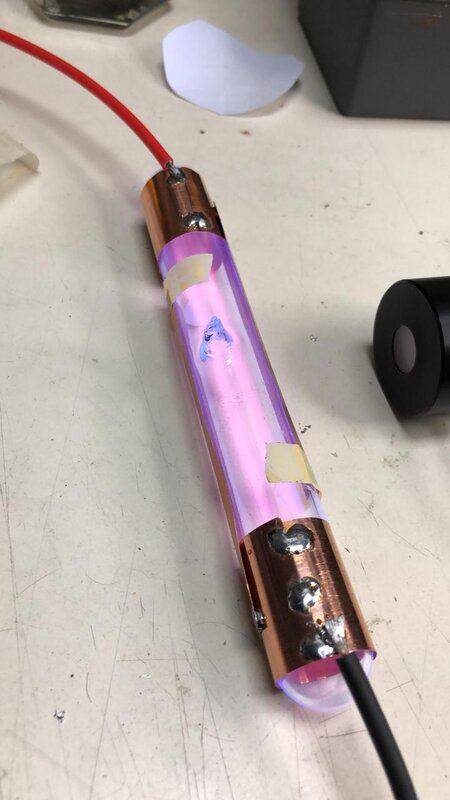
The discussion revolves around the phenomenon of a double filament discharge observed in excimer lamps, specifically those powered by capacitive discharge electrodeless pulses. Participants explore the experimental setup, characteristics of the discharge, and potential influences on its behavior.
Discussion Character
- Exploratory
- Technical explanation
- Debate/contested
Main Points Raised
- Some participants describe the experimental setup involving a quartz tube evacuated and filled with a krypton and chlorine mixture, powered by a high-voltage pulsed source.
- There are inquiries about the symmetry of the discharge and whether it appears as two distinct filaments when viewed from different angles.
- Participants discuss the nature of the pulsed source, with some confirming it is bipolar, while others question the direction of electron travel.
- One participant notes that the presence of permanent magnets previously distorted the discharge in a different experiment, raising questions about their effect in the current setup.
- Concerns are raised about why two parallel discharges exist, as currents in parallel typically attract each other.
Areas of Agreement / Disagreement
Participants express curiosity and propose various hypotheses regarding the double filament discharge, but there is no consensus on the underlying reasons for the observed phenomenon or the influence of external factors such as magnets.
Contextual Notes
Participants mention limitations in their observations, such as the effect of the lamp's geometry and the positioning of electrodes, which may influence the discharge characteristics.
Who May Find This Useful
This discussion may be of interest to researchers and practitioners in the fields of plasma physics, electrical engineering, and experimental optics, particularly those working with excimer lamps and discharge phenomena.