Why Does Pspice Simulation Stop Working and Show Gray Voltage Markers?

Click For Summary

Discussion Overview

The discussion revolves around issues encountered while using Pspice for circuit simulations, specifically regarding simulation failures and gray voltage markers. Participants explore potential causes, troubleshooting steps, and alternative software options, with a focus on voltage multipliers and circuit design strategies.

Discussion Character

  • Technical explanation
  • Debate/contested
  • Experimental/applied
  • Mathematical reasoning

Main Points Raised

  • One participant reports that Pspice shows gray voltage markers and stops working after successful simulations, raising concerns about software stability.
  • Another participant suggests simplifying the output circuit to a single stage of the multiplier to troubleshoot the issue.
  • There is a discussion about the meaning of specific labels in the Pspice schematic, with one participant explaining that L1=L1, L2=L2, L3=L3 represents an alternative transformer construction.
  • Several participants request the ASCII node source file to run simulations independently, highlighting issues with the provided files being incomplete or incorrect.
  • One participant mentions that Pspice has bugs and suggests trying LTspice as an alternative simulation tool.
  • Concerns are raised about capacitor shorting in the schematic, with participants noting that this may not be the root cause of the simulation problems but should be addressed.
  • Another participant discusses the impact of circuit parameters on simulation stability, suggesting the use of resistors to stabilize capacitive circuits.
  • There is a mention of the time required to charge capacitors in the circuit, with calculations provided for the number of cycles needed at different frequencies.
  • One participant expresses a need for a specific output voltage and discusses design constraints, including the use of small components for a voltage multiplier aimed at building a compact defibrillator.
  • Participants debate the suitability of using 1pF capacitors and the implications of using high-voltage diodes in the design.
  • There is a suggestion to consider alternative circuit designs, such as a two-transistor self-oscillating inverter, for achieving high voltage outputs.

Areas of Agreement / Disagreement

Participants express various viewpoints on troubleshooting the Pspice simulation issues, with no consensus on a single solution. There are competing suggestions regarding circuit design and component choices, indicating ongoing debate and exploration of ideas.

Contextual Notes

Participants have not fully specified design constraints, such as the required output voltage and charge, which may affect the discussion. The limitations of the Pspice software and the implications of using specific components in high-voltage applications are also noted but remain unresolved.

Who May Find This Useful

This discussion may be useful for individuals working with circuit simulations, particularly those using Pspice or LTspice, and those interested in voltage multiplier designs and high-voltage applications.

ernd59
Messages
28
Reaction score
0
Hi,

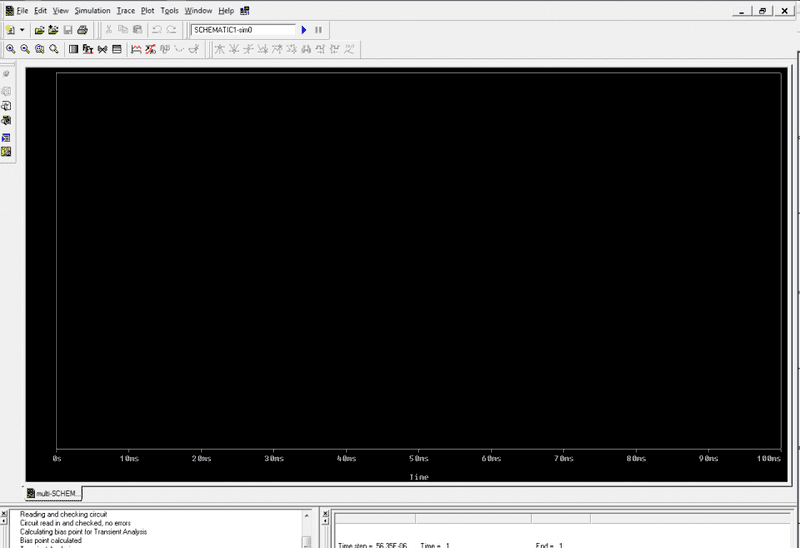
I have a strange problem with Pspice, it always shows after successful attempts, the simulation program stops working and all voltages markers turns to gray and can't see any results any more
Pspice capture.PNG
Sche.PNG
 
Engineering news on Phys.org
What happens if you simplify the output circuit to just a single stage of the multiplier?

Also, what does it mean on the left where it says L1=L1, L2=L2, L3=L3?
 
What happens if you simplify the output circuit to just a single stage of the multiplier?

it works, but as soon as i copy past some diodes (i change the name and the number of of course) i get this problem,

Also, what does it mean on the left where it says L1=L1, L2=L2, L3=L3?[/QUOTE]

that's an alternative way how a transformer is built in pspice
 
Can you attach the ascii node source file to a post. Then I can run it without having to start from scratch.
Pspice has some bugs. Have you tried to run it on LTspice?
 
Baluncore said:
Can you attach the ascii node source file to a post. Then I can run it without having to start from scratch.
Pspice has some bugs. Have you tried to run it on LTspice?

no i did not :/
 

Attachments

There is no circuit in that file.
** Profile: "SCHEMATIC1-sim0" [ C:\Users\Student27\Desktop\Pspice versuche\z wie z-schematic1-sim0.sim ]

** Creating circuit file "z wie z-schematic1-sim0.sim.cir"
** WARNING: THIS AUTOMATICALLY GENERATED FILE MAY BE OVERWRITTEN BY SUBSEQUENT SIMULATIONS

*Libraries:
* Local Libraries :
* From [PSPICE NETLIST] section of pspiceev.ini file:
.lib "nom.lib"

*Analysis directives:
.TRAN 0 100ms 0
.PROBE
.INC "z wie z-SCHEMATIC1.net"

.INC "z wie z-SCHEMATIC1.als".END

It should have one line per component that specifies nodes component name and value/model. For example; C3 is connected between ground node 0 and another node, maybe 3, it is called C3 and has a value of 1nF.
0 3 C3 1n
 
Baluncore said:
There is no circuit in that file.
sorry
 

Attachments

Not useful. Please look in the file before you post it to verify it is the raw spice node code.
 
Baluncore said:
Not useful. Please look in the file before you post it to verify it is the raw spice node code.
sorry but i found nothing with that format
 
  • #10
ernd59 said:
sorry but i found nothing with that format
 

Attachments

  • z.PNG
    z.PNG
    8.9 KB · Views: 703
  • #11
ernd59 said:
sorry but i found nothing with that format

In PSPICE, is there an option to Export a SPICE Deck? That would be the ASCII file that we can try to run ourselves.
 
  • #12
Try shorting the caps with a high-ish value resistor - like 1 meg or 10 meg.
SPICE goes a little unstable sometimes when you have a long capacitively coupled circuit like that.
 
  • #13
I just noticed that C3 and C13 appear to be shorted in the schematic. That may not be the cause of your problems, but you should fix that connectivity at some point. :smile:
 
  • #14
berkeman said:
In PSPICE, is there an option to Export a SPICE Deck? That would be the ASCII file that we can try to run ourselves.
i have a trial version of Pspice, i can't :(
 
  • #15
berkeman said:
I just noticed that C3 and C13 appear to be shorted in the schematic. That may not be the cause of your problems, but you should fix that connectivity at some point. :smile:
ok thanks :smile:
 
  • #16
tfr000 said:
Try shorting the caps with a high-ish value resistor - like 1 meg or 10 meg.
SPICE goes a little unstable sometimes when you have a long capacitively coupled circuit like that.
ok , I am going to try it
 
  • #17
I used LTspice.
Schematic.png
Traces.png
 
  • Like
Likes   Reactions: ernd59 and berkeman
  • #19
I think it might depend on how you define the driving voltage.
For sine 12V, LTspice generates; V = 12 * sine(wt) i.e. 24 Vpp = 8.5 Vrms. What does Pspice do ?

You run at 500 kHz, I run at 1kHz. Neither has any load so we are both looking at electrostatic voltage.

You show 8 testpoints on your schematic, but you only show 7 traces on the plot.
Your highest output voltage is not being displayed. Has the EHT shorted another of your capacitors or diodes ?
 
  • #20
hi,

im using Ltspice now :), I am trying to use C19 as Dummy load ( from the german word Ersatzlast) but it does not work
Multi.PNG
 

Attachments

  • Multi.PNG
    Multi.PNG
    30.4 KB · Views: 731
  • #21
Attached is my LTspice Vmult3.asc file. Remove the .txt suffix to run it.
You can attach your .asc by adding a .txt suffix.
 

Attachments

  • #22
It will take 500,000,000 cycles of your oscillator to charge the C19 = 500uF through 1pF multiplier capacitors.
At 1.5MHz that will take 333.4 seconds, well over 5 minutes.
Your simulation runs for 1 millisecond which is why it does not appear to work.
 
  • Like
Likes   Reactions: ernd59
  • #23
Baluncore said:
It will take 500,000,000 cycles of your oscillator to charge the C19 = 500uF through 1pF multiplier capacitors.
At 1.5MHz that will take 333.4 seconds, well over 5 minutes.
Your simulation runs for 1 millisecond which is why it does not appear to work.
thanks :), i need C19 to be charged in less than 15 sec , if i put a 35 MHz it schould works right ?
 
  • #24
ernd59 said:
i need C19 to be charged in less than 15 sec , if i put a 35 MHz it schould works right ?
Probably NOT.
It will be difficult to simulate that with any version of spice. 15 seconds at 35MHz is 525 million cycles. It will take hours to simulate.

You have not specified the design constraints. What output voltage do you need ?
You have not explained why your transformer ratio is what you have selected.

It was a wise move to convert to a single phase multiplier, as it needs only 50% the number of diodes and uses 33% less caps, and it only requires twice the frequency.

In your previous circuit you showed one diode only as an MMSD4148. What diodes are you really using ?
Are you building an IC ? That is the only way I can see you using 1pF capacitors.
Your 1pF capacitors have a similar capacitance to 1N4148 diodes. That is really not good.

1nF capacitors are available that are both small and cheap.
The bigger the pump capacitors the lower the frequency needed to pump the charge.

You keep changing the circuit without justification.
If you have an LTspice.asc file please post it so I can run and modify it without a waste of time.

The Villard Cascade, voltage multiplier is probably not now the best choice for HV generation.
What is your application. Are you building a taser or a cattle prod ?
 
  • Like
Likes   Reactions: ernd59
  • #25
Baluncore said:
Probably NOT.
It will be difficult to simulate that with any version of spice. 15 seconds at 35MHz is 525 million cycles. It will take hours to simulate.

You have not specified the design constraints. What output voltage do you need ?
i need a 2 kv output
You have not explained why your transformer ratio is what you have selected.
It was a wise move to convert to a single phase multiplier, as it needs only 50% the number of diodes and uses 33% less caps, and it only requires twice the frequency.
In your previous circuit you showed one diode only as an MMSD4148. What diodes are you really using ?
Are you building an IC ? That is the only way I can see you using 1pF capacitors.

my final goal is to build a compact defibrillator (i just started ), i wanted to build voltage multiplier using only the smallest component possible that´s why I am using 1pF capacitors, right now I'm just exploring the limits, (how small can i get but still i need to have reasonable results)

Your 1pF capacitors have a similar capacitance to 1N4148 diodes. That is really not good.
i edited the diode now they have reverse 3kv voltage
 

Attachments

  • #26
Design strategy. What output voltage do you need ?
What output charge in coulombs do you need ?

What HV switch will you use to trigger the discharge ?

Charge pump ladders are used when capacitor and diode breakdown voltages are less than the final output voltage.
The reservoir side of the ladder is then used as the output storage capacitor. The other side is the pump.
By proposing 3 kV diodes you show you have not understood the advantage of the ladder multipliers.

If you have a transformer then why not wind it for the highest possible voltage.
Or better still, go for a two transistor self oscillating inverter with a HV transformer and rectifier.
Or the modern approach, a switching boost converter.

Capacitors come in different form factors. Terminal separation limits voltage.
If you select a surface mount form you should be able to get an optimum (voltage * capacitance) product.
A 1 pF capacitor is usually the same size as a 1nF capacitor because of the standardised packaging.

Where are you going to find a small 500uF capacitor that is rated at 2 kV ?
A single standard capacitor would actually be 470 uF. It would need to be rated at 2 kV.
Two 1000uF caps in series would be possible. Each would be rated at 1 kV
Six 3300 uF caps in series would give 550 uF. Each would be rated at 350 V.
So a six stage multiplier is a possibility.

The transformer would need an increased voltage ratio that had Vpp = 330 V.
With LTspice, 12 V is Vpp = 24. Transformer turns ratio will need to be 330 / 24 = 13.75
That will need an inductance ratio of 189 for the transformer.
You also need to turn your transformer back into a single secondary to make the new ratio clear.

There is little point in attaching a .asc file if it has not been updated to use sensible capacitors and your selected diodes.
Document your design requirements on the spice simulation schematic.

Your attempts at circuits show that you need to study the real component parts catalogues more.
You should also look at how others have designed defibrillators.
 
  • Like
Likes   Reactions: ernd59

Similar threads

Replies
93
Views
9K
  • · Replies 3 ·
Replies
3
Views
5K
  • · Replies 5 ·
Replies
5
Views
5K
Replies
1
Views
3K
  • · Replies 1 ·
Replies
1
Views
3K
  • · Replies 22 ·
Replies
22
Views
5K
Replies
20
Views
3K
Replies
30
Views
7K
  • · Replies 5 ·
Replies
5
Views
2K
Replies
4
Views
3K