Why Does the Official Key State X=2.05 Instead of X=1 in This Adiabatic Process?

Join the discussion
Ask a follow-up here, or get your own question answered by working scientists, mathematicians and engineers — people, not an autocomplete.
Real named experts · corrections over time · the nuance an AI answer skips
32 replies · 3K views
bhupesh
Messages
22
Reaction score
5
Homework Statement
A spherical bubble inside water has radius 𝑅. Take the pressure inside the bubble and the water pressure to be 𝑝0. The bubble now gets compressed radially in an adiabatic manner so that its radius becomes (𝑅 − 𝑎). For 𝑎 ≪ 𝑅 the magnitude of the work done in the process is given by (4𝜋𝑝0𝑅𝑎2 )𝑋, where 𝑋 is a constant and 𝛾 = 𝐶𝑝⁄𝐶𝑉 = 41⁄30. The value of 𝑋 is ____
Relevant Equations
work done in a process=external pressure*change in volume
First law of thermodynamics, dX signifies change in X,
dQ=dU+dW
Q=heat energy
U=internal energy
W=work done
for any process, dU=n*Cv*dT
T=temperature of system,n=number of moles of gas undergoing the process
Cv=molar heat capacity at constant volume
Cp=molar heat capacity at constant pressure
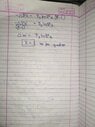
as the process has been given as an adiabatic one, dQ=0, further attempt is given in the attached files, but the problem is I got X=1 while the official key states it to be X=2.05, could anyone explain why
 

Attachments
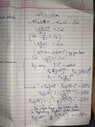
  • SidewaysAgain01.jpg
    SidewaysAgain01.jpg
    55.8 KB · Views: 243
  • SidewaysAgain02.jpg
    SidewaysAgain02.jpg
    44.1 KB · Views: 215
Physics news on Phys.org
I have also got a solution given on the internet that I am not able to comprehend, anyone wants it??
 
bhupesh said:
I have also got a solution given on the internet that I am not able to comprehend, anyone wants it??
Bro this is literally from JEE adv 2020 (I even appeared in that paper), you can find thousands of explanations online!

for example, here's one
 
kshitij said:
Bro this is literally from JEE adv 2020 (I even appeared in that paper), you can find thousands of explanations online!

for example, here's one
I couldn't understand thatt solution and why my solution is wrong, i have written that in the question
clearly
 
bhupesh said:
I couldn't understand thatt solution and why my solution is wrong, i have written that in the question
clearly
What you couldn't understand in that solution? Also I didn't go through your solution well enough to comment on that.
 
kshitij said:
Bro this is literally from JEE adv 2020 (I even appeared in that paper), you can find thousands of explanations online!

for example, here's one
could you also share how was your experience of that particular exam
 
kshitij said:
Also I didn't go through your solution well enough to comment on that.
I see that you didn't write ##dV=4\pi r^2a##, use this formula just as we used to do when we took the change in volume for of an elementary shell here, ##dr## can be written as ##a##
 
I am a scrub in thermodynamics, maybe @Chestermiller who is expert can have a look at this.

However the problem statement gives you the value of ##\gamma## (I believe that's the ##\phi## in your work) but you nowhere use the value of ##\phi ## in your work, because according to your work it gets simplified. Maybe that thing you do about keeping only the first term in the binomial expansion is wrong, maybe you got to look for another approximation.
 
Chestermiller said:
My result for the work to compress the bubble adiabatically and reversibly is ##4\pi R^2 a p_0##, independent of ##\gamma##, exactly the same as yours. It seems to me your analysis is flawless.
I note that in post #1 the power of 2 is on a, not R. It also seems obvious that the adiabatic aspect would not affect the first order term.
This suggests to me that the original question says, or intended to say
"The work done is ##4\pi R^2 a p_0+4\pi R a ^2p_0X##."
I believe ##\gamma## would feature in the expression for X.
 
  • Like
Likes   Reactions: Twigg, Delta2 and Chestermiller
haruspex said:
I note that in post #1 the power of 2 is on a, not R. It also seems obvious that the adiabatic aspect would not affect the first order term.
This suggests to me that the original question says, or intended to say
"The work done is ##4\pi R^2 a p_0+4\pi R a ^2p_0X##."
I believe ##\gamma## would feature in the expression for X.
What do you get for X when you do this? I get X = 1.05
 
Last edited:
haruspex said:
It also seems obvious that the adiabatic aspect would not affect the first order term.
I would be very interesting to know how you come to this conclusion. Such is the case but how do you say that it is obvious.
 
Delta2 said:
I would be very interesting to know how you come to this conclusion. Such is the case but how do you say that it is obvious.
Because for a small displacement ##\delta r## the change in pressure will be of order o(1), e.g. proportional to ##\delta r##, so the work done will be like ##p_0(\delta r+o(\delta r))##, e.g. ##p_0(\delta r+O(\delta r^2))##.
 
haruspex said:
Because for a small displacement ##\delta r## the change in pressure will be of order o(1), e.g. proportional to ##\delta r##, so the work done will be like ##p_0(\delta r+o(\delta r))##, e.g. ##p_0(\delta r+O(\delta r^2))##.
Sorry I don't understand what you trying to say, I am abit confused about the big o small o notation and also pressure times displacement doesn't give us work, pressure times volume does.
 
@Delta2 I think what's going on is that since this is adiabatic, ##pV^\gamma## is a constant, so ##\frac{dp}{p} = -\gamma \frac{dV}{V}##. Making a simple first order approximation, ##\frac{\Delta p}{p} = -\gamma \frac{\Delta V}{V}##, where ##\Delta## means finite difference as opposed to differentials. ##\Delta V## scales linearly with radial displacement ##\delta r##, so ##\Delta p## scales linearly with ##\delta r##. If you work it out, you get a pressure ##p## vs displacement ##\delta r## given by ##p\approx p_0 (1 + 3\gamma \frac{\delta r}{R})##. Since the term with ##\gamma## in it is small compared to 1, it vanishes at lowest order, and the work will just be ##W \approx p_0 \Delta V##, which is first order in ##a##, aka ##O(a^1)##. The variation in pressure becomes a second order term in a.
 
  • Informative
Likes   Reactions: Delta2
Chestermiller said:
What do you get for X when you do this? I get X = 1.05
I ended up with 2.05 (from ##\frac{3}{2} \gamma##), but I trust your work over mine
 
but the exam is such you can challenge a particular question for bonus if its a typo or its answer given is wrong, many challenged the answer as 2.05 but finally ans was not changed, it remained 2.05
I have a solution available on the internet that is doubtful to me and i have attached that, check question no. 13 in the pdf file
 

Attachments

Chestermiller said:
What do you get for X when you do this? I get X = 1.05
but they have clearly mentioned that the whole process is adiabatic??
 
@bhupesh, I still agree with everyone else on the thread in saying that this problem is somewhere on the spectrum between poorly worded and dead wrong. In the solutions you posted, they define the average pressure as half the change in pressure. That makes no sense to me, unless there's a constraint force balancing p0, which is not at all stated explicitly in the problem. I got the same number as the solutions, but I would've challenged their answer too.

I'm sorry they weren't more open-minded in reviewing the challenges. That sucks :confused:

Edit: after re-reading the problem statement, they say explicitly that the pressure inside the bubble is p0, so there's no room for a constraint force balancing p0. They're just wrong.
 
Last edited:
  • Wow
Likes   Reactions: kshitij
hmm, thanks for helping
 
Twigg said:
I ended up with 2.05 (from ##\frac{3}{2} \gamma##), but I trust your work over mine
My solution for the work done by the gas on the surroundings was $$W=p_0v_0\left[\frac{(1-x)^{3-3\gamma}-1)}{(1-\gamma)}\right]$$where x = a/R. If I expand this in a Taylor series in x, I get $$W=-p_0v_0\left(3x+(3\gamma-2)\frac{x^2}{2}\right)$$which leads to X=1.05.

The reason you ended up with 2.05 is that you left out the third term in the expansion of ##(R-a)^3##
 
  • Informative
Likes   Reactions: Twigg
Delta2 said:
@bhupesh if you consider only the second order term in the binomial expansion what do you get that its coefficient is?
I am getting 1.05 with only second term included, neglecting the first term
 
Chestermiller said:
My solution for the work done by the gas on the surroundings was $$W=p_0v_0\left[\frac{(1-x)^{3-3\gamma}-1)}{(1-\gamma)}\right]$$where x = a/R. If I expand this in a Taylor series in x, I get $$W=-p_0v_0\left(3x+(3\gamma-2)\frac{x^2}{2}\right)$$which leads to X=1.05.

The reason you ended up with 2.05 is that you left out the third term in the expansion of ##(R-a)^3##
why are we adding these terms when a is a infinitesimal quantity
 
bhupesh said:
why are we adding these terms when a is a infinitesimal quantity
We are treating a as a small but finite quantity, not an infinitesimal.
 
Twigg said:
We are treating a as a small but finite quantity, not an infinitesimal.
then also we cannot add them and write X=1+1.05, it would be X=(1/a )+ 1.05