arhzz
- 284
- 58
- Homework Statement
- Use nodal voltage analysis to solve the circuit
- Relevant Equations
- Circuit Analysis
Hello! Consider this circuit
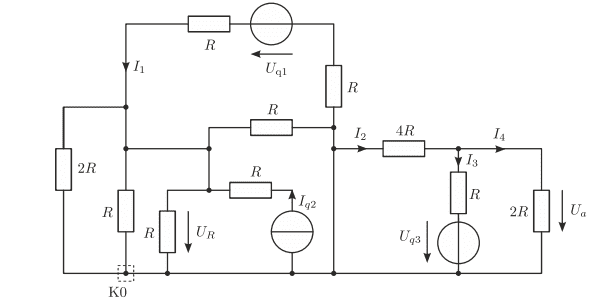
Now I am susposed to solve this using nodal analysis. The first step is to "prepare the network" so that I can set up the conductance matrix.
Now I've tried it for a bit and was not really able to do it. So I went ahead and looked at the solutions and this is how it looks like.
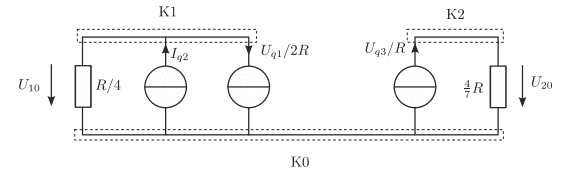
Now I think I've figured out how the got the right part of the circuit (the K2). Now the reference node is clear all of the wires are connected to K0 to it. Now looking at the voltage source that is to the right we can transform that into a current source and add the conductances of the resistors (R 2R and 4R).
## \frac{1}{4R} + \frac{1}{R} + \frac{1}{2R} ## this gives us the conductance G ## G =\frac{7}{4R} ## and if we want the resistance we need to take 1/G and we get the solution from the book. Now the current that the source is "emitting" is simply voltage divided through resistance,so and the nodal voltage is from K2 to K0, so its ##U_{20} ## The right part is pretty much clear but the left one is confusing me.
Now we can transform Uq1 just like we did for Uq3 but,I need to add the two resistors that are infront of it and behind it(since they are in series) .If we do that the current will be calculated like Uq1/2R. Now what I do not understand is how they get to the value of R/4? I've tried redrawing the circuit many times and I have not been able to do it. I can see that one of the resistors is short circuted but I can't seem to get to the R/4. This is how I have the circuit drawn
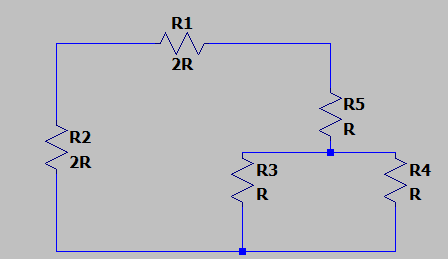
Take note that the current source at R1 and R4 are missing since I can't find them in LT spice. Now if I calculate the total resitance here I don't get the R/4 like in the solution.I've tried it a bunch of times and it feels like guessing at this point. What am I doing wrong ?Thanks and excuse the long post.
Now I am susposed to solve this using nodal analysis. The first step is to "prepare the network" so that I can set up the conductance matrix.
Now I've tried it for a bit and was not really able to do it. So I went ahead and looked at the solutions and this is how it looks like.
Now I think I've figured out how the got the right part of the circuit (the K2). Now the reference node is clear all of the wires are connected to K0 to it. Now looking at the voltage source that is to the right we can transform that into a current source and add the conductances of the resistors (R 2R and 4R).
## \frac{1}{4R} + \frac{1}{R} + \frac{1}{2R} ## this gives us the conductance G ## G =\frac{7}{4R} ## and if we want the resistance we need to take 1/G and we get the solution from the book. Now the current that the source is "emitting" is simply voltage divided through resistance,so and the nodal voltage is from K2 to K0, so its ##U_{20} ## The right part is pretty much clear but the left one is confusing me.
Now we can transform Uq1 just like we did for Uq3 but,I need to add the two resistors that are infront of it and behind it(since they are in series) .If we do that the current will be calculated like Uq1/2R. Now what I do not understand is how they get to the value of R/4? I've tried redrawing the circuit many times and I have not been able to do it. I can see that one of the resistors is short circuted but I can't seem to get to the R/4. This is how I have the circuit drawn
Take note that the current source at R1 and R4 are missing since I can't find them in LT spice. Now if I calculate the total resitance here I don't get the R/4 like in the solution.I've tried it a bunch of times and it feels like guessing at this point. What am I doing wrong ?Thanks and excuse the long post.
