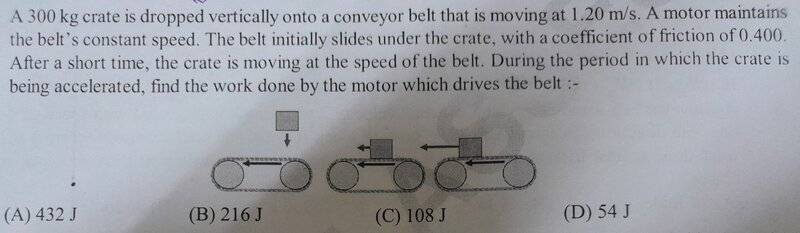
Why is the work done double its expected value? (conveyer belt)

Click For Summary
The discussion centers on the discrepancy between calculated and expected work done by a motor on a crate on a conveyor belt. The initial calculation suggests 216 J is needed to match the crate's velocity with the belt, while the provided answer is 432 J. The additional energy accounts for frictional forces acting during the crate's acceleration, which generates heat and requires work to overcome. The motor must exert force over a greater displacement due to the average speed difference between the crate and the belt, effectively doubling the energy required. Thus, the total work done by the motor is 432 J, combining both kinetic energy and energy lost to friction.
Aurelius120
Messages
269
Reaction score
24
Homework Statement
A 300kg crate is dropped vertically onto a conveyer belt moving at constant speed of 1.20m/s under the action of motor. If coefficient of kinetic friction is 0.400 find work done my the motor.
Relevant Equations
NA
The question was this:
20230515_035028.jpg


My calculations show that the answer should be equal to work done on crate to make it reach the same velocity which is equal to 216 J but the answer given is 432 J

It is believed that extra energy is needed to overcome friction but friction is an internal force and there is no mention of heat loss so work done should be independent of friction.

Also if extra energy was needed to overcome friction between belt and crate, it should also mean that the work done in pushing two blocks of metal placed on each other would be more than that of a single block made by melting both which is not true?

Please Explain 🙏

Thank You
 
Physics news on Phys.org
Aurelius120 said:
Homework Statement: A 300kg crate is dropped vertically onto a conveyer belt moving at constant speed of 1.20m/s under the action of motor. If coefficient of kinetic friction is 0.400 find work done my the motor.
Relevant Equations: NA

there is no mention of heat loss so work done should be independent of friction
Kinetic friction occurs when two surfaces in contact slide against each other. The work done is the frictional force multiplied by the relative movement.

That said, there is a flaw in the question.
Suppose the crate lands with speed v. The normal impulse from the belt, assuming no bounce, is mv. If the static friction coefficient is ##\mu_s##, there is a frictional impulse of up to ##\mu_smv##, leading to an instantaneous (effectively) gain of up to ##\mu_sv## in horizontal velocity of the crate. If that exceeds the belt speed, no sliding will occur. Even if less than the belt speed, it will reduce the sliding distance.
Of course, there may be some losses in the horizontal impulse itself. That depends on the characteristics of the belt.
 
Last edited:
Aurelius120 said:
My calculations show that the answer should be equal to work done on crate to make it reach the same velocity which is equal to 216 J but the answer given is 432 J
I am puzzled also. Kinetic energy in the final state is
\frac{1}{2}mv^2=216\ J
I do not find factor 2 to it.
 
anuttarasammyak said:
I am puzzled also. Kinetic energy in the final state is
\frac{1}{2}mv^2=216\ J
I do not find factor 2 to it.
The other half the work was expended against friction.
In reaching the belt speed, v, the crate had an average speed of v/2. So the belt has travelled twice as far against the frictional force as the crate has been pushed by it.
 
  • Like
Likes scottdave, hutchphd and jbriggs444
The motor has to expend its effort against a belt which is always moving at full speed. The belt is expending its effort against a box which is moving on average at half that speed. First slow, then fast.

The motor exerts its force over twice the displacement.

There is a gotcha here. The word "average" is suspect. The horizontal acceleration is, as @haruspex points out, not uniform. It might even be impulsive. So the above analysis can be called into question.

Let us address that problem. If the acceleration were uniform, there would be little problem. The time-weighted average would match the displacement-weighted average. The factor of two would be correct and justifiable. The question is: Do the details of the interaction between belt and box matter?

For a very massive belt and a very small box, the answer is no. It is an inelastic collision in the horizontal direction. The amount of energy dissipated (in friction between box and belt) is fixed regardless of the acceleration profile.

Edit to add...

We might wonder if we really have a requirement of a "very massive belt" to make this analysis work. Yes, it is important. If the belt were very light then we might envision a scenario where the box drops on the belt, slowing it to a crawl. This would dissipate negligible energy to friction since the belt is so light. The motor could then speed the belt back up without having to spend twice the energy to do so since it would be accelerating a half-speed (on average) belt.
 
jbriggs444 said:
The motor exerts its force over twice the displacement.
Would you mind explaining this a little further?:

Assuming no vertical impulse, just letting the box gently sit on the moving belt, which does not change its velocity at any time, as stated in the problem.
What that displacement would be that is doubled?
 
There is a similarity of this situation with the one described here in that we have a deformable system with non-conservative forces coming into play. Suppose we consider the (belt + crate) as our system with the motor as the external agent providing work. We write the (dare I say?) first law of thermodynamics equation for this situation as $$\Delta E_{int}=W_{motor}$$ and figure out what goes into the internal energy change of this system ignoring what happens in the vertical direction.

There is change in kinetic energy of the crate but not the belt, no change in potential energy and thermal energy generated by kinetic friction. Thus the left-hand side is $$\Delta E_{int}=\Delta K_{crate}+\Delta E_{therm}$$Now ##\Delta K_{crate}=\frac{1}{2}mv^2##. To find the thermal energy, we ask an inertial observer at rest in the belt's frame "What did you see and what do you make of it?" She replies, "I saw a crate moving at horizontal speed ##v## drop on the crate, slide for a while and then come to rest. I conclude that its kinetic energy was entirely converted into thermal energy that raised the temperature of the rubbing surfaces." That tells us that ##\Delta E_{therm}=\frac{1}{2}mv^2.## Thus, going back to the first law,$$\Delta E_{int}=\Delta K_{crate}+\Delta E_{therm}=2\times\left(\frac{1}{2}mv^2\right)=W_{motor}$$
 
  • Like
Likes Pushoam, MatinSAR, scottdave and 3 others
Lnewqban said:
Would you mind explaining this a little further?:

Assuming no vertical impulse, just letting the box gently sit on the moving belt, which does not change its velocity at any time, as stated in the problem.
What that displacement would be that is doubled?
The belt moves at full speed at all times. The box moves (relative to the belt or relative to the motor) at an average of half speed. So the belt's displacement relative to the motor is twice the displacement of the box.
 
You can actually use the equations of motion to see what happens in more detail, if the energy considerations are not sufficiently intuitive. You can even consider the system as long horizontal block that moves with constant velocity along the horizontal direction. As the smal block makes contact, a constant friction force will act on both blocks (or block and belt). I will consider the reference frame attached to the ground. In this frame, the large block moves with constat velocity. The small one is accelerated by the friction force so the acceleration is ##a=\mu g##. It will take a time ##\Delta t =\frac{v}{\mu g} ## to reach the velocity v. During this time, the block moves a distane (in the ground frame) ##d_1=\frac{v^2}{2\mu g} ##. The big bloc (or the belt) moves (with constant veocity, v) a distance ##d_2= v\Delta t= v \frac{v}{\mu g} = 2d_1##. So, the work done by the friction force on the big block is twice as much as the work done by the same force on the small block. This is the same think that other posts already mentioned, the small block's average speed is one half of v.
 
  • #10
jbriggs444 said:
...So the belt's displacement relative to the motor is twice the displacement of the box.
Thank you.
I still don't see, from the perspective of the mechanical energy or work received by the box, why we are considering the belt's displacement relative to the motor.
Sorry, my calculation still gives me 216 Joules.

In order to keep the belt velocity constant, the motor had to increase enough torque to provide the naturally occurring belt-box kinematic friction force for a while, while acceleration of the box respect to ground is happening.
 
  • #11
Lnewqban said:
Thank you.
I still don't see, from the perspective of the mechanical energy or work received by the box, why we are considering the belt's displacement relative to the motor.
Sorry, my calculation still gives me 216 Joules.

In order to keep the belt velocity constant, the motor had to increase enough torque to provide the naturally occurring belt-box kinematic friction force for a while, while acceleration of the box respect to ground is happening.
The motor only cares about the speed of the belt and the force it is exerting to propel it. The speed of the box relative to the belt does not enter into that calculation.

Let us assume, for simplicity, that the box accelerates uniformly over some interval ##t## to the belt velocity ##v##. During this interval, the box will have covered displacement ##\frac{1}{2}vt##. Meanwhile, the belt will have covered displacement ##vt##.

If force ##F## is being applied, by the work energy theorem, the box has gained ##\frac{1}{2}Fvt## energy. We have already used ##KE=\frac{1}{2}mv^2## to calculate that this is 216 Joules.

Meanwhile, the work energy theorem tells us that the motor has supplied ##Fvt## energy. That's double.

Also, in case it was not clear, the original question is about the energy supplied to the belt, not about the energy supplied to the box.
 
Last edited:
  • Like
Likes Lnewqban and nasu
  • #12
Aurelius120 said:
... It is believed that extra energy is needed to overcome friction but friction is an internal force and there is no mention of heat loss so work done should be independent of friction.
When the box comes into initial contact with the belt, the box's x-component of velocity is zero. The box then gets accelerated in the x-direction, by friction for some time T. After T, the box's velocity is the same as the belt's.

During T, there is sliding between the belt and the box - heat will unavoidably be produced by friction. (This energy will increase the temperature of the surfaces and eventually be lost to the environment.)

The heat generated by friction turns out to be 216J. So the total energy (kinetic + heat) required to get the box up to speed is 216J+216J = 432J.

Edit: Aha, @kuruman beat me to it with a more detailed explanation.
 
  • #13
Steve4Physics said:
The heat generated by friction turns out to be 216J. So the total energy (kinetic + heat) required to get the box up to speed is 216J+216J = 432J.
Yes. See post #7 for the argument supporting that the heat generated by friction is equal to the final kinetic energy of the crate.
 
  • #14
jbriggs444 said:
Meanwhile, the work energy theorem tells us that the motor has supplied ##Fvt## energy.
I am not sure that the work-energy theorem can be invoked here because it gives the wrong result. The work-energy theorem says that $$\Delta K=W_{net}$$ where ##W_{net}## is the sum of the works crossing the boundaries of your chosen system. Since we are interested in the work done by the motor, it makes sense to consider the crate plus the belt as the system so that we can identify ##W_{net}=W_{motor}~##. Then, $$\Delta K=\Delta K_{crate}+\Delta K_{belt}=\frac{1}{2}mv^2+0=W_{motor}$$ which is the wrong result.

My point is that in this and other situations, where one has deformable systems, the W-E theorem may not apply. Total energy conservation is the way to go as indicated in post #7.
 
  • #15
haruspex said:
Kinetic friction occurs when two surfaces in contact slide against each other. The work done is the frictional force multiplied by the relative movement.

That said, there is a flaw in the question.
Suppose the crate lands with speed v. The normal impulse from the belt, assuming no bounce, is mv. If the static friction coefficient is ##\mu_s##, there is a frictional impulse of up to ##\mu_smv##, leading to an instantaneous (effectively) gain of up to ##\mu_sv## in horizontal velocity of the crate. If that exceeds the belt speed, no sliding will occur. Even if less than the belt speed, it will reduce the sliding distance.
Of course, there may be some losses in the horizontal impulse itself. That depends on the characteristics of the belt.
Is the maximum frictional impulse the entire integral ## \mu_s mv = \mu_s \int ( N - mg ) dt## or is it just to applied to the contribution from the normal force?
 
  • #16
kuruman said:
I am not sure that the work-energy theorem can be invoked here because it gives the wrong result. The work-energy theorem says that $$\Delta K=W_{net}$$
That is one version.

In determining the energy output of the motor, it is enough that we can compute ##E = \vec{F} \cdot \Delta \vec{S}##.

In determining the kinetic energy imparted to the box we have a rigid object. So there is no wrong result here.

kuruman said:
My point is that in this and other situations, where one has deformable systems, the W-E theorem may not apply. Total energy conservation is the way to go as indicated in post #7.
The work energy theorem always applies. It does take due care to select the correct version. The point about deformable systems is well taken.
 
  • #17
jbriggs444 said:
So the belt's displacement relative to the motor is twice the displacement of the box.
But more relevantly, its displacement against the frictional force is twice that of the box?
 
  • #18
haruspex said:
But more relevantly, its displacement against the frictional force is twice that of the box?
So that the [negation of the] work done on the belt by the box is twice the work done on the box by the belt? Yes, that is an apt way of thinking of it.

Then by conservation of energy, the [positive] work done by the motor on the belt is twice the work done on the box by the belt.
 
  • #19
Equivalent Problem:
I attach a battery (voltageV) to a capacitor C which delivers a charge Q=CV to the cap.
Energy supplied by the battery=VQ=CV2
Enerrgy stored in the cap= CV2/2

Same reasons
 
  • Like
Likes TonyStewart and jbriggs444
  • #20
So friction does not transfer energy from belt to block? Also if a positive charge is projected opposite to given electric field, work done in maintaining the field is double?
 
  • #21
Also assuming there was no motor can someone calculate the final and intial values of energy to show that the frictional losses are correct or not?

Assume some mass for belt
 
  • #22
Aurelius120 said:
So friction does not transfer energy from belt to block? Also if a positive charge is projected opposite to given electric field, work done in maintaining the field is double?
"transfer" may not be the right word. Energy is provided to the block. It comes from the belt. But the belt loses twice as much energy as the box picks up. That is because there is slippage at the interface. Half of the energy from the belt is goes into losses from the slippage.

In the case of a capacitor, the field in the capacitor is building over time. On average, the capacitor is only halfway charged. So you are pushing in a unit charge at full voltage, but the field in the capacitor is only at half voltage. You are wasting half of the energy into resistance in the wires and electromagnetic radiation and, eventually, heat.
 
  • #23
Aurelius120 said:
Also assuming there was no motor can someone calculate the final and intial values of energy to show that the frictional losses are correct or not?

Assume some mass for belt
If the belt has finite mass, the energy loss to friction will be less than with the motor. [By inspection, it has to be less. Because if the belt is made of a single sheet of paper, negligible energy would be lost in the inelastic collision of a box with a sheet of paper]

You work with momentum conservation in an inelastic collision. Belt has mass ##M##, initial velocity ##v_i##. Box has mass ##m##, initial velocity zero.$$(M+m)v_f = Mv_i$$Solve for vf:$$v_f = v_i \frac{M}{m+M}$$We know that initial kinetic energy is:$${KE}_i = \frac{1}{2}Mv_i^2$$Final kinetic energy is:$${KE}_f = \frac{1}{2}(M+m)\frac{v_iM}{M+m}^2=\frac{1}{2}Mv_i^2\frac{M}{M+m}$$Let us work that out for the case of a belt that is ten times as massive as the box at hand: ##M = 3000 \text{kg}, m = 300 \text{kg}, v_i = 1.2 \text{m/s}##

Initial KE is 2160 J. The final KE should be ##\frac{3000}{3300} = \frac{10}{11}## of that. 1964 J. We've lost 196 J. This is less than the 216 J that we lost to friction with the motor turned on.

If we now turn the motor on, we need to supply that 196 J of lost energy in order to have enough energy to account for getting the belt back up to speed. Then we need to supply another 216 J of energy in order to account for getting the box up to speed. It is no longer a simple 2:1 ratio.

Is that the sort of analysis you were after?

Edit: I'd missed one additional bit of algebra.$${KE}_f = \frac{1}{2}(M+m)\frac{v_iM}{M+m}^2=\frac{1}{2}Mv_i^2\frac{M}{M+m}=\frac{1}{2}Mv_i^2\frac{M+m}{M+m}-\frac{1}{2}mv_i^2\frac{M}{M+m}$$Which is to say that the energy lost to friction is ##\frac{M}{M+m}## of the at-speed kinetic energy of the box. In the limit of increasing M, frictional loses are equal to the final kinetic energy of the box.

Edit to add...

Note that the energy loss will turn out to be invariant. It does not matter what reference frame you use, the energy loss in an inelastic collision will be the same. The starting total energy and the ending total energy will vary depending on the choice of frame. But the delta will not.
 
Last edited:
  • #24
jbriggs444 said:
The motor only cares about the speed of the belt and the force it is exerting to propel it. The speed of the box relative to the belt does not enter into that calculation.

......

Also, in case it was not clear, the original question is about the energy supplied to the belt, not about the energy supplied to the box.
Your explanation and time are much appreciated, @jbriggs444
 
  • #25
Is the heat generation of 216J due specific to conveyer belt ? Rack and pinion, linear motor or other transportation system shares the same?
 
  • #26
anuttarasammyak said:
Is the heat generation of 216J due specific to conveyer belt ? Rack and pinion, linear motor or other transportation system shares the same?
It is quite generic. The nature of the propulsion of the target does not enter in, except to the extent that the target might slow down temporarily as a result of the interaction. Such a slow down would reduce the energy loss. [See the analysis in #23]
 
Last edited:
  • Like
Likes anuttarasammyak
  • #27
jbriggs444 said:
If we now turn the motor on, we need to supply that 196 J of lost energy in order to have enough energy to account for getting the belt back up to speed.
I will quibble slightly here. If you have only a single speed motor then this cannot be accomplished without additional losses.
If you have a variable speed motor then just start the belt at zero and ramp it very slowly..... the entire question is then moot.
A similar (and classic) mechnical problem is zero energy of the mass on a spring with no gravity and then with gravity "turned on".
 
  • #28
hutchphd said:
I will quibble slightly here. If you have only a single speed motor then this cannot be accomplished without additional losses.
I agree that there is a potential for additional losses.

However, the original problem statement asks for "work done by the motor". It does not inquire about the amount of electrical power consumed to run the motor.
 
  • #29
anuttarasammyak said:
Rack and pinion
With rack and pinion, there is a non-conservative impact. If the rack and crate have masses M, m respectively the work lost is ##\frac 12mv^2\frac M{M+m}##, maximising to ##\frac 12mv^2## as ##M\rightarrow\infty##.
Since there will always be some elasticity in the rack, a little of the lost energy may go into lateral oscillations, but they will die out without assisting the rack's motion.
 
  • #30
haruspex said:
With rack and pinion, there is a non-conservative impact. If the rack and crate have masses M, m respectively the work lost is 12mv2MM+m, maximising to 12mv2 as M→∞.
Thank you. For simplicity we may separate pinion from rack before cargo.
After crete falls down conservation of momentum says the loss of kinetic energy of
\frac{1}{2}mv^2\frac{M}{M+m} < \frac{1}{2}mv^2
which would go to heat generation Q.
After cargo settles we attach pinion to supply kinetic enrgy to pinion and crete cargo of
\frac{1}{2}mv^2(\frac{2M+m}{M+m}) < mv^2
to restore speed v. I am not sure how heat is argued more.

[EDIT]
"After cargo settles we attach pinion to supply kinetic enrgy to pinion and crete cargo of"
correction for my confusion rack/pinion
"After cargo settles we attach pinion to rack in order to supply kinetic enrgy to rack - crete cargo of"
In the limit of m/M ##\rightarrow## 0, Q ##\rightarrow \frac{1}{2}mv^2## and pinion supply energy ##\rightarrow mv^2##, double of final kinetic energy of crete.
 
Last edited:

Similar threads

  • · Replies 7 ·
Replies
7
Views
3K
  • · Replies 2 ·
Replies
2
Views
3K
  • · Replies 5 ·
Replies
5
Views
2K
  • · Replies 3 ·
Replies
3
Views
2K
Replies
8
Views
7K
Replies
1
Views
2K
Replies
4
Views
3K
  • · Replies 8 ·
Replies
8
Views
2K
Replies
8
Views
2K
  • · Replies 5 ·
Replies
5
Views
2K