Will a round-headed rod topple if it slides down a frictionless slope?

Click For Summary
SUMMARY

The discussion centers on the behavior of a round-headed rod sliding down a frictionless slope. Participants clarify that while a ball does not roll due to the absence of friction, a round-headed rod will not topple if it remains perpendicular to the slope. However, if the rod is vertical, it will experience a net torque that causes it to topple as it slides. The key takeaway is that the orientation of the rod significantly influences its stability on a frictionless surface.

PREREQUISITES
  • Understanding of basic physics concepts such as torque and center of mass.
  • Familiarity with rigid body dynamics and motion on inclined planes.
  • Knowledge of the effects of friction on motion and stability.
  • Ability to analyze forces acting on objects in motion.
NEXT STEPS
  • Study the principles of torque and equilibrium in rigid body dynamics.
  • Learn about the effects of friction on motion and stability in mechanical systems.
  • Explore the dynamics of objects on inclined planes, focusing on different shapes and orientations.
  • Investigate real-world applications of frictionless models in physics and engineering.
USEFUL FOR

Physics students, mechanical engineers, and anyone interested in understanding the dynamics of objects on slopes, particularly in the context of frictionless environments.

  • #121
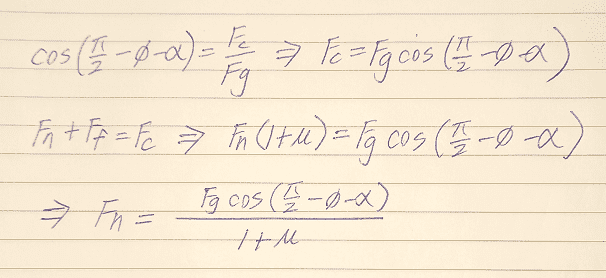
OK, here's what I can say.

1655253036853.png

But I still don't know ##\theta~##, it's actually the value I'm looking for, so what should we do next?

Edit :
Another interesting thing is ##~tan~\theta=\frac{F_n}{F_f}=\frac {1}{u}~~ \Rightarrow~~\theta={tan}^{-1}\left( \frac{1}{u}\right)##
If we substitute it into above equation, we can get ##F_n##
But isn't ##\theta## the answer I am looking for? Why can it be found directly by ##u##?
If so, why do I need to do so many other complicated derivations? I feel really lost.
Maybe it's as simple as that if friction doesn't vary with speed and no other complex stuff is involved. :smile:
 
Last edited:
Physics news on Phys.org
  • #122
alan123hk said:
Another interesting thing is ##\theta={tan}^{-1}\left( \frac{1}{u}\right)##

alan123hk said:
But isn't ##\theta## the answer I am looking for? Why can it be found directly by ##u##?
If so, why do I need to do so many other complicated derivations? I feel really lost.
If you look up at #108, you may notice:
jbriggs444 said:
arc cotangent of the coefficient of friction
The free body diagram, writing down the force balance equations and torque balance equations and solving the resulting et of simultaneous equations is the brute force crank-and-grind method to solving problems of this sort. It essentially always works.

But more efficient shortcuts can exist. For the frictionless case, a number of participants here were able to immediately intuit that "perpendicular to the slope" was the answer. That answer also falls out of the arctangent of one over the coefficient of friction or [equivalently] the arc cotangent of the coefficient of friction
 
Last edited:
  • Like
Likes   Reactions: alan123hk and hutchphd
  • #123
jbriggs444 said:
The free body diagram and writing down the force balance equations and torque balance equations and solving the set of simultaneous equations is the brute force crank-and-grind method to solving problems of this sort. It essentially always works. But more efficient shortcuts can exist. For the frictionless case, a number of participants here were able to immediately intuit that "perpendicular to the slope" was the answer. That answer also falls out of the arctangent of one over the coefficient of friction or [equivalently] the arc cotangent of the coefficient of friction
Okay, I'm basically satisfied with my understanding of the problem now. As for the advanced calculation method, I need time to study it. Thank you very much for your help.
 
  • #124
I finally got it, it turns out that the explanation is very simple, no complicated math. :smile:

In the absence of friction, no matter what the shape of the object, as long as the slope normal vector at the point where the slope intersects the object passes through the object's center of mass, the normal force ##F_n## will not produce a twisting force and the object will remain unrotated. Conversely, if this normal vector does not pass through the object's center of mass, then a twisting force is created to rotate the object.

In addition, regardless of the rotating state or the non-rotating state, the acceleration of the object's center of mass sliding down the slope remains the same and should be equal to ##\frac{F_g~sin(\alpha)}{m} ##. But if the object is rotating, the torque applied to it seems to vary with its angle and profile, so its angular velocity change should be a fairly complex process.

1655603674034.png
 
Last edited:

Similar threads

  • · Replies 16 ·
Replies
16
Views
17K
  • · Replies 11 ·
Replies
11
Views
9K
  • · Replies 13 ·
Replies
13
Views
3K
  • · Replies 6 ·
Replies
6
Views
2K
  • · Replies 8 ·
Replies
8
Views
3K
  • · Replies 6 ·
Replies
6
Views
3K
  • · Replies 3 ·
Replies
3
Views
2K
  • · Replies 1 ·
Replies
1
Views
9K
Replies
14
Views
7K
  • · Replies 13 ·
Replies
13
Views
3K