- 15,875
- 9,019
A recent thread posed the question whether work is done by static friction in the case of an accelerating car. Before I had a chance to reply, the thread was closed on the grounds that the subject was "beaten to death". Undaunted, I am determined to deliver the coup de grâce here with a simple derivation.
We assume rolling without slipping. Let
##I_{cm}=qmR^2~~~(0 \leq q\leq 1)## = the moment of inertia of the wheel, radius ##R## and mass ##m##, about its CM.
##F## = the force acting on the wheel at the CM; it is the torque on the wheel divided by the radius ##R##.
##f##= the force of static friction on the wheel.
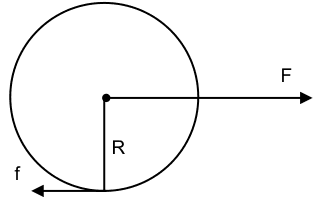
From the FBD shown above, we get
##F-f=ma_{cm}##
##fR=I_{cm}\alpha=qmR^2(a_{cm}/R)##
These equations give
##a_{cm}=\dfrac{F}{(q+1)m}~\rightarrow~\alpha=\dfrac{F}{(q+1)mR};~~~~f=\dfrac{qF}{q+1}##
We invoke the SUVAT equation sans time in the linear and rotational forms to find the changes in translational and rotational kinetic energy, after the CM of the wheel has advanced by ##\Delta s_{cm}##.
$$\Delta K_{trans}=\frac{1}{2}m(2a_{cm}\Delta s_{cm})=\frac{1}{2}m\left[2\frac{F}{(q+1)m}\Delta s_{cm}\right]=\frac{F\Delta s_{cm}}{(q+1)}$$
$$\Delta K_{rot}=\frac{1}{2}I_{cm}(2\alpha\Delta \theta)=\frac{1}{2}qmR^2\left[2\frac{F}{(q+1)mR}\frac{\Delta s_{cm}}{R}\right]=\frac{qF\Delta s_{cm}}{(q+1)}=f\Delta s_{cm}$$Interpretation
The input work crossing the system boundary is ##F\Delta s_{cm}## and is equal to ##\Delta K=\Delta K_{trans}+\Delta K_{rot}## in agreement with the work-energy theorem. Static friction does no work on the system but partitions the input work between two internal degrees of freedom, translational and rotational, according to the size of parameter ##q##. Specifically, ##f\Delta s_{cm}## is the amount of input work diverted into change in rotational energy. When ##q=0## (point mass) all the input work goes into translational internal energy; when ##q=1## (a ring with all the mass at ##R##) we have equipartition of energy. R.I.P.
Note: It often helps to view energy transformations in terms of the first law of thermodynamics. This idea is presented among others in a trilogy of insight contributions currently under preparation.
We assume rolling without slipping. Let
##I_{cm}=qmR^2~~~(0 \leq q\leq 1)## = the moment of inertia of the wheel, radius ##R## and mass ##m##, about its CM.
##F## = the force acting on the wheel at the CM; it is the torque on the wheel divided by the radius ##R##.
##f##= the force of static friction on the wheel.
From the FBD shown above, we get
##F-f=ma_{cm}##
##fR=I_{cm}\alpha=qmR^2(a_{cm}/R)##
These equations give
##a_{cm}=\dfrac{F}{(q+1)m}~\rightarrow~\alpha=\dfrac{F}{(q+1)mR};~~~~f=\dfrac{qF}{q+1}##
We invoke the SUVAT equation sans time in the linear and rotational forms to find the changes in translational and rotational kinetic energy, after the CM of the wheel has advanced by ##\Delta s_{cm}##.
$$\Delta K_{trans}=\frac{1}{2}m(2a_{cm}\Delta s_{cm})=\frac{1}{2}m\left[2\frac{F}{(q+1)m}\Delta s_{cm}\right]=\frac{F\Delta s_{cm}}{(q+1)}$$
$$\Delta K_{rot}=\frac{1}{2}I_{cm}(2\alpha\Delta \theta)=\frac{1}{2}qmR^2\left[2\frac{F}{(q+1)mR}\frac{\Delta s_{cm}}{R}\right]=\frac{qF\Delta s_{cm}}{(q+1)}=f\Delta s_{cm}$$Interpretation
The input work crossing the system boundary is ##F\Delta s_{cm}## and is equal to ##\Delta K=\Delta K_{trans}+\Delta K_{rot}## in agreement with the work-energy theorem. Static friction does no work on the system but partitions the input work between two internal degrees of freedom, translational and rotational, according to the size of parameter ##q##. Specifically, ##f\Delta s_{cm}## is the amount of input work diverted into change in rotational energy. When ##q=0## (point mass) all the input work goes into translational internal energy; when ##q=1## (a ring with all the mass at ##R##) we have equipartition of energy. R.I.P.
Note: It often helps to view energy transformations in terms of the first law of thermodynamics. This idea is presented among others in a trilogy of insight contributions currently under preparation.

