[Worksheet] Horizontal/Vertical components + other

  • Thread starter Thread starter Torald
  • Start date Start date
  • Tags Tags
    Components
Join the discussion
Ask a follow-up here, or get your own question answered by working scientists, mathematicians and engineers — people, not an autocomplete.
Real named experts · corrections over time · the nuance an AI answer skips
4 replies · 3K views
Torald
Messages
2
Reaction score
0
Hey there.

Was given this sheet a while ago. Went over it in class a week ago, completely forgot everything about it today (This is a fresh sheet, lost the one I did.). Have an NAB tomorrow, and couldn't find my physics teacher today to get this worked out.

So, the problem is that I have no clue with what to do. I got some basic info down, but that is it.

Course is in Higher Physics.


Thanks in advance.

Edit : FORGOT THE WORKSHEET!
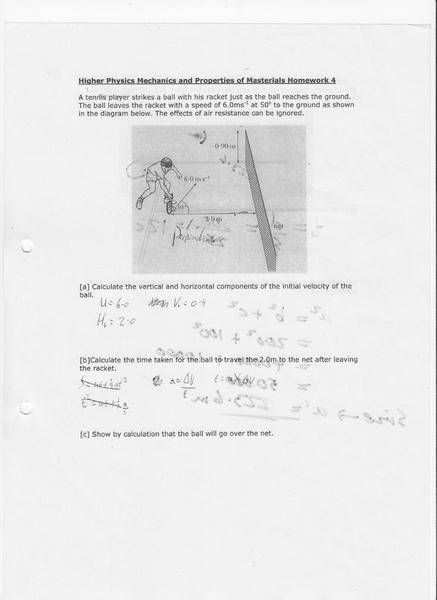
Phys_001.jpg
 
Physics news on Phys.org
I don't understand what you wrote there.

For (a), you should consider a triangle, where one angle is 50° and the other one is 90° ("standing" on the ground). This will give a relation between horizontal speed and total speed, as well as a relation between vertical and total speed via trigonometry.

For b: Does the horizontal velocity change? If not, how can you calculate the time until the ball reaches the net?

c: What is the vertical position of the ball after that time?
 
Thanks for the reply.

U = Initial Velocity (6.0 m/s)

Hv = Horizontal Component (2.0m)

Vv = Vertical Component (0.9m)

Focusing on question a):

[STRIKE]Trigonometry...Egh. Hate it.

Since the Hv is perpendicular (90 degrees), to calculate the components, it would involve cos(x), right?
Don't know what do with that, though. For the Hv, would I do (As in, punt into a calculator) "6.0cos(90)"? Or "2.0cos(90)"? Or...?

As I said, I have not much of a clue as to what to do here.

Your help is most appreciated.

Edit: Alright. I think I figured out how to calculate the components.

Vv = 6sin(50) = 3.9

Hv = 6cos(50) = 4.5

But shouldn't they add up to 6? 3.9 + 4.5 = 8.4

Gah. Confuzzled.[/STRIKE]

Got it!

The Hv = Vcos(Θ)
= 6cos(50)
= 3.9

Trick to remember : HC - Horizontal Cos


The Vv = Vsine(Θ)
= 6sine(50)
= 4.5

Trick to remember : VS - Vertical Sine


For

D = 2.0
V = 6.0

So, use d=v/t |With rearranging| t = d/v

2.0/6.0 = 0.3


Although, I don't know what to do for [c]. Help would be good. I assume it involves the Vv, Velocity, time.
 
Last edited:
For c) so at 3 s it reaches the net. How far will it travel vertically in 3s with initial velocity 6sin30? If this is greater than 0.9 then it makes it over the net.
 
Torald said:
The Vv = Vsine(Θ)
= 6sine(50)
= 4.5
You should be careful with rounding (4.596...)

For

D = 2.0
V = 6.0

So, use d=v/t |With rearranging| t = d/v

2.0/6.0 = 0.3

No, it is a horizontal distance, and the horizontal speed is not 6m/s.


@ofeyrpf: Don't forget gravity.