2.3.361 AP Calculus Exam of differentials of sin wave

Click For Summary
SUMMARY

The discussion focuses on the analysis of the derivatives of the sine wave and its transformations, particularly in the context of the AP Calculus Exam. Participants explore the relationship between trigonometric functions and polynomial functions, questioning whether a polynomial of degree 3 could represent the same behavior as a sine function. Key calculations include the evaluation of the integral $\displaystyle h(6) = \int_0^6 f(t) \, dt < 0$, and the derivatives $h'(6) = f(6) = 0$ and $h''(6) = f'(6) > 0$, which confirm the characteristics of the function at that point.

PREREQUISITES
  • Understanding of trigonometric functions, specifically sine and cosine.
  • Knowledge of calculus concepts such as derivatives and integrals.
  • Familiarity with polynomial functions and their properties.
  • Experience using graphing tools like Desmos for visual representation of functions.
NEXT STEPS
  • Explore the properties of sine and cosine derivatives in depth.
  • Learn about polynomial approximation of trigonometric functions.
  • Study the Fundamental Theorem of Calculus and its applications.
  • Investigate the use of graphing calculators and software for calculus problems.
USEFUL FOR

Students preparing for the AP Calculus Exam, educators teaching calculus concepts, and anyone interested in the relationships between trigonometric and polynomial functions.

karush
Gold Member
MHB
Messages
3,240
Reaction score
5
View attachment 9451

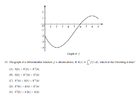
image due to graph, I tried to duplicate this sin wave on desmos but was not able to.

so with sin and cos it just switches to back and forth for the derivatives so thot a this could be done just by observation but doesn't the graph move by the transformations

well anyway?
 

Attachments
  • Capture.PNG
    Capture.PNG
    7 KB · Views: 140
Physics news on Phys.org
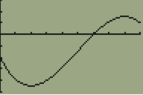
what makes you think it's a trig function ? ... could it also be a polynomial function of degree 3 ? note my calc screenshotas you stated, you don't need the equation of the curve to make the correct choice ...

$\displaystyle h(6) = \int_0^6 f(t) \, dt < 0$

$h'(6) = f(6) = 0$

$h''(6) = f'(6) > 0$
 

Attachments

  • cubic_f.png
    cubic_f.png
    367 bytes · Views: 129

Similar threads

  • · Replies 1 ·
Replies
1
Views
1K
  • · Replies 1 ·
Replies
1
Views
2K
  • · Replies 1 ·
Replies
1
Views
2K
  • · Replies 6 ·
Replies
6
Views
2K
Replies
4
Views
2K
  • · Replies 1 ·
Replies
1
Views
2K
  • · Replies 6 ·
Replies
6
Views
2K
  • · Replies 2 ·
Replies
2
Views
1K
  • · Replies 7 ·
Replies
7
Views
2K
  • · Replies 6 ·
Replies
6
Views
2K