A little help with this circuit

  • Thread starter Thread starter manual
  • Start date Start date
  • Tags Tags
    Circuit
Click For Summary

Discussion Overview

The discussion revolves around calculating the resonant frequency of a circuit involving a coil, a variable capacitor, and a transformer, specifically in the context of a transmitter and receiver setup. Participants explore the effects of the transformer on resonant frequency and the configuration of the circuit components, including whether the circuit is series or parallel.

Discussion Character

  • Exploratory
  • Technical explanation
  • Conceptual clarification
  • Debate/contested

Main Points Raised

  • One participant inquires about calculating the resonant frequency with a coil of 2 microhenries and a capacitor of 1 nanofarad, questioning how the transformer affects these calculations.
  • Another participant suggests that while the antenna's resonant characteristics could affect the Q factor of the tuned circuits, they do not necessarily change the resonant frequency itself.
  • There is a clarification that the transmitter uses a series tuned circuit, while the receiver employs a parallel tuned circuit.
  • One participant expresses confusion about the role of the coil in relation to the inductance of the sending circuit and its effect on frequency.
  • Another participant speculates that the coil likely has a greater inductance than the transformer primary and discusses the filtering effect of the tuned circuit on harmonic energy.
  • A later reply emphasizes the need for actual values to determine resonance frequencies and compares the circuit to a Kettering ignition system.
  • One participant asserts that changing the coil's inductance from 2 microhenries to 3 microhenries would not affect the frequency, given the specified conditions.

Areas of Agreement / Disagreement

Participants express varying opinions on the impact of the transformer and coil on resonant frequency, with no consensus reached on the exact effects or configurations. The discussion remains unresolved regarding the specific calculations and relationships between components.

Contextual Notes

Participants mention the need for more detailed information about circuit components and values to accurately calculate resonant frequencies. There are also references to historical context and comparisons to older technologies, which may influence understanding.

manual
Messages
4
Reaction score
0
hello,
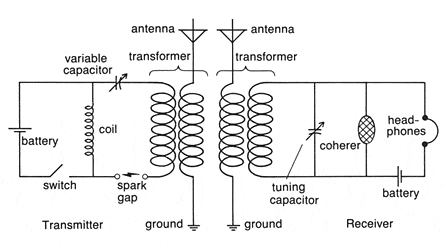
i would like to know something for this circuit
marc_RX_TX_2.gif


i am wondering how can i calculate the resonant frequency for this circuit.
as i know, i can calculate the resonant frequency using the following equation:

HertzResonator002.gif


my problem is if the coil = 2 microhenry for the sending circuit and the variable capacitor is set to 1 nanofarad for the sending circuit and receiving circuit. how would the transformer for the antenna effect my calculations? will it change the resonant frequency?

i am looking forward to knowing how can i calculate the frequency for this circuit if the "coil" is 2 microhenry and the primary + the secondary is 1 microhenry for the transformer in the transmitter and receiver circuit (the capacitor is 1 nanofarad for transmitter and receiver circuit)With my best regards.
 

Attachments

  • marc_RX_TX_2.gif
    marc_RX_TX_2.gif
    15.7 KB · Views: 477
  • HertzResonator002.gif
    HertzResonator002.gif
    300 bytes · Views: 434
Last edited:
Engineering news on Phys.org
You would have to know quite a bit more about the circuit components, but if the antenna was resonant and produced a resistive load for the tuned circuits, it would affect the Q of the tuned circuits, but not the frequency.

In each case the primary of the transformer for the antenna is the main inductance for the tuned circuit.

Just the presence of the secondary winding does not affect the inductance of the primary much, but connecting an antenna that was mostly capacitive would affect the resonant frequency of the tuned circuit.

The receive tuned circuit would resonate at about 3.56 MHz with the components you list.

That circuit would not have been used for 90 years or so. Spark gaps and coherers have been replaced a long time ago.
 
thanks for replay,

by the way is this a LC series or parallel circuit?
it makes me confused.

In each case the primary of the transformer for the antenna is the main inductance for the tuned circuit.
what about the coil? how it will effect the inductance in the sending circuit?
 
The transmitter uses a series tuned circuit and the receiver uses a parallel tuned circuit.

Battery power to the "coil" is switched rapidly by the "switch" and this generates a high voltage across it and this contains a lot of high frequency harmonics.

The tuned circuit (consisting of the capacitor and the primary of the transformer) act to filter out some of this harmonic energy so that a relatively small range of frequencies would be transmitted.

By today's standards, they were horrible wideband noise makers
 
thanks for replay again, bro ;)

The tuned circuit (consisting of the capacitor and the primary of the transformer) act to filter out some of this harmonic energy so that a relatively small range of frequencies would be transmitted.
So the primary of the transformer must has inductance of 2 microhenry to get about 3.56 MHz and the 2 microhenry coil won't effect the frequency even if i changed it to 3 microhenry and set the primary of the transformer for the transmitter circuit to 2 microhenry (the capacitor is 1 nanofarad for each circuit).So the primary and the secondary of the transformer in the receiving circuit must be 2 microhenry to get the range of frequencies what the transmitter circuit is sending (3.56 MHz).

am i right?
 
Last edited:
You would need to know the actual values to work out the resonance frequencies.

I would guess that the "coil" has a much greater inductance than the coupling transformer primary, but spark transmitters were a little before my time.

The circuit looks very much like a Kettering ignition system and the antenna transformer is able to extract a little of the energy flowing in the circuit and filter it so that is is comparatively narrow banded in its frequency range.

I hope you are not thinking of building one of these?
 
i am not going to build it, but i am looking forward to knowing how can i calculate the frequency for this circuit if the "coil" is 2 microhenry and the primary + the secondary is 1 microhenry for the transformer in the transmitter and receiver circuit (the capacitor is 1 nanofarad for transmitter and receiver circuit) Because i am reading and learning about LC + RLC circuits and this one making me confused when the transformer combined with the coil in the transmitter and receiver circuit.
 
Last edited:

Similar threads

  • · Replies 10 ·
Replies
10
Views
2K
  • · Replies 32 ·
2
Replies
32
Views
4K
  • · Replies 1 ·
Replies
1
Views
2K
Replies
2
Views
1K
  • · Replies 30 ·
2
Replies
30
Views
5K
  • · Replies 9 ·
Replies
9
Views
3K
  • · Replies 5 ·
Replies
5
Views
2K
  • · Replies 11 ·
Replies
11
Views
4K
  • · Replies 81 ·
3
Replies
81
Views
8K
  • · Replies 12 ·
Replies
12
Views
2K