goodphy
- 212
- 8
Hello.
I have a difficulty to understand the branch cut introduced to solve this integral.
[tex]\int_{ - \infty }^\infty {dp\left[ {p{e^{ip\left| x \right|}}{e^{ - it\sqrt {{p^2} + {m^2}} }}} \right]}[/tex]
here p is a magnitude of the 3-dimensional momentum of a particle, x and t are space and time coordinates respectively and m is the particle mass. This integral is showed up in the quantum field theory textbook.
The textbook tries to solve this equation by converting it a contour integral in the complex plane. So, p is now replaced with a complex variable z.
[tex]\int_{ - \infty }^\infty {dz\left[ {z{e^{iz\left| x \right|}}{e^{ - it\sqrt {{z^2} + {m^2}} }}} \right]}[/tex]
The textbook said [tex]{\sqrt {{z^2} + {m^2}} }[/tex] must be restricted to a single branch and the branch points are [tex]z = \pm im[/tex] and the branch cuts are convenienly set as shown in the attached image.
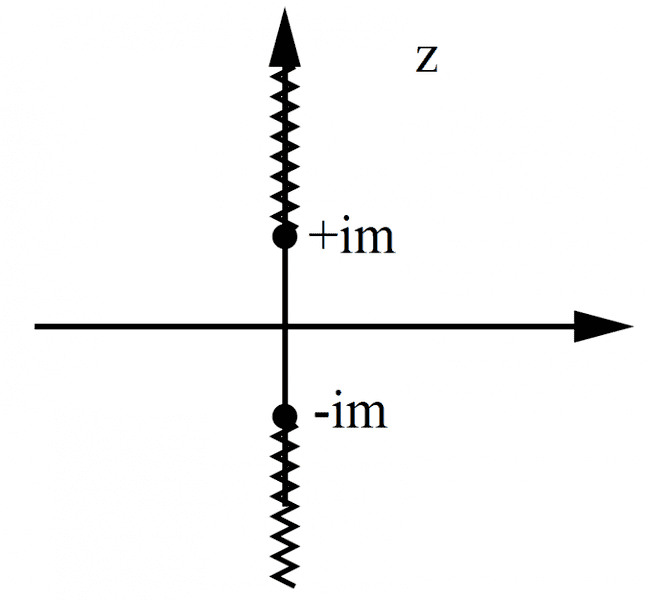
Actually, I don't understand why branch cuts are set like this. As far as I know, the branch cut is the line that we never cross with any mathematical operation in order to make a single-valued function. So I think these branch cuts are set in order to make [tex]{{e^{ - it\sqrt {{z^2} + {m^2}} }}}[/tex] the single-valued function but I don't know how.
Could you please tell me why the branch cuts are set like this? How do these branch cuts make the single-valued function?
I have a difficulty to understand the branch cut introduced to solve this integral.
[tex]\int_{ - \infty }^\infty {dp\left[ {p{e^{ip\left| x \right|}}{e^{ - it\sqrt {{p^2} + {m^2}} }}} \right]}[/tex]
here p is a magnitude of the 3-dimensional momentum of a particle, x and t are space and time coordinates respectively and m is the particle mass. This integral is showed up in the quantum field theory textbook.
The textbook tries to solve this equation by converting it a contour integral in the complex plane. So, p is now replaced with a complex variable z.
[tex]\int_{ - \infty }^\infty {dz\left[ {z{e^{iz\left| x \right|}}{e^{ - it\sqrt {{z^2} + {m^2}} }}} \right]}[/tex]
The textbook said [tex]{\sqrt {{z^2} + {m^2}} }[/tex] must be restricted to a single branch and the branch points are [tex]z = \pm im[/tex] and the branch cuts are convenienly set as shown in the attached image.
Actually, I don't understand why branch cuts are set like this. As far as I know, the branch cut is the line that we never cross with any mathematical operation in order to make a single-valued function. So I think these branch cuts are set in order to make [tex]{{e^{ - it\sqrt {{z^2} + {m^2}} }}}[/tex] the single-valued function but I don't know how.
Could you please tell me why the branch cuts are set like this? How do these branch cuts make the single-valued function?
Last edited: