Does the block move along the pink dotted lines

Click For Summary
The discussion centers on the motion of a block projected from the bottom of a fixed sphere, specifically whether it follows the pink dotted lines in the provided diagram. The initial analysis indicates that the block's speed will decrease as it rises due to gravitational effects, necessitating a more comprehensive free body diagram (FBD) for various positions. Key questions include determining the block's speed as a function of the angle of deflection, the normal reaction force at maximum vertical velocity, and the angle at which the acceleration vector is horizontal. The participants emphasize the importance of mechanical energy conservation and proper FBDs to solve these problems accurately. Ultimately, the conversation highlights the complexities of analyzing motion in a circular path and the need for precise calculations to derive the correct relationships.
Kaushik
Messages
282
Reaction score
17
Homework Statement
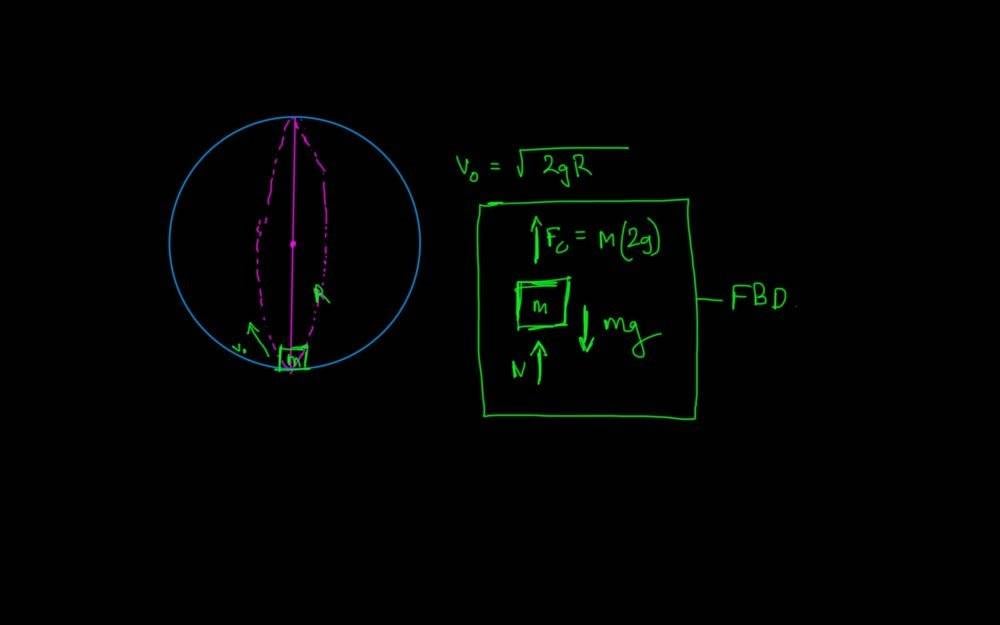
A small block ##m## is projected with speed ##v_0 = \sqrt{2gR}## from bottom of a fixed sphere of radius ##R## , so that the block moves in a vertical circular path.
Relevant Equations
Attached below.
Does the block move along the pink dotted lines as attached in the figure below?
I tried to draw the FBD of the small block ##m ## at the lowermost point which is also attached below.(The direction of ## v_0 ## is actually tangential)
phy.forum.5.jpg


Is the figure above correct? If not, why?
 
Physics news on Phys.org
Kaushik said:
Problem Statement: A small block ## m ## is projected with speed ## v_0 = √2gR ## from bottom of a fixed sphere of radius ##R## , so that the block moves in a vertical circular path.
Relevant Equations: Attached below.

Does the block move along the pink dotted lines as attached in the figure below?
I tried to draw the FBD of the small block ##m ## at the lowermost point which is also attached below.(The direction of ## v_0 ## is actually tangential)
View attachment 246940

Is the figure above correct? If not, why?
Your diagram is fine for the initial motion, but the speed will drop as the block rises. What exactly is the question to be answered? You probably need an FBD for a more general position.
 
  • Like
Likes Kaushik
haruspex said:
What exactly is the question to be answered?

The questions to be answered are -
i) The speed of the block as a function of ## Θ ##, where Θ is the angle of deflection from the lowest vertical.
ii) Normal reaction when the vertical component of the block's velocity is maximum.
iii)The angle between the thread and the lowest vertical at the moment when the total acc. vector of the block is directed horizontally.


I didn't write these questions before as I wanted the image.Like, I wanted the intuition of how this system really looks.

Thanks.
 
Last edited:
Kaushik said:
The questions to be answered are -
i) The speed of the block as a function of ## Θ ##, where Θ is the angle of deflection from the lowest vertical.
ii) Normal reaction when the vertical component of the block's velocity is maximum.
iii)The angle between the thread and the lowest vertical at the moment when the total acc. vector of the block is directed horizontally.


I didn't write these questions before as I wanted the image.Like, I wanted the intuition of how this system really looks.

Thanks.
Then, as I posted, you need to draw the FBD and write equations for the general position, as described in (i).
Don't bother trying to draw perspective, as you seem to have done in post 1. Just show the plane in which the block moves.
 
  • Like
Likes Kaushik
Kaushik said:
deflection from the lowest vertical.
What does the above line mean? Should I assume that the block lies at an angle theta from the lowest point?
 
Last edited:
Kaushik said:
(The direction of ## v_0 ## is actually tangential)
Is the figure above correct? If not, why?
The diagram does not look correct. Since the initial velocity is tangent to the circle, the block will start sliding on the inside surface of the circle, presumably without friction. The questions to consider are, will the block slide all the way up to the "12 o'clock" position or will it fall off at some intermediate point and, if so, where is that point and what is the subsequent path of the block?
 
  • Like
Likes Kaushik
kuruman said:
The diagram does not look correct. Since the initial velocity is tangent to the circle, the block will start sliding on the inside surface of the circle, presumably without friction. The questions to consider are, will the block slide all the way up to the "12 o'clock" position or will it fall off at some intermediate point and, if so, where is that point and what is the subsequent path of the block?
We know that the velocity decreases as the angle theta increases because of ## g ##. Can we find the velocity of the block as a function of theta? If yes, can I get a hint?
 
Kaushik said:
What does the above line mean? Should I assume that the block lies at an angle theta from the lowest point?
The "lowest vertical " means the radius line from the centre of the circle to the bottom of the circle. Take another radius line from the centre of the circle to the block and call the angle between the two radii theta,
Draw the FBD for that.
 
  • Like
Likes Kaushik
Hint: Mechanical energy conservation plus a free body diagram. I assume the question to be answered is "Draw the complete path of the block inside the shell."
 
  • Informative
Likes Kaushik
  • #10
Kaushik said:
We know that the velocity decreases as the angle theta increases because of ## g ##. Can we find the velocity of the block as a function of theta? If yes, can I get a hint?
Anything conserved?
 
  • Like
Likes Kaushik
  • #11
kuruman said:
Mechanical energy conservation
Using your hint, i found ##V(Θ) = √(2gRcosΘ)##

Thanks a lot.
 
  • #12
Kaushik said:
Using your hint, i found ##V(Θ) = √(2gRcosΘ)##

Thanks a lot.
Is that what you were looking for?
 
  • Like
Likes Kaushik
  • #13
kuruman said:
Is that what you were looking for?
Apart from that, I have 2 more questions to solve.
Kaushik said:
ii) Normal reaction when the vertical component of the block's velocity is maximum.
iii)The angle between the thread and the lowest vertical at the moment when the total acc. vector of the block is directed horizontally.
These are the remaining questions I need to solve.
Kaushik said:
ii) Normal reaction when the vertical component of the block's velocity is maximum.
This happens when the angle is 90 right ?
 
  • #14
Kaushik said:
This happens when the angle is 90 right ?
Look at your expression for ##V(\Theta)##. At what angle does it have a maximum?
 
  • Like
Likes Kaushik
  • #15
kuruman said:
Look at your expression for ##V(\Theta)##. At what angle does it have a maximum?
I meant 0.
 
  • #16
Kaushik said:
I meant 0.
Good. Now draw a free body diagram of the block wjen it is at ##\Theta=0##. However, before you do that count how many items outside the block exert a force on it. You should draw as many forces acting on the block as you have items interacting with it. Also, draw the acceleration of the block outside the FBD.
 
  • Informative
Likes Kaushik
  • #17
kuruman said:
Good. Now draw a free body diagram of the block when it is at ##\Theta=0##. However, before you do that count how many items outside the block exert a force on it. You should draw as many forces acting on the block as you have items interacting with it. Also, draw the acceleration of the block outside the FBD.
The forces I noticed are - Normal Force( Centripetal force here), Weight.
 
  • #18
That's it, good job. Now what do you think you should do next? What's the purpose of drawing a free body diagram?
 
  • Like
Likes Kaushik
  • #19
kuruman said:
That's it, good job. Now what do you think you should do next? What's the purpose of drawing a free body diagram?
Now should I equate ## F_{net} ## to centripetal acceleration? Is it ## N = 3mg ##?
 
Last edited:
  • #20
Yes and yes.
I stand corrected. I misread the question. See post #34 by @jbriggs444 who has a knack for keeping me honest.
 
Last edited:
  • Like
Likes Kaushik
  • #21
kuruman said:
Yes and yes.
Thanks a lot for your help.
 
  • #22
You are welcome. Can you finish the problem now and answer the third question?
 
  • Like
Likes Kaushik
  • #23
kuruman said:
You are welcome. Can you finish the problem now and answer the third question?
Yes.
 
  • Like
Likes kuruman
  • #24
Kaushik said:
ii) Normal reaction when the vertical component of the block's velocity is maximum.
Kaushik said:
Now should I equate ##F_{net}## to centripetal acceleration? Is it ##N=3mg##?
No and no.

##F_{net}## is only equal to [mass times] centripetal acceleration if tangential acceleration is zero. The vertical component of the block's velocity will not be maximized at the bottom of the circle.
 
  • Like
Likes kuruman and Kaushik
  • #25
jbriggs444 said:
No and no.

##F_{net}## is only equal to [mass times] centripetal acceleration if tangential acceleration is zero. The vertical component of the block's velocity will not be maximized at the bottom of the circle.
If not at the bottom, where else?
 
  • #26
Kaushik said:
If not at the bottom, where else?
You have speed as a function of angle. What is the vertical component of velocity as a function of angle?
 
  • Like
Likes Kaushik
  • #27
jbriggs444 said:
You have speed as a function of angle. What is the vertical component of velocity as a function of angle?
Can I get a hint?
 
  • #28
Kaushik said:
Can I get a hint?
Umm, it is pretty simple. If you know how fast something is moving and in what direction it is moving, surely you can figure out the vertical component of that motion.
 
  • Like
Likes Kaushik
  • #29
jbriggs444 said:
Umm, it is pretty simple. If you know how fast something is moving and in what direction it is moving, surely you can figure out the vertical component of that motion.
So the direction is tangential. So I have to find its vertical component.
 
  • #30
Kaushik said:
So the direction is tangential. So I have to find its vertical component.
I'll try again, yes. But first you have to find the speed.
 
  • Like
Likes Kaushik

Similar threads

  • · Replies 11 ·
Replies
11
Views
3K
  • · Replies 3 ·
Replies
3
Views
6K
Replies
73
Views
4K
  • · Replies 25 ·
Replies
25
Views
1K
  • · Replies 8 ·
Replies
8
Views
2K
  • · Replies 10 ·
Replies
10
Views
1K
  • · Replies 9 ·
Replies
9
Views
2K
  • · Replies 3 ·
Replies
3
Views
2K
  • · Replies 6 ·
Replies
6
Views
2K
  • · Replies 98 ·
4
Replies
98
Views
6K