AC Current in unconnected wires

Click For Summary

Discussion Overview

The discussion revolves around the unexpected presence of AC current in an unconnected ground wire after an electrician disconnected it. Participants explore potential causes for this phenomenon, including electrical safety concerns and the implications of grounding in electrical systems.

Discussion Character

  • Exploratory
  • Technical explanation
  • Debate/contested
  • Safety-related

Main Points Raised

  • One participant experienced a shock from their computer and found that the ground wire was unconnected, yet it showed AC current when live was switched on.
  • Some participants propose that the AC current could be due to insulation leakage or capacitive coupling from stray electrical fields affecting the floating ground wire.
  • There is a question about whether the participant tested for current or voltage, with clarification that a phase tester was used, indicating voltage presence.
  • Another participant suggests measuring the actual current that could flow, indicating it might be low and not life-threatening, but still a concern for safety.
  • Concerns are raised about the functionality of RCCBs (Residual Current Circuit Breakers) in the context of the disconnected ground wire and their ability to detect faults.
  • One participant notes that being barefoot on a marble floor while touching a metallic part of the computer could have contributed to the shock experience.
  • There is a discussion about whether the previous RCCB was faulty, considering that a disconnected ground wire would affect its testing capabilities.
  • Another participant mentions that small shocks (around 1mA) might not trip an RCD (Residual Current Device), which could lead to misunderstandings about electrical safety.

Areas of Agreement / Disagreement

Participants express various hypotheses regarding the cause of the AC current in the ground wire, with no consensus reached on a definitive explanation. Concerns about electrical safety and the role of RCCBs are also debated without resolution.

Contextual Notes

Participants note the limitations of testing methods and the implications of a disconnected ground wire on electrical safety devices, but do not resolve these issues.

GingerLee
Messages
20
Reaction score
0
Hello,
My electrician had to disconnect the ground wire from mains distribution box a day ago. And he forgot to attach it back. I did not know it was un-attached.

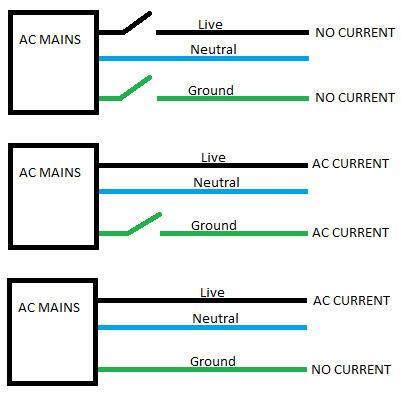
Then in the evening, I touched my computer and got a shock. I used a screw driver type phase tester and checked the ground part of all the outlets in the house and they all were showing AC current.

I thought maybe there is mixup of live and ground wire, so I quickly disconnected all the devices and appliances. I switched off the live using MCB from the mains. Neutral was still connected. And now ground was not showing any AC current.
JA9hq.jpg


Later on I found, the electrician forgot to attach the ground in the mains distribution box.

This beats me. The ground wire was totally unconnected from both ends. I checked all the outlets one by one. But still whenever I switched on live, ground wire would show current too.

I checked live and ground using multimeter's continuity test, there is no short circuit.

Can someone please explain why an isolate ground wire is showing AC current ?
 
Engineering news on Phys.org
Fire the electrician! He should have checked his work before leaving. The stray current could be from insulation leakage or stray electrical fields capacitive coupling on the floating wire.
 
Did you test for current or voltage?
 
nsaspook said:
Fire the electrician! He should have checked his work before leaving. The stray current could be from insulation leakage or stray electrical fields capacitive coupling on the floating wire.
Thanks for telling about capacitive coupling. I think this explains it :)

Jobrag said:
Did you test for current or voltage?
I used a screw driver phase tester, so I guess I checked voltage. The lamp inside the screw driver would glow if its at higher voltage than person using it.
 
Do you have RCCBs fitted? If not, use the compensation you get from the electrician to fit them.
 
If you connect a DMM between the points where you got a shock and measure the actual current that can flow. It will probably be no more than a milliAmp or so. Not life threatening but your electrician should still sort it out as the next fault could kill someone.
 
GingerLee said:
Then in the evening, I touched my computer and got a shock.
You presumably contacted a metallic part of the computer or a peripheral, but were you also in contact with some other conductive path to ground?
 
sophiecentaur said:
If you connect a DMM between the points where you got a shock and measure the actual current that can flow. It will probably be no more than a milliAmp or so. Not life threatening but your electrician should still sort it out as the next fault could kill someone.
After I connected the ground wire properly, there is no more shock. The current in the ground wire is not showing anything. Now its 0 mA.

NascentOxygen said:
You presumably contacted a metallic part of the computer or a peripheral, but were you also in contact with some other conductive path to ground?
I think so. I was barefoot on marbled floor. And I touched one of the screws of the metallic cabinet.

Jobrag said:
Do you have RCCBs fitted? If not, use the compensation you get from the electrician to fit them.
It was not working that's why I called the electrician in the first place. I test it every two months, as is written on the box. Installed a new one now :)
 
GingerLee said:
I think so. I was barefoot on marbled floor. And I touched one of the screws of the metallic cabinet.
Hmm, I would not have expected a marble floor to be conductive at the low voltage in question.

GingerLee said:
Jobrag said:
Do you have RCCBs fitted? If not, use the compensation you get from the electrician to fit them.
It was not working that's why I called the electrician in the first place. I test it every two months, as is written on the box. Installed a new one now :)
But was the old RCCB actually faulty? If the system's ground wire was disconnected, as you say it was, then the TEST button (whose purpose I presume is to divert a small current to ground) cannot fulfill its function so even a properly functioning RCCB will not respond to the TEST button under these circumstances, it seems to me.
 
  • #10
It all depends on how bad a shock you actually got. You will feel a small (1mA) shock that an RCD will ignore because it isn't considered lethal. If RDCs tripped with less than their specified current then they would always be going off and people wouldn't put up with the inconvenience.
 

Similar threads

Replies
18
Views
2K
Replies
24
Views
3K
  • · Replies 26 ·
Replies
26
Views
3K
  • · Replies 1 ·
Replies
1
Views
1K
  • · Replies 79 ·
3
Replies
79
Views
7K
  • · Replies 5 ·
Replies
5
Views
2K
  • · Replies 13 ·
Replies
13
Views
7K
  • · Replies 5 ·
Replies
5
Views
2K
  • · Replies 18 ·
Replies
18
Views
5K
Replies
13
Views
4K