AC - Node Voltage Method for difficult circuit

Click For Summary
SUMMARY

The discussion focuses on applying the Node Voltage Method to analyze a complex circuit involving capacitors, inductors, and resistors. The user seeks to calculate the voltage u(t) and clarifies the role of the coefficient 'a' in relation to the voltage source. Key parameters include iz(t) = 2cos(2t−45°) A, C1 = 1/2 F, C2 = 1/3 F, L1 = 1 H, L2 = 3 H, R3 = 2 Ω, and R4 = 1 Ω. The calculations provided yield Z1 = j and Z2 = -2j, confirming the user's understanding of the circuit's behavior.

PREREQUISITES
  • Node Voltage Method
  • Complex impedance calculations
  • AC circuit analysis
  • Understanding of phasors and sinusoidal functions
NEXT STEPS
  • Study the application of the Node Voltage Method in AC circuits
  • Learn about complex impedance in RLC circuits
  • Explore phasor representation of sinusoidal sources
  • Investigate the use of Laplace transforms in circuit analysis
USEFUL FOR

Electrical engineering students, circuit designers, and professionals involved in AC circuit analysis and design will benefit from this discussion.

devmew
Messages
2
Reaction score
0
Hi!
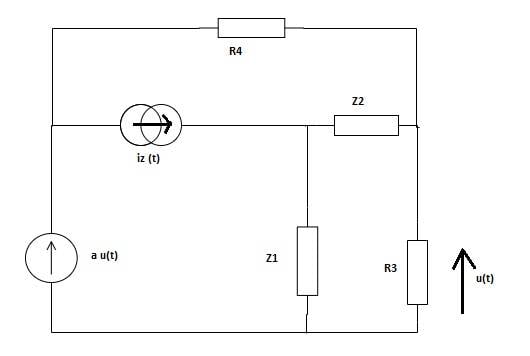
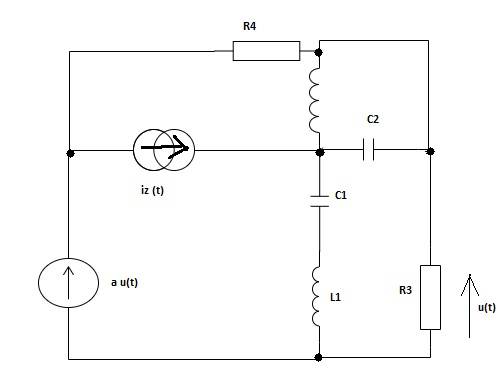
I'm trying to understand and solve this circuit by Node Voltage Method. I have to calculate u(t). In my mind, I don't have any idea if any current should go through Z1 in my calculations.
I would be grateful if you could write even equations for this circuit. Is 'a' just a prefix to multiply the value of voltage source? (z is the letter for 'complex' in my language).

Data:
iz(t)=2cos(2t−45°) A C1=1/2 [F] C2=1/3 [F] L1=1[H] L2=3[H]
R3=2[Ω] R4=1[Ω] a=1/2 [V/V]
1.jpg
2.jpg


My calculations:
Iz=1+j; ω=2rad/s; Z1=j; Z2=-2jThank you in advance.
 
Physics news on Phys.org
Welcome to PhysicsForums. :smile:

Is a*u(t) a VCVS? That seems like a non-standard voltage source symbol, but it does look like you are using a different symbol for the iz(t) source...

Also, I don't see how the 2nd circuit follows from the first, but I could be missing something. Were you given the 1st circuit and you wanted to simplify it via the 2nd diagram?
 
  • Like
Likes   Reactions: devmew
a=e^(-j*2*π/3)=cos(-2*π/3)+jsin(-2*π/3)
 
I=√2.[cos(-45o)+j.sin(-45o)]=1-j
 

Attachments

  • 1-j.jpg
    1-j.jpg
    14.9 KB · Views: 235
@berkeman a*u(t) is only hint, needed to calculations. It describes the relationship between voltage source and voltage on resistor. 'a' is just a coefficient. I was given the first circuit and I wanted to simplify it via 2nd diagram.
@Babadag I'm looking to get the value u(t) in function of sinx. So, I changed it into sin function.
$$i_z(t)=2cos(2t-45°)=2sin(2t-45°+90°)=2sin(2t+45°)$$
$$I_z=\frac{2}{\sqrt{2}}(cos(45°)+j sin(45°))=\frac{2}{\sqrt{2}}(\frac{\sqrt{2}}{2}+j\frac{\sqrt{2}}{2})=1+j$$

a*u(t) is the voltage source, and iz(t) is the power source. I'm sorry, I didn't know the worldwide symbols.

$$Z_1=\frac{1}{jωC_1}+jωL_1=\frac{1}{j}+2j=-j+2j=j$$
$$\frac{1}{Z_2}=\frac{1}{jωL_2}+jωC_2$$
$$Z_2=\frac{6}{3j}=-2j$$
 
Last edited:

Similar threads

  • · Replies 10 ·
Replies
10
Views
4K
Replies
15
Views
2K
  • · Replies 6 ·
Replies
6
Views
2K
  • · Replies 26 ·
Replies
26
Views
3K
  • · Replies 4 ·
Replies
4
Views
2K
  • · Replies 2 ·
Replies
2
Views
2K
  • · Replies 4 ·
Replies
4
Views
2K
  • · Replies 3 ·
Replies
3
Views
2K
Replies
7
Views
3K
  • · Replies 15 ·
Replies
15
Views
4K