An interesting experimental phenomenon about electric field

Click For Summary

Discussion Overview

The discussion revolves around an experimental observation related to electric fields and their effects on an electron beam in a Scanning Electron Microscope (SEM). Participants explore the conditions under which the electron beam oscillates and the implications of circuit configurations on electric and magnetic fields.

Discussion Character

  • Exploratory
  • Technical explanation
  • Debate/contested
  • Experimental/applied

Main Points Raised

  • One participant describes an experiment involving a chip in an SEM where an electron beam oscillates with the frequency of an AC source, suggesting an electric field may be responsible for this behavior.
  • Another participant questions how the AC source is isolated from Earth and discusses the implications of potential differences between points in the circuit.
  • Some participants propose that an electric field exists between points A and B in the circuit, while others argue that the electric field may primarily remain within the circuit components.
  • There is mention of the possibility that the oscillation of the electron beam could be influenced by magnetic fields as well as electric fields, though the strength of these fields is debated.
  • A later reply suggests that the observed oscillation could be related to the thermal vibration of a component (R1) rather than solely due to electric or magnetic fields.

Areas of Agreement / Disagreement

Participants express differing views on the nature and source of the oscillation of the electron beam, with no consensus reached on whether the oscillation is primarily due to electric fields, magnetic fields, or mechanical vibrations. The discussion remains unresolved regarding the exact mechanisms at play.

Contextual Notes

Participants note the complexity of the circuit and the potential for confusion due to terminology, such as the use of "B" for different points in the discussion. There are also unresolved questions about the strength and influence of the electric and magnetic fields in the experimental setup.

Chengjun Li
Messages
4
Reaction score
0
Hi,

I find an interesting related to electric field when doing experiment.
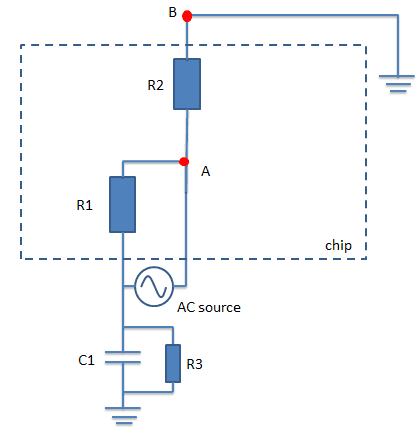
I put a chip which has the following circuit inside Scanning Electron Microscopy(SEM), an electron beam is irradiating on R1.
upload_2015-3-17_21-20-57.png

The AC source is isolated from Earth by using a capacitor C1 and resistor R3 in the middle.

I found that the electron beam is oscillating with a frequency the same with the AC source.
So I think there may be electric field resulted which deflects the electron beam periodically.

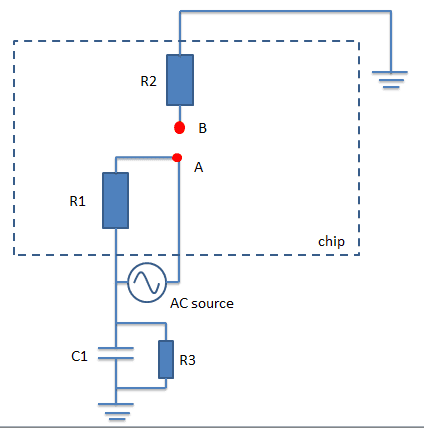
Then I did the following experiment.
upload_2015-3-17_21-24-43.png

The only change I made is cutting off the connection between point A and B.
I found this time electron beam is no longer oscillating. My question is that 1. how does the oscillating electric field produced?
2. why in the second situation, there is no electric field?
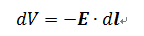
I know that electric field is produced due to potential gradient in space.
upload_2015-3-17_20-54-37.png

I think in the second situation Point B should have a potential of 0V since it is connected to earth, Point A has a potential not equal to 0V, there is potential difference between them, why there is no electric field be produced between point A and B?
 
Physics news on Phys.org
I know that electric field is produced due to potential gradient in space.
The electric field and the potential gradient are two ways of talking about the same thing ... they are not cause and effect.

I think in the second situation Point B should have a potential of 0V since it is connected to earth, Point A has a potential not equal to 0V, there is potential difference between them, why there is no electric field be produced between point A and B?
You never measure potential, only potential difference. If you use the GND as your reference potential, then any point in the circuit connected directly to GND will read 0V: you are basically putting the positive and negative voltmeter probes in the same place.

The would certainly be an electric field between A and B (through R2) in the top diagram. (You have complicated things by using "B" for two different things.) There would also be a magnetic field around the resistor and the track. The electric and magnetic field will change because the driving potential is AC.

The AC source is isolated from Earth by using a capacitor C1 and resistor R3 in the middle.
In what way would this setup be considered to "isolate" the AC source from earth?

To me it looks like the circuit initially connects both ends of the AC source to ground through different networks ... so point B (top diagram) and the far end of R3 are effectively connected. Not so in the bottom diagram.

I found that the electron beam is oscillating with a frequency the same with the AC source.
So I think there may be electric field resulted which deflects the electron beam periodically.
...
The only change I made is cutting off the connection between point A and B.
I found this time electron beam is no longer oscillating.
What is it about the electron beam that is oscillating and how could you tell?
What was the aim of the experiment?

It sounds like there is some coupling between the electrons in the beam and the electric field of the AC (voltage?) source.
It is difficult to tell what is going on from this description - but realize that the beam may be deflected by a magnetic field as well.
There may be something else responsible for the oscillations - which changed when you cut the connection.
 
Simon Bridge said:
The electric field and the potential gradient are two ways of talking about the same thing ... they are not cause and effect.

You never measure potential, only potential difference. If you use the GND as your reference potential, then any point in the circuit connected directly to GND will read 0V: you are basically putting the positive and negative voltmeter probes in the same place.

The would certainly be an electric field between A and B (through R2) in the top diagram. (You have complicated things by using "B" for two different things.) There would also be a magnetic field around the resistor and the track. The electric and magnetic field will change because the driving potential is AC.

In what way would this setup be considered to "isolate" the AC source from earth?

To me it looks like the circuit initially connects both ends of the AC source to ground through different networks ... so point B (top diagram) and the far end of R3 are effectively connected. Not so in the bottom diagram.What is it about the electron beam that is oscillating and how could you tell?
What was the aim of the experiment?

It sounds like there is some coupling between the electrons in the beam and the electric field of the AC (voltage?) source.
It is difficult to tell what is going on from this description - but realize that the beam may be deflected by a magnetic field as well.
There may be something else responsible for the oscillations - which changed when you cut the connection.
Thank you for your reply! I think my previous statement of the problem is not clear enough. Please allow me to describe my experiment in detail.

First we fabricate a chip, a MEMS chip, mainly used for mechanical testing of nanostructure. The inner design of the chip is shown below.
upload_2015-3-18_10-28-34.png

R1 I mentioned in last thread is the area which the arrow points at. Enlarged image is shown below.
upload_2015-3-18_10-33-57.png

R1 mechanically function as a thermal actuator, it will oscillate under AC voltage.The aim of the experiment is to measure oscillation amplitude under different frequency. The part on the left is a fixed structure, it should always be stationary.

R2:
one end of R1 is also connected to other structures as I highlighted in yellow color. I simplified them as R2. All the pins are electrically connected(green line) using conductive tape, except the two pins through which the AC voltage is applied to. I connect the upper left corner pin to ground when doing experiment.
upload_2015-3-18_11-50-22.png


R3: The function generator we use to provide AC voltage is Agilent 33250A
upload_2015-3-18_11-28-39.png

On the manual, it says "Except for its remote interface connectors and trigger connector,the 33250A is isolated from chassis (earth) ground. This isolation helps to eliminate ground loops in your system and also allows you to reference the output signal to voltages other than ground."

Below is the R1 under electron beam.
upload_2015-3-18_11-14-10.png

As I mentioned the left part is always stationary. But when I applied the AC voltage, I found the left part is also oscillating.

upload_2015-3-18_11-16-34.png

I think the only reason is electron beam is deflected periodically.

Right now I want to figure out what on Earth make the electron beam deflected.

It may be electric field.
As you said, "The would certainly be an electric field between A and B (through R2) in the top diagram." But I think the electric field will mainly remain inside the circuit(conductors and resistors) and produces the current. Only a small part exists in the space outside the circuit which I am not sure is strong enough to deflect the electron beam(5 KeV).

It may be magnetic field. But the voltage we applied is only 6Vpp, and the current is very small. Again, I am not sure whether the magnetic field is strong enough.

It seems now it's hard to give an qualitative but clear explanation of how does the electron beam deflect. I am not sure whether simulation could work. I would like to hear more advice before doing that since it waste quite some time if finally it fails.
 
Last edited:
It looks as if you are seeing the thermal vibration of R1, as intended. I notice that you do not use a DC bias, so the mechanical frequency will be twice that of the generator.I can see what looks like some mechanical third harmonic on R1. The fixed structure shows a lower amplitude vibration, without harmonics. It is possible that this is propagating mechanically across from R! and losing harmonics in the process. Maybe you are seeing the mechanical wave in the dielectric and it makes the fixed structure look wavy.
 
tech99 said:
It looks as if you are seeing the thermal vibration of R1, as intended. I notice that you do not use a DC bias, so the mechanical frequency will be twice that of the generator.I can see what looks like some mechanical third harmonic on R1. The fixed structure shows a lower amplitude vibration, without harmonics. It is possible that this is propagating mechanically across from R! and losing harmonics in the process. Maybe you are seeing the mechanical wave in the dielectric and it makes the fixed structure look wavy.
Thank you for your reply. Yes, the pure mechanical frequency is two times that of the generator. But the experiment was done in a vacuum environment. There is no dielectric. And not only I observed the vibration as close as the left structure, but also I saw the same phenomenon as far as the surrounding pin pads.I don't think the mechanical wave can propagate that far.
 

Similar threads

  • · Replies 30 ·
2
Replies
30
Views
4K
  • · Replies 21 ·
Replies
21
Views
4K
  • · Replies 9 ·
Replies
9
Views
4K
  • · Replies 4 ·
Replies
4
Views
3K
  • · Replies 2 ·
Replies
2
Views
11K
  • · Replies 22 ·
Replies
22
Views
2K
  • · Replies 3 ·
Replies
3
Views
2K
  • · Replies 12 ·
Replies
12
Views
2K
  • · Replies 1 ·
Replies
1
Views
1K
  • · Replies 8 ·
Replies
8
Views
2K