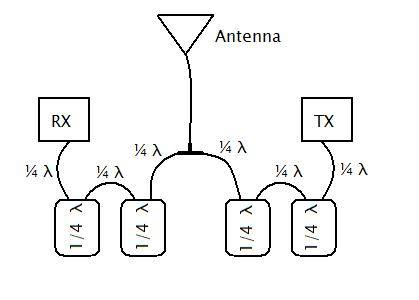
Discussion Overview
The discussion revolves around the functioning and configuration of quarter wave cavity duplexers, particularly focusing on impedance transformation and the role of cable lengths in achieving desired filtering effects. Participants explore theoretical aspects, practical applications, and specific configurations related to duplexers in communication systems.
Discussion Character
- Exploratory
- Technical explanation
- Debate/contested
Main Points Raised
- One participant questions the purpose of using 1/4 wavelength sections of cable in the duplexer setup, expressing confusion about impedance transformation when all components are stated to be 50 ohms.
- Another participant notes that a 1/4 wave line acts as a transmission line transformer, suggesting that it can create different impedance appearances at either end depending on the termination.
- Concerns are raised about the potential undesired impedance transformations that can occur with 1/4 wave interconnects, advocating for the use of 1/2 wavelength lengths to maintain consistent impedance.
- One participant mentions that the interconnections are often described as 1/4 λ to enhance the rejection notch of the opposite frequency in band pass filters, but expresses confusion about the underlying electromagnetic theory.
- There is a discussion about how the input impedance of a 1/4 λ transmission line can be calculated, with references to reactive impedances and the implications for power reflection.
- Another participant elaborates on the structure of duplexers, explaining the role of cavities as bandpass filters and the necessity of filtering out unwanted frequencies to prevent overload.
- Questions arise regarding whether the inputs to the cavities can be viewed as short circuits and how this relates to the transformation to an open circuit through the use of 1/4 λ cables.
Areas of Agreement / Disagreement
Participants express differing views on the effectiveness and implications of using 1/4 wavelength versus 1/2 wavelength cables in duplexer configurations. There is no consensus on the best approach or the clarity of the underlying electromagnetic principles.
Contextual Notes
Some participants highlight the complexity of the topic, noting that assumptions about impedance and the behavior of transmission lines may not be fully resolved. The discussion reflects a range of experiences and understandings of duplexer operation.